


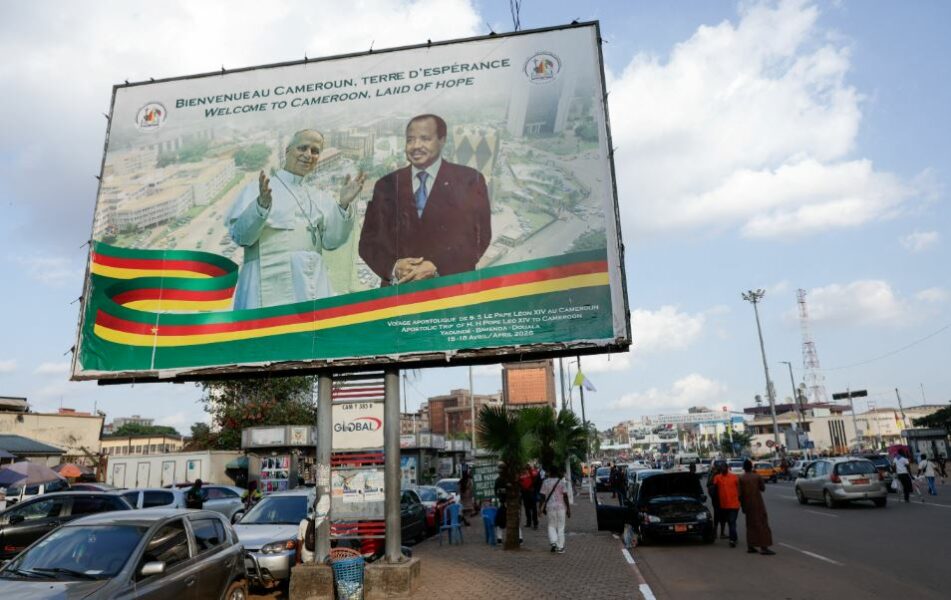
The separatist leaders of Cameroon’s Anglophone regions have announced a temporary suspension of hostilities on the occasion of Pope Leo XIV’s visit, who is in the country since today, April 15, as part of his first apostolic trip to Africa. According to Aciprensa, the truce will allow the free movement of the faithful and facilitate participation in the events planned during the Cameroonian stage of the pontifical journey.
The measure, of a limited nature, will extend for three days—from April 15 to 17—and affects the areas hardest hit by the conflict between separatist groups and government forces, especially in the northwest and southwest regions of the country.
A three-day truce amid a prolonged conflict
The announcement was made by Lucas Asu, spokesperson for the Ambazonia Government Council, who explained that the decision has been adopted in coordination with various armed groups of the so-called Unity Alliance. According to the statement, the separatist forces have received instructions to ensure security during this period to allow the movement of civilians, pilgrims, and religious leaders.
Asu emphasized that the measure responds to the “profound spiritual importance” of the papal visit and seeks to facilitate the population’s participation “without fear” in this exceptional event.
A gesture with limited reach
The separatists’ declaration comes at a particularly sensitive moment. Since 2017, Cameroon’s Anglophone regions have been living through an armed conflict that has caused thousands of deaths and massive displacements, with cities like Bamenda turned into epicenters of violence.
In this context, the truce represents a significant gesture, although strictly temporary in scope. The separatist leaders themselves have insisted that the suspension of hostilities does not imply a change in their political positions or in the dispute over the future of these regions.
Warning against political instrumentalization
In their statement, the separatists wanted to make it clear that the Pope’s visit should not be interpreted as support for the Cameroonian government. “The Holy Father’s visit is of a pastoral and spiritual nature,” they stated, warning against any attempt to use it as a sign of normalization or political legitimation.
This nuance reflects the sensitivity surrounding the pontifical trip, in a context where any gesture or statement can be interpreted in political terms by both the government and the opposition.
The Church, between mediation and pressure
Leo XIV’s visit thus takes on a particular meaning in Cameroon, where the Catholic Church plays an active role in the public debate. The bishops have intervened in issues such as governance, elections, or national unity, appealing to transparency and dialogue.
In the regions affected by the conflict, the Church has also assumed a mediating role, insisting on the need to protect the civilian population and promote peaceful solutions. This position, however, places it in a delicate situation, subject to both societal support and scrutiny from the authorities.
A visit under observation
In the ecclesiastical province of Bamenda, one of the key points of the trip, church officials have intensified calls for participation. For many faithful, the Pope’s presence represents an opportunity for hope amid years of violence and social fracture.
However, the complexity of the context means that this visit cannot be understood solely in pastoral terms. In a scenario marked by instability, every gesture of the Pontiff will be watched closely, both for its spiritual dimension and for its possible implications in an ongoing crisis.