


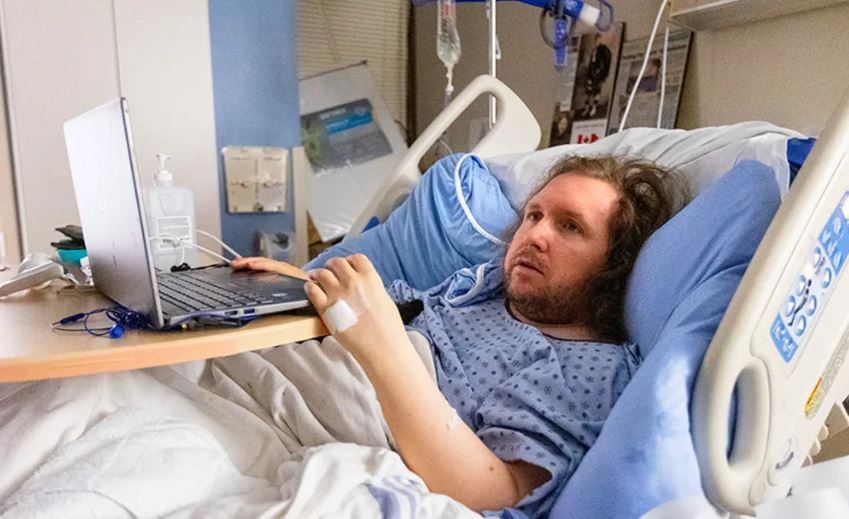
A Canadian patient with a degenerative disease has recently received the sacraments of the Catholic Church, including the Anointing of the Sick, in a context marked by the deterioration of his health and his complaints against his country’s healthcare system. According to LifeSiteNews, it is Roger Foley, known for his opposition to the euthanasia program in Canada.
The case occurs in a country where euthanasia—legal since 2016 under the so-called MAiD program (Medical Assistance in Dying)—has experienced a progressive expansion, both in the number of cases and in the circumstances in which it can be applied, which has generated a growing debate about its ethical and health implications.
Foley, who suffers from incurable spinocerebellar ataxia, has gone through a significant worsening of his physical condition in recent weeks. In this context, he accepted the visit of a priest, despite having recognized himself for years as a non-religious person.
An approach to faith amid the deterioration
Foley himself described the priest’s visit as «a very beautiful experience», in which he felt «honored and moved». During the meeting, he was able to raise his doubts about faith and receive answers to his concerns.
Although he acknowledges that it is difficult for him to believe, especially because of the experiences he has lived through, he assures that he has begun to pray recently, encouraged by a close person. «I am confused», he admits, pointing out that his questions about suffering and the existence of God remain open.
His health condition is especially delicate: he cannot feed himself and depends on intravenous nutrition, in addition to suffering pain, extreme fatigue, and cognitive deterioration.
Hospital conditions and complaints of inadequate treatment
Foley has also denounced the conditions in which he has been hospitalized for more than ten years. According to his account, administrative decisions have directly affected his health, such as the imposition of fluorescent lighting in his room, despite his sensitivity to light.
This type of lighting causes him intense pain, temporary blindness, and worsening of his condition. Although he managed to use adapted lights for a brief period, he claims that the staff received orders not to use them, under threat of labor sanctions.
Pressures to accept euthanasia
One of the most controversial aspects of his case is the pressure that, according to his complaint, he has received on various occasions to accept euthanasia.
Foley has described these proposals as «traumatizing», especially when they occur in parallel to difficulties in accessing treatments or adequate care. «I have decided to continue fighting for my life», he states, emphasizing that his life «still has value», despite having received contrary messages.
The search for alternatives and home care
The patient maintains that his condition could stabilize if he had access to home care, something that, according to his complaint, is being blocked by the hospital administration, despite the support of his doctor.
Currently, various organizations are promoting campaigns to raise funds that will allow financing personalized care outside the hospital.
For Foley, his situation is not isolated, but representative of broader problems in the Canadian healthcare system. According to him, there is a tendency to offer euthanasia in contexts where patients do not receive sufficient care.