


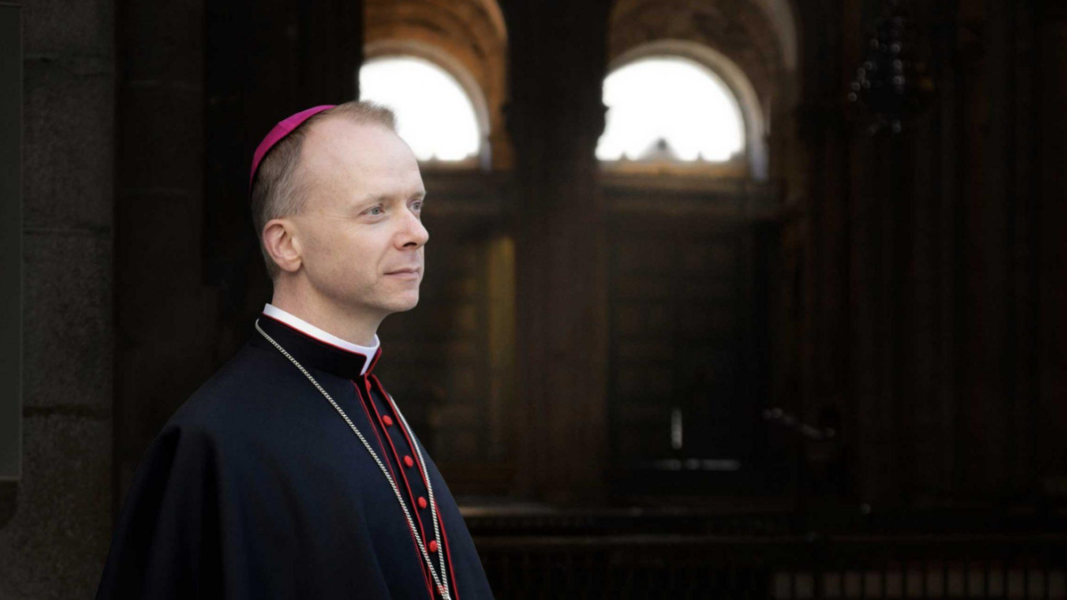
Msgr. Erik Varden, Trappist monk, bishop of Trondheim (Norway) and current president of the Nordic Episcopal Conference—who also preached this year’s Lenten spiritual exercises to the Pope—offers a demanding meditation on God’s help, dismantling the illusions of self-sufficiency, despair, and false hope that disfigure Christian life. A theme to meditate on this Holy Saturday in anticipation of the risen Christ.
The bishop recalls a truth that modern man tends to forget: Christian life does not begin in human effort, but in radical dependence on God. It is not a devout idea, but a concrete reality. As he himself states clearly: «God’s help is not something occasional for us; it is an attribute of his being that sustains us in existence».
This statement places the issue in its proper place. We are not dealing with a God to whom one turns in times of trouble, as if he were an emergency resource. We are dealing with the very foundation of life. And yet, man often acts as if he could dispense with that help.
The Illusion of Spiritual Self-Sufficiency
One of the most subtle—and most dangerous—errors is that of the person who believes he can sustain himself. It is not necessarily an irreligious attitude. On the contrary: it can grow within an apparently ordered, disciplined, even fervent life.
But that construction has a crack. When man begins to rely on his own works, he stops dwelling in God’s help. As Varden warns, there is the risk of settling into «a pernicious security» that degenerates into superficiality, arrogance, and constant judgment toward others.
The problem is not religious practice itself, but the inner displacement that turns spiritual life into a form of self-affirmation. At that point, faith ceases to be dependence and becomes control.
The Other Side: Enclosure in Weakness
In contrast to self-sufficiency, Varden points out another equally sterile deviation: that of those who, impressed by their own fragility, renounce seeking God’s help.
It is not true humility, but a form of stagnation. The soul becomes trapped in itself, repeating its misery, unable to escape it. It is what the author describes as a kind of morbid fascination with one’s own need, which can become «a golden calf».
Here too the relationship with God is broken. Not out of pride, but out of a kind of resignation that, at bottom, denies the efficacy of grace.
The False Hope That Does Not Require Conversion
However, there is a third attitude that permeates much of contemporary mentality: presumption. It is the idea that God’s mercy is guaranteed, regardless of man’s disposition.
Varden points it out without ambiguity: it is an empty hope, «a hope that lacks charity» and that arises from a logic of entitlement, not love. In other words, man stops converting because he takes it for granted that it is not necessary.
This way of thinking deeply disfigures Christianity. Because it eliminates moral tension, the call to transformation, and reduces the relationship with God to a comfortable expectation.
To Fall, But Not to Be Destroyed
In the face of these deviations, the meditation introduces a decisive criterion: it is not the fact of falling that defines man, but what happens after the fall.
«Those who live within God’s help can fall without being crushed», Varden affirms. And he adds a biblical image of great power: God «puts his hand underneath» them.
This completely changes the perspective. Christian life is not that of the one who never fails, but that of the one who, even in the fall, remains sustained by a help that does not disappear.
On the contrary, whoever lives on the margins of that help—whether out of pride or discouragement—is exposed to a fall without a horizon of recovery.
God’s Silence and the Experience of Abandonment
But the most difficult issue is not that. The true scandal appears when the believer seeks God and finds no response. When prayer seems to get lost in the void.
Varden does not avoid this problem. On the contrary, he places it at the center of the Christian experience. And he does so by resorting to the figure of Job, the paradigm of the man who suffers without understanding.
Here emerges what the author, following Marion Muller-Colard, identifies as the “Lament”: a radical expression of human pain that does not seek explanations nor accepts easy consolations.
«The lament has no object», he notes. «It does not need words; words are only a pretext». It is a form of suffering that is not resolved with arguments. And, for that very reason, it demands another kind of response.
Not to Explain, But to Accompany
In the face of that suffering, the usual temptation is to intervene with speeches, with answers, with attempts to justify God. But that reaction, far from helping, usually closes the wound even more.
The meditation is clear on this point: the wounded soul does not need explanations, but to be recognized. «It needs to hear that it has been listened to, that its signal has been received and understood».
This demands a form of presence that is not easy. It involves renouncing having the last word, accepting the mystery, and simply standing beside the one who suffers.
A Faith That Traverses the Darkness
Job’s journey, as presented by Varden, finally leads to a decisive point. After the lament and the experience of threat—when man discovers that he is not protected as he thought—something new emerges.
Not an explanation. Not a solution. But a different way of knowing God.
When Job says: «By hearing I knew you, but now my eyes have seen you», he is not solving his problem. He is recognizing that he has entered a deeper relationship, stripped of illusions.
Returning to Dwell in God’s Help
The conclusion of the meditation is demanding. Living in God’s help does not mean seeking securities, nor building a faith to measure, nor reducing God to a guarantor of stability.
It means accepting that Christian life passes through trial, through darkness, and through renouncing controlling everything.
Because, as Varden reminds us, «without me you can do nothing» is not a moral warning, but a description of reality.
And the question that remains for us is direct: does man live within that help… or does he continue trying to live as if he did not need it?