


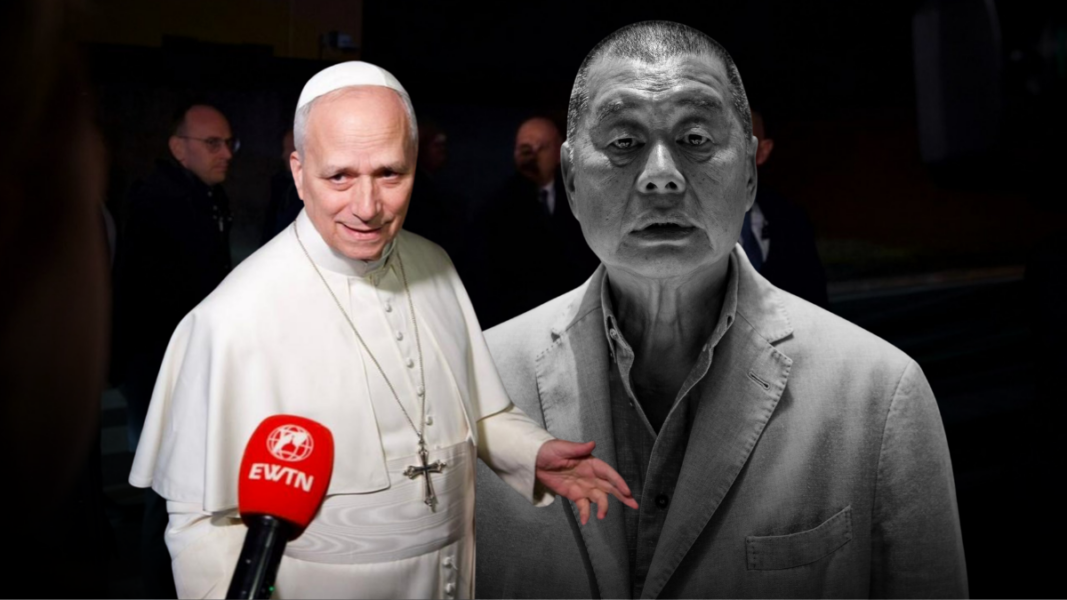
Pope Leo XIV stated that he “cannot comment” on the 20-year prison sentence of Catholic businessman and journalist Jimmy Lai, imprisoned in Hong Kong under the national security law imposed by China. The statement was made to journalists upon leaving the pontifical residence of Castel Gandolfo, which was his first informal exchange with the press since December of last year.
The phrase—brief and measured—did not go unnoticed. Lai is not unknown to the Vatican: the Pontiff received his wife and daughter in October 2025. However, upon confirmation of the sentence, the response was blunt: “I cannot comment”.
An Emblematic Case
Jimmy Lai, founder of the pro-democracy newspaper Apple Daily, was sentenced on February 9 following a process that his defenders describe as a political trial. A practicing Catholic, he became one of the most visible faces in the defense of civil liberties in Hong Kong.
On other occasions, Leo XIV has defended press freedom and reminded that imprisoned journalists challenge the conscience of the international community. But when the case directly affects the Chinese regime, the Pope has chosen not to speak out.
The Vatican-China Agreement
Since 2018, the Holy See has maintained a provisional agreement with the People’s Republic of China on the appointment of bishops, renewed on several occasions. The stated objective has been to ensure ecclesial unity and avoid the fracture between the official Church—controlled by the Chinese Catholic Patriotic Association—and the so-called underground Church, loyal to Rome.
However, the agreement has been the subject of persistent criticism. While Rome insists that dialogue prevents a greater rupture, Xi Jinping’s regime has strengthened the policy of “sinicization” of religion: communities must submit to state supervision, adapt their activities to the principles of the Communist Party, and accept controls over formation, catechesis, and pastoral life.
In recent years, there have been pressures, detentions, and restrictions on bishops and priests who do not fully align with the official structures. The underground Church continues to exist, albeit under conditions of strong surveillance.
Silence and Diplomacy
In this context, the “I cannot comment” acquires a meaning that goes beyond a simple evasion. The Holy See maintains that its diplomacy is discreet and that dialogue with Beijing seeks to protect Catholic faithful in China.
But the silence on a specific case—that of a Catholic sentenced by the regime—raises an inevitable question.
Is Leo XIV’s silence a necessary diplomatic prudence to avoid jeopardizing a delicate negotiation? Or does it reflect a real limitation in publicly pointing out the abuses of Chinese power?
Finally, Leo XIV reiterated his general call for peace and dialogue: “Let us pray for less hate and more peace.” A universal appeal that, in the Chinese case, remains wrapped in a carefully measured silence.