


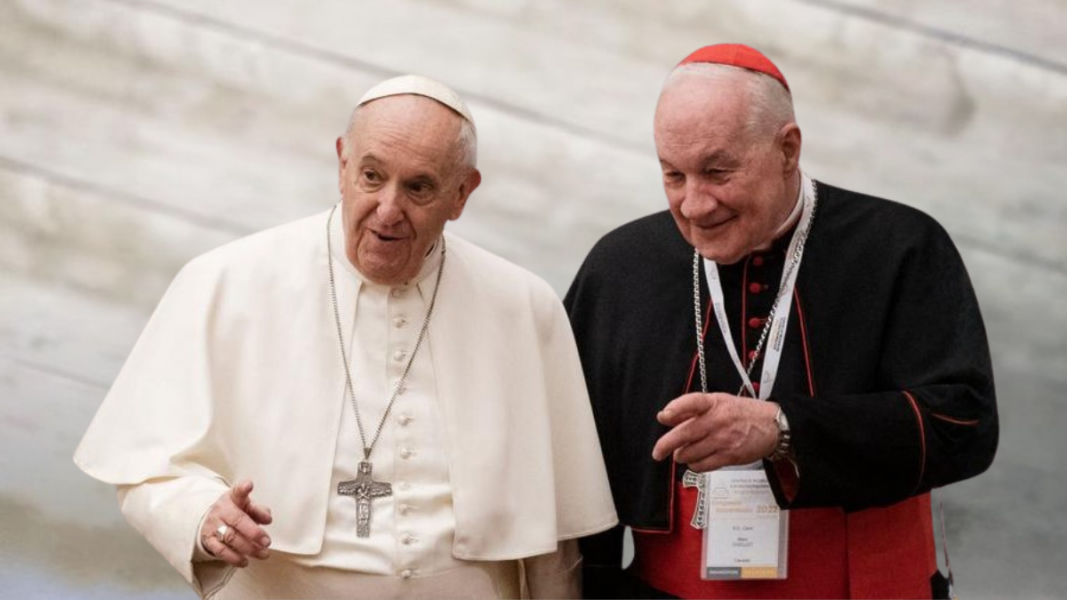
Cardinal Marc Ouellet, emeritus prefect of the Dicastery for Bishops, published this Monday on Vatican News a theological reflection on the appointment of laypeople and religious women to positions of authority within the Roman Curia, supporting one of the most significant decisions promoted by Pope Francis in the framework of the reform contained in the Apostolic Constitution Praedicate Evangelium.
Francis’s reform and the synodal logic
At that time, Francis justified this innovation by appealing to the synodal principle and to greater participation of the faithful in the communion and mission of the Church as a fulfillment of the Second Vatican Council:
«We can say that the last Ecumenical Council has not yet been fully understood, lived, and applied. We are on a journey, and a fundamental stage of this journey is the one we are living with the Synod, which asks us to move out of the logic of ‘that’s how it’s always been done,’ of applying the same old schemes, of the reductionism that ends up wanting to frame everything always in what is already known and practiced.»
(Francis, preface to the book «John XXIII. The Vatican II a Council for the world», 2022)
However, as Ouellet rightly recalls, the canonical justification presented with Praedicate Evangelium did not achieve general consensus. Some experts considered that the issue—debated for centuries among theologians and canonists—was resolved in a voluntaristic manner, adopting a doctrinal position without sufficiently broad prior dialogue.
Current cases such as that of Sister Raffaella Petrini—whose initial appointment generated legal questions and was subsequently regularized by Leo XIV through normative modifications—or that of Sister Simona Brambilla, at the head of a dicastery, serve as examples to see the practical application of Francis’s decisions.
Read also: The Pope appoints a woman as prefect of a dicastery, but with cardinal oversight
A debated issue in the canonical sphere
Ouellet acknowledges that this decision has generated discomfort, since ecclesial tradition has historically linked governance in the Church to the ordained ministry. The Second Vatican Council, the cardinal recalls, affirmed the sacramentality of the episcopate (Lumen Gentium, 21) and the relationship between the sacrament of Holy Orders and the functions of teaching, sanctifying, and governing.
However, the prelate emphasizes that this does not imply that the sacrament of Holy Orders is the only source of all exercise of authority. In his view, the debate cannot be reduced to a question of legal technique, but requires a broader theological reading.
A reading from pneumatology
In his reflection, Ouellet proposes considering the issue from a «pneumatological» perspective, that is, from the action of the Holy Spirit in the Church. He points out that sacramental theology has extensively developed its Christological dimension, but has paid less attention to the role of the Holy Spirit.
The Spirit, he states, not only accompanies the sacramental acts of the risen Christ, but also acts beyond them through charisms and diverse ministries. This charismatic dimension was revalued by the Second Vatican Council after centuries of lesser theological development in this area.
From this perspective, authority in the Church is not exhausted in the power of orders. Canon law already contemplates the possibility that laypeople cooperate in the exercise of the power of governance (c. 129 §2), which allows integrating recognized charisms into administrative, legal, or pastoral tasks that do not require sacramental ordination.
In areas such as administrative management, cultural or political discernment, financial administration, or ecumenical dialogue, it may be appropriate for competence not to depend necessarily on sacramental ordination, but on the suitability and experience of the designated person
Temporary measure or ecclesiological development?
In the final part of his reflection, the Canadian cardinal raises whether it is a provisional concession or an ecclesiological advance. In his judgment, Francis’s gesture opened a promising path by recognizing the authority of charisms in communion with hierarchical authority, in line with the conciliar orientations that invite pastors to recognize the ministries and charisms of the laity (Lumen Gentium, 30-33).
Ouellet thus considers that this integration can contribute to renewing the image of pastoral authority, particularly in a context in which clericalism and certain forms of exercise of power disconnected from service have been denounced.