


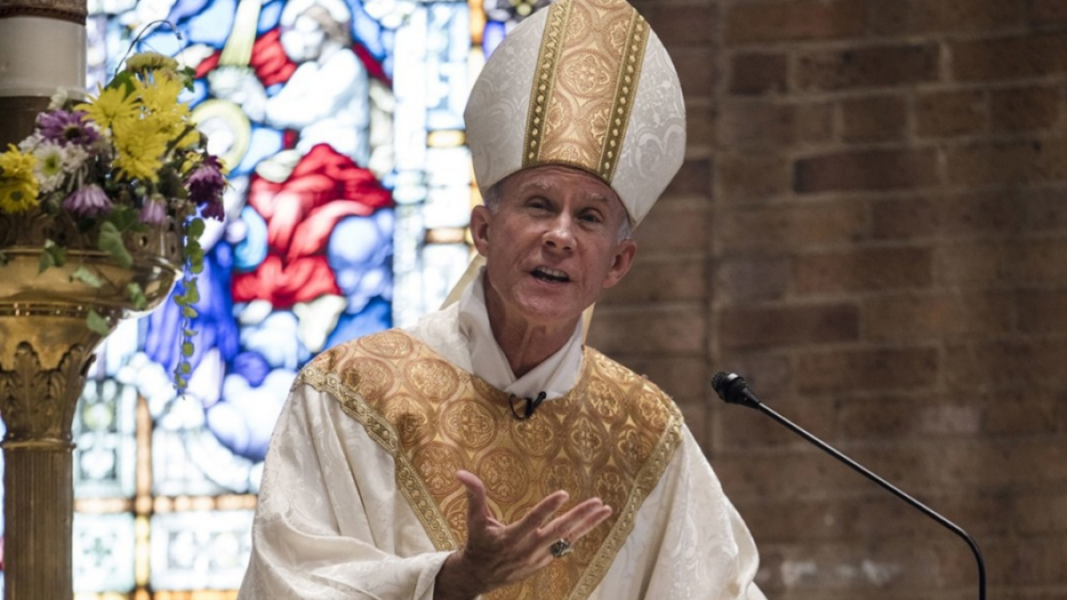
Mons. Joseph E. Strickland recently published an article to warn of a problem that, in his view, can no longer be ignored: the internal confusion in the Church and the progressive loss of the sense of the sacred, especially in the liturgy.
In an extensive text titled “Altar: When Silence, Confusion, and the Loss of the Sacred Endanger Souls”, the emeritus bishop argues that the Church is going through a moment in which pastoral silence, far from being prudent, becomes a form of negligence. It is not— he emphasizes— about reacting to external pressures or media controversies, but about responsibly assuming the duty to warn when souls are in danger.
Strickland starts from a realization shared by many faithful: the feeling of bewilderment. Not so much in the face of the world’s hostility, which the Church has always known, but before a confusion that arises from within it and that affects doctrine, morals, and, in particular, worship.
The Duty to Warn
The bishop turns to the biblical figure of the sentinel from the prophet Ezekiel to recall that the pastor is not called solely to administer structures or preserve a false calm. His mission is to watch, discern, and warn when danger approaches, even knowing that doing so may have a personal cost.
According to Strickland, most Catholics do not seek confrontation or rupture. They simply try to be faithful and ask for clarity. They wonder why direct teaching is often replaced by ambiguous formulas, why speaking with precision is considered divisive, and why what for centuries was presented as firm now seems negotiable.
The Liturgy, at the Center of the Crisis
The core of Strickland’s warning lies in the liturgy. Not as an aesthetic issue or personal preferences, but as a theological problem of the first order. The way the Church celebrates— he insists— models the faith of the faithful, their understanding of God, and their moral life.
In this context, he denounces the almost total disappearance of silence, the loss of reverence, the horizontalization of worship, and the transformation of the altar into a mere meeting space. When sacrifice and transcendence cease to be expressed clearly, faith weakens and the sense of the eternal fades.
The bishop recalls that the Second Vatican Council never called for ruptures with tradition or unlimited creativity. On the contrary, it spoke of continuity and organic development. However, in the following decades, practices were introduced that went far beyond what the Council intended, with consequences that today— he asserts— are evident.
Mercy without Conversion
Strickland also devotes an important part of his reflection to the notion of mercy. He warns against a mercy detached from truth, presented as accompaniment without conversion and compassion without a call to repentance. Christ forgave, he recalls, but never stopped warning about sin, judgment, and eternal life.
A Church that avoids warning to not discomfort— he asserts— is not being merciful, but abandoning the faithful. In this framework, he criticizes the institutional silence in the face of widely known and documented problems, from the loss of faith in the Real Presence to the emptying of seminaries and catechetical confusion.
“I Cannot Remain Silent”
Mons. Strickland openly declares that he cannot remain silent. Not because he believes himself above the Church or out of a spirit of confrontation, but precisely out of fidelity to his episcopal mission.
He assumes that speaking clearly may bring criticism, marginalization, or misunderstanding, but he rejects the comfort of silence when the good of souls is at stake. In his final call, he exhorts bishops to recover the fear of God, priests to guard the altar with reverence, and the faithful to remain firm, prayerful, and faithful to the Tradition received.