


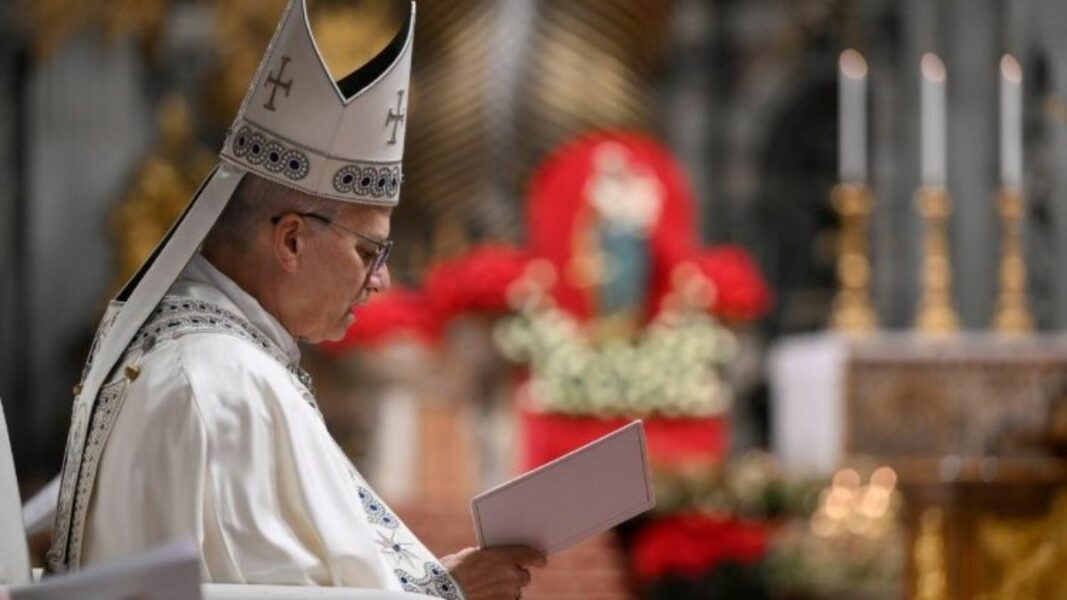
In the afternoon of December 31, 2025, in St. Peter’s Basilica, Pope León XIV presided over the celebration of the First Vespers of the Solemnity of the Most Holy Mother of God, followed by the traditional Te Deum of thanksgiving for the civil year that is ending. The liturgy, celebrated in the context of the closing of the Jubilee, served the Pontiff to offer a profound theological and pastoral reflection on the Christian meaning of time, history, and hope.
In his homily, León XIV contrasted God’s plan, revealed in the Incarnation and freely welcomed by the Virgin Mary, with the power strategies that today continue to mark the life of nations with wars, ideologies, and false religious motivations. The Pope emphasized that the Jubilee has been a sign of a world called to reconciliation according to the divine plan, recalled Rome’s singular vocation as a martyred city, and exhorted to live the passage to the new year from a concrete Christian hope, embodied in the little ones, the weak, and the forgotten, entrusting everything to the intercession of the Mother of God, Salus Populi Romani.
We leave below the complete words of León XIV:
Dear brothers and sisters!
The liturgy of the First Vespers of the Mother of God has a singular richness, which comes both from the dizzying mystery it celebrates and from its precise location at the end of the civil year. The antiphons of the psalms and the Magnificat insist on the paradoxical event of a God born of a virgin, or, conversely, on Mary’s divine motherhood. And at the same time, this solemnity, which concludes the Octave of Christmas, covers the passage from one year to another and extends over it the blessing of Him «who was, who is, and who is to come» (Rev 1:8). Moreover, today we celebrate it in the last moments of the Jubilee, in the heart of Rome, near the Tomb of Peter, and thus the Te Deum that will soon resound in this Basilica will want to expand as if to give voice to all the hearts and faces that have passed under these vaults and through the streets of this city.
We have heard in the biblical Reading one of the apostle Paul’s astonishing syntheses: «But when the fullness of time had come, God sent his Son, born of a woman, born under the law, in order to redeem those who were under the law, so that we might receive adoption as children» (Gal 4:4-5). This way of presenting the mystery of Christ suggests a plan, a great plan over human history. A mysterious plan but with a clear center, like a high mountain illuminated by the sun in the midst of a dense forest: this center is the «fullness of time».
And precisely this word—«plan»—has resounded in the canticle from the Letter to the Ephesians: «He has made known to us the mystery of his will, according to his good pleasure that he set forth in Christ, as a plan for the fullness of time, to unite all things in him, things in heaven and things on earth» (Eph 1:9-10).
Sisters, brothers, in this our time we feel the need for a wise, benevolent, merciful plan. One that is free and liberating, peaceful, faithful, like the one that the Virgin Mary proclaimed in her canticle of praise: «His mercy is for those who fear him from generation to generation» (Lk 1:50).
Other plans, however, today as yesterday, envelop the world. They are rather strategies aimed at conquering markets, territories, zones of influence. Armed strategies, clothed in hypocritical discourses, ideological proclamations, false religious motives.
But the Holy Mother of God, the smallest and the highest among creatures, sees things with God’s gaze: she sees that with the strength of his arm the Most High scatters the plans of the proud, brings down the mighty from their thrones, and exalts those who are humble; he has filled the hungry with good things, and sent away the rich empty-handed (cf. Lk 1:51-53).
The Mother of Jesus is the woman with whom God, in the fullness of time, has written the Word that reveals the mystery. He did not impose it: he first proposed it to her heart and, having received her «yes,» wrote it with ineffable love in her flesh. Thus God’s hope intertwined with Mary’s hope, descendant of Abraham according to the flesh and above all according to faith.
God likes to wait with the heart of the little ones, and he does so by involving them in his plan of salvation. The more beautiful the plan, the greater the hope. And, in fact, the world advances in this way, driven by the hope of so many simple, unknown people but not to God, who despite everything believe in a better tomorrow, because they know that the future is in the hands of Him who offers them the greatest hope.
One of these people was Simon, a fisherman from Galilee, whom Jesus called Peter. God the Father granted him such frank and generous faith that the Lord could build his community upon it (cf. Mt 16:18). And we are here today, praying near his tomb, where pilgrims from all parts of the world come to renew their faith in Jesus Christ, Son of God. This has happened in a special way during the Holy Year that is about to conclude.
The Jubilee is a great sign of a new world, renewed and reconciled according to God’s plan. And in this plan Providence has reserved a particular place for this city of Rome. Not for its glories, not for its power, but because here Peter and Paul and so many other martyrs shed their blood for Christ. For that reason Rome is the city of the Jubilee.
What can we wish for Rome? That it be up to its little ones. To the children, to the elderly who are alone and fragile, to families who have more difficulty getting by, to men and women who have come from afar hoping for a dignified life.
Today, dear brothers, we give thanks to God for the gift of the Jubilee, which has been a great sign of his plan of hope over humanity and over the world. And we give thanks to all those who in the months and days of 2025 have worked in the service of pilgrims and to make Rome more welcoming. This had been, a year ago, the desire of the beloved Pope Francis. I would like it to still be so, and I would say even more after this time of grace. May this city, animated by Christian hope, be at the service of God’s plan of love over the human family. May we obtain this through the intercession of the Holy Mother of God, Salus Populi Romani.