


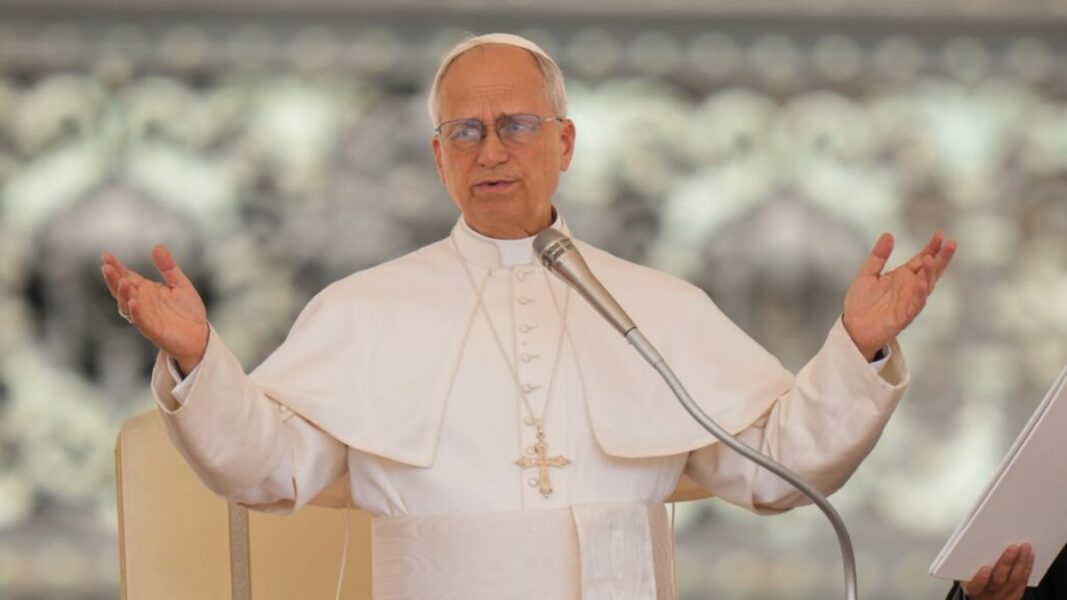
In the General Audience of December 31, 2025, held in St. Peter’s Square, Pope León XIV wished to offer a spiritual reading of the year that is concluding, marked by the end of the Jubilee, the Christmas season, and the events that have struck the Church and the world. Before the faithful and pilgrims from numerous countries, the Pontiff invited us to live the passage to the new year from gratitude, hope, and conversion, placing before God both the joys and the pains of the time lived.
In his catechesis, León XIV recalled the value of the Te Deum as an authentically Christian act of thanksgiving, emphasized the meaning of the Jubilee pilgrimage as an image of the Christian life oriented toward eternity, and highlighted the passage through the Holy Door as a sign of the “yes” to a new life, transformed by forgiveness and committed to charity. In the light of the mystery of Christmas, the Pope insisted that the central message of the Jubilee—and of the Christian faith—is summed up in one decisive word: love, the foundation of mercy, forgiveness, and hope that the Church announces to the world.
We leave below the words of León XIV:
Dear brothers and sisters, good morning and welcome!
We are living this moment of reflection on the last day of the civil year, near the end of the Jubilee and in the heart of the Christmas season.
The year that has passed has been marked by important events: some joyful, like the pilgrimage of so many faithful on the occasion of the Holy Year; others painful, like the death of the beloved Pope Francis and the war scenarios that continue to devastate the planet. As the year concludes, the Church invites us to place everything before the Lord, entrusting ourselves to His Providence and asking Him to renew, in us and around us, in the coming days, the wonders of His grace and mercy.
In this dynamic is inscribed the tradition of the solemn singing of the Te Deum, with which this afternoon we will thank the Lord for the benefits received. We will sing: “We praise you, God,” “You are our hope,” “May your mercy always be with us.” In this regard, Pope Francis observed that while “worldly gratitude, worldly hope are apparent, […] crushed by the self, by its interests, […] in this Liturgy a different atmosphere is breathed: that of praise, of wonder, of thanksgiving” (Homily at First Vespers of the Solemnity of the Blessed Virgin Mary, Mother of God, December 31, 2023).
And it is with these attitudes that today we are called to meditate on what the Lord has done for us in the past year, as well as to make an honest examination of conscience, to evaluate our response to His gifts, and to ask forgiveness for all the moments in which we have not known how to treasure His inspirations and invest better the talents He has entrusted to us (cf. Mt 25,14-30).
This leads us to reflect on another great sign that has accompanied us in the past months: that of the “journey” and the “goal.” So many pilgrims have come this year from all parts of the world to pray at Peter’s Tomb and to confirm their adherence to Christ. This reminds us that our entire life is a journey, whose ultimate goal transcends space and time, to be fulfilled in the encounter with God and in full and eternal communion with Him (cf. Catechism of the Catholic Church, 1024). We will also ask for this in the prayer of the Te Deum, when we say: “Receive us in your glory in the assembly of the saints.” It is no coincidence that St. Paul VI defined the Jubilee as a great act of faith in “the expectation of our future destinies […] which from now on we anticipate and […] prepare” (General Audience, December 17, 1975).
And in this eschatological perspective of the encounter between the finite and the infinite is framed a third sign: the passage through the Holy Door, which many of us have made, praying and imploring indulgence for ourselves and for our loved ones. This expresses our “yes” to God, who with His forgiveness invites us to cross the threshold of a new life, animated by grace, shaped by the Gospel, inflamed by “love for neighbor, in whose definition [is…] included the whole man, […] in need of understanding, help, consolation, sacrifice, even if he is a stranger to us, even if he is annoying and hostile, but endowed with the incomparable dignity of brother” (St. Paul VI, homily on the occasion of the closing of the Holy Year, December 25, 1975; cf. Catechism of the Catholic Church, 1826-1827). It is our “yes” to a life lived with commitment in the present and oriented toward eternity.
Dear ones, we meditate on these signs in the light of Christmas. St. Leo the Great, in this regard, saw in the feast of the Birth of Jesus the announcement of a joy that is for all. “Let the saint exult – he exclaimed – because the reward is near; let the sinner rejoice, because forgiveness has been offered to him; let the pagan recover his spirits, because he is called to life” (First Sermon for Christmas of the Lord, 1).
His invitation today is addressed to all of us, saints by Baptism, because God has become our companion on the journey toward True Life; to us, sinners, so that, forgiven, with His grace we may rise and set out again; and finally, to us, poor and fragile, so that the Lord, making our weakness His own, has redeemed it and has shown us the beauty and strength in His perfect humanity (cf. Jn 1,14).
For this reason, I would like to conclude by recalling the words with which St. Paul VI, at the end of the 1975 Jubilee, described the fundamental message: this, he said, is summed up in one word: “love.” And he added: “God is love! This is the ineffable revelation, of which the Jubilee, with its pedagogy, with its indulgence, with its forgiveness and finally with its peace, full of tears and joy, has wanted to fill our spirit today and always life tomorrow: God is love! God loves me! God awaits me and I have found Him! God is mercy! God is forgiveness! God, yes, God is life!” (General Audience, December 17, 1975).
May these thoughts accompany us in the passage between the old and the new year and then always in our life.