


There is a constant among the actors who portray Jesus—at least those who have done it conscientiously—, Robert Powell in the classic Jesus of Nazareth by Zeffirelli, Jim Caviezel in Mel Gibson’s The Passion and now Jonathan Roumie in the series The Chosen—a production that leans towards a more «human» side and with questionable creative licenses—, and it is that their interpretation inevitably brings them closer to a deeper inner life.
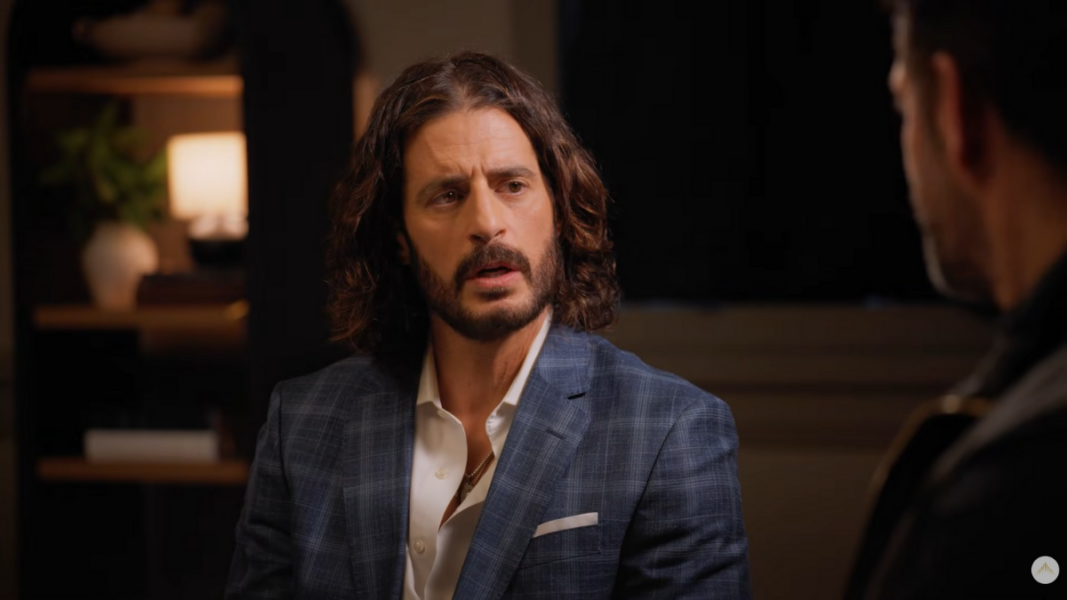
A few days ago, Roumie was interviewed by the American priest Mike Schmitz about his role as Jesus, but beyond the series’ gossip, the actor speaks sincerely about his faith and acknowledges that, after embodying the Passion, he can no longer live his faith in the same way. The Cross ceased to be an image contemplated from outside to become an inner reality that continues to act in his daily life.
He speaks like a Catholic aware that his spiritual life has been deeply marked by what he was entrusted to represent. Portraying Jesus Christ, especially in the Passion scenes, has not been for him just another professional exercise, but a turning point in his relationship with God, with the Mass, and with the Christian sense of suffering.
A faith that deepens in silence and the Cross
Roumie explains that, before starting the filming of the final scenes, he asked God for a specific grace: to be able to participate, even minimally, in the experience of Christ’s suffering. He was not seeking drama or heroism, but understanding. As he recounts, that request had real, physical, and spiritual consequences.
Injuries, prolonged pain, and an emotional impact that later led him to seek silence and retreat in a monastery marked this stage. Far from presenting these experiences as extraordinary, he describes them as part of an inner process that is still open and that will probably accompany him for the rest of his life.
He does not speak of trauma, but of transformation. Of a faith that is no longer sustained by general ideas, but by a more serious contemplation of Christ’s sacrifice.
The Eucharist at the center
One of the most visible fruits of this spiritual journey has been a concrete change in his way of living the Mass. Roumie confesses that the Passion led him to a much more vivid awareness of the real presence of Christ in the Eucharist. That inner conviction led him to begin receiving Communion kneeling and on the tongue, as an expression of reverence before the same Lord who suffered on the Cross.
He even recounts an uncomfortable episode in which a priest asked him to stand up while receiving Communion. Far from turning it into controversy, Roumie presents it as a moment of personal discernment, accompanied by his spiritual director, which reinforced his decision to persevere in a way of receiving the Lord that he considers consistent with his faith.
For him, it is not a matter of aesthetic preference or ideological stance, but of a concrete response to a believed truth: Christ is really present on the altar.
The Mass as the actualization of the sacrifice
In his testimony, a deeply Catholic understanding appears clearly: the Passion does not belong only to the past or to an audiovisual representation, but is sacramentally actualized in every Mass. What is contemplated on the screen becomes present— in an unbloody way— on the altar.
This certainty explains why Roumie says he can no longer «disconnect» during the liturgy. The Cross that he portrayed reappears in every Eucharistic celebration, compelling him to a more conscious, more reverent, and more demanding participation.
Offering suffering: a classical spirituality
Far from psychological or motivational discourses, Roumie concludes with a simple and demanding affirmation: everyone suffers, and suffering only finds meaning when it is offered united to that of Christ. It is, he says, the only way to go through it.
To offer it for others, for the Church, for the souls in purgatory. Not to flee from pain, but to redeem it. This spirituality, deeply Catholic and traditional, is not for him a learned theory, but a daily practice that has become inseparable from his life of faith.
A permanent mark
Roumie acknowledges that this stage will not close with the end of the series. He needs silence, prayer, and time to continue assimilating what he has lived. He knows that the experience has shaped him interiorly and that he does not wish to detach himself from it, because it keeps him united to Christ even when the spotlights go out.