


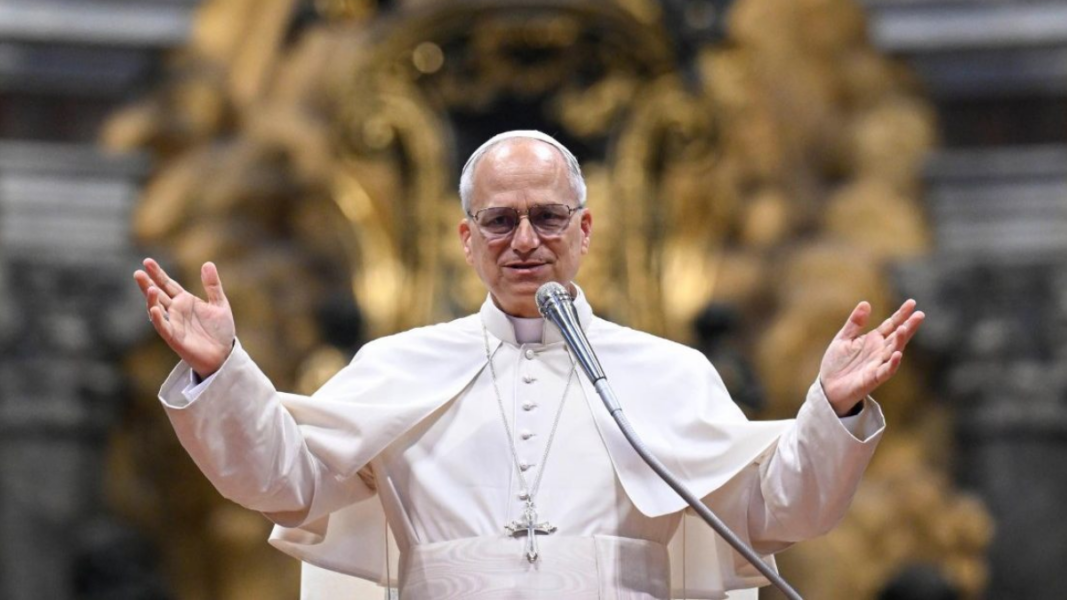
In the context of the meeting with Hispanic American priests, religious men, religious women, and seminarians studying in Rome, Leo XIV sent a message centered on the radical meaning of the Christian vocation and the evangelical call to “follow Christ” without reservations. The text, dated December 9, 2025—memorial of St. John Diego—and delivered today on the feast of Our Lady of Guadalupe, emphasizes the absolute primacy of God, the need for a life configured to the cross, and spiritual formation as a response to a society marked by noise and confusion.
We leave below the complete words of the Holy Father:
Dear brothers and sisters:
When Jesus Christ called his disciples, he almost invariably used the word “follow me.” In that brief word, we can find the deepest purpose of our life, whether as seminarians, as priests, or as members of consecrated life.
If we reread the Gospel texts on vocation, the first thing we notice is the absolute initiative of the Lord. He calls them, without any prior merit on the part of his interlocutors (cf. Mt 9,9; Jn 1,43) and looking rather to the vocation to which he summons them being an opportunity to bring the Gospel message to sinners and the weak (cf. Mt 9,12-13). In this way, his disciples become instruments of the plan of salvation that God has for all men (cf. Jn 1,48).
At the same time, the Gospel exhorts us to become aware of the commitment involved in responding to this vocation. It speaks to us of demands that we can identify in the frustrated call to the rich young man (Mt 19,21): the demand of the absolute primacy of God, the only good one (v. 17); the demand of the imperative need for theoretical and practical knowledge of the divine law (v. 18-19); and the demand of detachment from all human security, with the consequent offering of all that we are and all that we have (v. 21).
St. Ambrose, in his exegesis of the surprising passage of the young man whom Jesus does not allow to bury his father (Lc 9,59), assumes that in that demand to leave everything—even things just in themselves—the Lord does not intend to evade natural duties, sanctioned by the law of God, but to open our eyes to a new life. In it, nothing can take precedence over God, not even what we had known until then as good, and it implies death to sin and to the old worldly man. All this “so that we may be one at the side of God almighty, and we may see his only-begotten Son” (Treatise on the Gospel of St. Luke, 40).
For Ambrose, this indispensable union with Jesus, far from separating us from our brother, results in communion with others. We do not walk in solitude; we are part of a community. We are not united by ties of sympathy, shared interests, or mutual convenience, but by belonging to the people that the Lord acquired at the price of his Blood (cf. 1 P 1,18-19). Our union tends toward an eschatological value that will be fulfilled when we imitate “the unity of eternal peace with an unbreakable concord of souls and in an endless alliance” and fulfill “what the Son of God promised us when he raised this prayer to his Father: ‘That they may all be one, as we are’ (Jn 17,21)” (Treatise on the Gospel of St. Luke, 40).
Finally, in the Gospel of St. John, Jesus repeats the word “follow me” to the Apostle Peter twice. He does so in a very different context, the Resurrection, right after the triple confession of love that Peter makes in reparation for his sin. Even confessing his love, the Apostle did not fully understand the mystery of the cross, but the Lord already had in mind the sacrifice with which Peter would give glory to God and repeats to him: “Follow me” (Jn 21,19). When throughout life our gaze becomes clouded, like Peter’s, in the midst of the night or through storms (Mt 14,25.31), it will be the voice of Jesus that with loving patience sustains us.
The second time Jesus says to Peter: “Follow me,” he assures us that the Lord knows our fragility, and that, many times, it is not the cross imposed on us, but our own selfishness, that becomes a cause of stumbling in our eagerness to follow him. The dialogue with the apostle shows us with what ease we judge our brother and even God, without welcoming his will in our lives with docility. Here too the Lord repeats to us, with constancy: “What does it matter to you? You follow me” (Jn 21,22).
Brothers and sisters, since we are in the society of noise that confuses, today more than ever servants and disciples are needed who proclaim the absolute primacy of Christ and who have the accent of his voice very clear in their ears and in their heart. This theoretical and practical knowledge of the divine Law is achieved above all through the reading of the Sacred Scriptures, meditated in the silence of deep prayer, through the reverent welcoming of the voice of legitimate pastors, and through the attentive study of the many treasures of wisdom that the Church offers us.
Amid joys and amid difficulties, our watchword must be: if Christ passed through there, it also corresponds to us to live what he lived. We must not cling to applause because its echo lasts little; nor is it healthy to remain only in the memory of the day of crisis or of times of bitter disappointment. Let us rather look that all this is part of our formation and say: if God has willed it for me, I too will it (cf. Sal 40,8). The deep bond that unites us with Christ, whether as priests, consecrated persons, or seminarians, has a likeness to what is said to Christian spouses on the very day of their wedding: “in sickness and in health; in poverty and in wealth” (Ritual of Marriage, 66).
May the Blessed Virgin Mary of Guadalupe, Mother of the true God by whom one lives, teach us to respond with courage and keeping in our heart the wonders that Christ has done in us, so that, without delay, we may go to announce the joy of having found him, of being one in the One, and living stones of a temple for his glory. May the Most Holy Mary watch over your stay in Rome and intercede for you so that everything you assimilate in Rome may be fruitful in your mission. May God bless you.
Vatican, December 9, 2025. Memorial of St. John Diego
LEO PP. XIV