


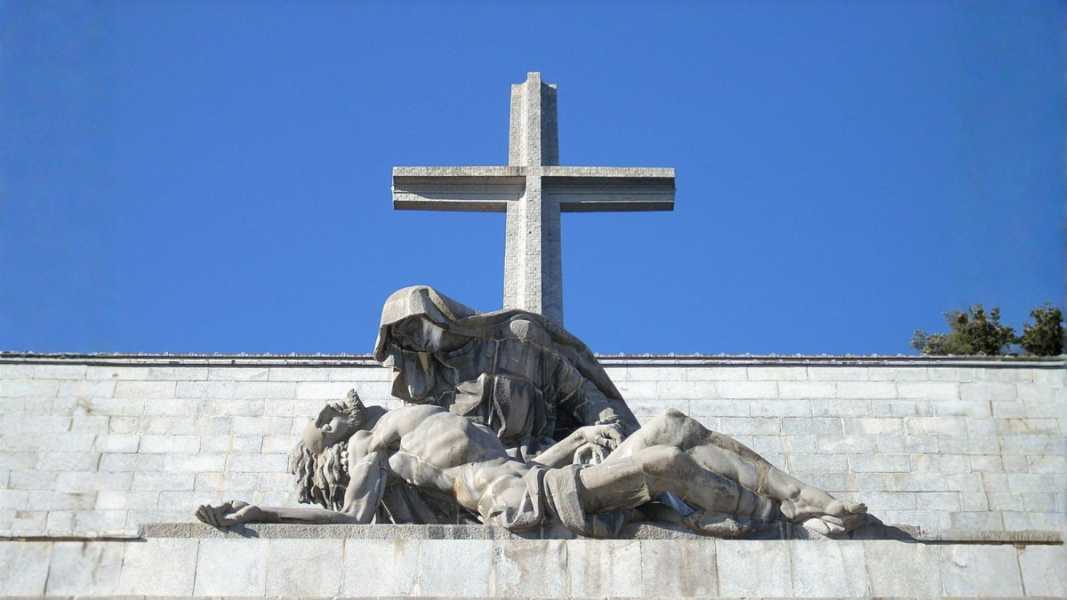
In a maneuver that seems carefully coordinated between the Government and certain sectors of the Church, the new architectural project for the Valley of the Fallen has been presented. A project that, far from seeking conservation or reconciliation, is a material profanation of one of the most significant monumental ensembles of contemporary Christendom.
Someone thought it was a good idea for the main design to consist of opening an enormous crack that crosses the esplanade of the Valley, culminating in the destruction and disappearance of one of the most valuable sculptural works in the ensemble: the Pietà by Juan de Ávalos. A piece of incalculable value, both for its spiritual symbolism and its artistic relevance, that crowns the access to the basilica at the foot of the Cross. It is, moreover, one of the most powerful religious symbols of the entire monument: the Mother holding her dead Son, an expression of pain, redemption, and hope.
The comparison is inevitable: this crack evokes the Taliban bombs that destroyed the Buddhas of Bamiyan. Those fanatics ended centuries of art and cultural memory; today, in the heart of Europe, Spain faces a gesture of barbarism of similar inspiration. Not with explosives, but with the ideological chisel and the pillory of resentment.
As for the basilica, the official statements offer little more than empty words. Talk of “minimal interventions,” of “informational panels,” of “reinterpreting the space.” But no one offers real guarantees about the preservation of its liturgical and artistic integrity. Rumors about the expulsion of the Benedictine community, custodians of the place since its foundation, are becoming increasingly insistent. And the attitude of certain bishops—cornered by sodomite scandals, dependent on political power, and fearful of confrontation—does not augur a firm defense of the sacred.
Thus, while the Government advances with a Taliban-inspired architectural intervention, the natural custodians of the place are evicted, the most emblematic religious sculptures are condemned to destruction, and the basilica is left at the mercy of a “redefinition” without limits or guarantees.
That crack they want to open in the Valley’s esplanade is not just physical. It is a metaphor for the ideological project that has been underway for years: opening a fissure in memory, in faith, and in the very foundations of Spanish Christian civilization. They began by profaning tombs, continued by dismantling symbols, and now seek to break the very stone upon which the Great Cross rises, a monumental sign of redemption.
But that crack—like every unjust wound—will one day have to be repaired. Because peoples who preserve memory do not indefinitely tolerate offense. What is presented today as an exercise in “historical reinterpretation” is, in reality, an act of cultural and spiritual barbarism, and as such it will be remembered.
Spain contemplates, in the Sierra de Madrid, its own modern Bamiyan: the attempt to erase the sacred under the pretext of progress. But faith and beauty—like deep roots—resist the blows of time and hatred. And although today they want to open cracks in the stone, they will not succeed in opening them in the soul of a people that does not forget.