


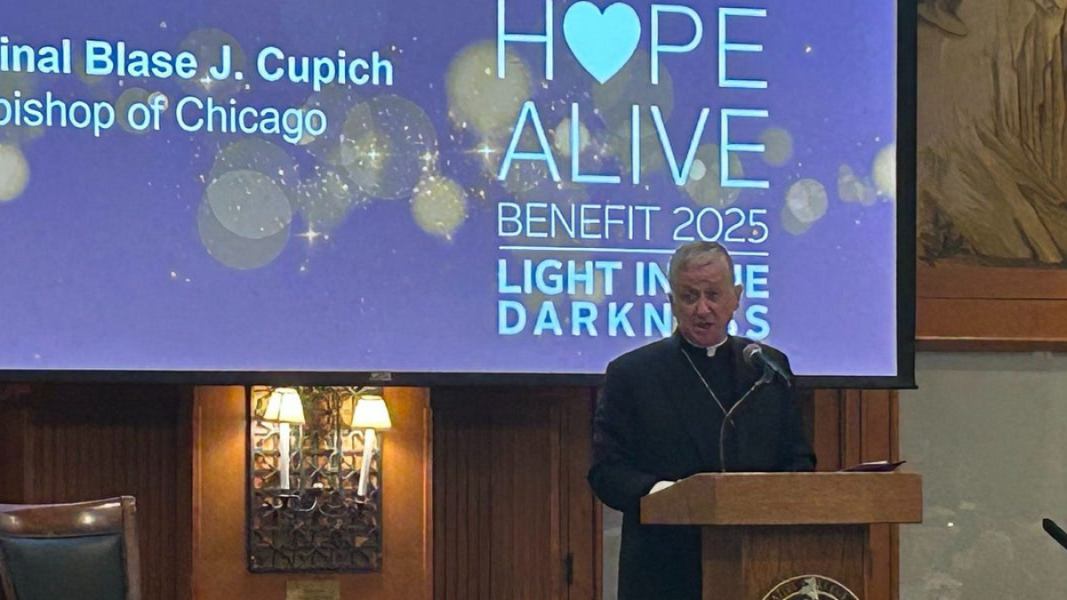
Cardinal Blase Cupich spoke out again about the controversy that arose around the award that the Archdiocese of Chicago planned to give to Democratic Senator Dick Durbin. As the prelate explained, the intention of the recognition was to highlight the legislator’s work in defense of immigrants and to emphasize that the situation of migrants is also part of an integral vision of the defense of life.
“Honoring Senator Durbin —Cupich said— was a way to recognize his work for the rights of immigrants and, at the same time, to give equal attention to the difficult situation of migrants as a pro-life issue.”
The cardinal made these statements during the Keep Hope Alive benefit event, organized by the archdiocese’s immigration ministry on November 3 at St. Ignatius College Prep school, with the participation of about 400 people. In his speech, Cupich stated that “Catholics must unite to defend every form of life and human dignity,” recalling that “as sacred as the life of the unborn is that of the poor, the elderly, the sick, and the migrants.”
The controversy over the recognition
The recognition for Durbin had been announced in September by the archdiocesan office of human dignity and solidarity, a decision that generated a strong reaction among U.S. bishops. Bishop Thomas Paprocki of Springfield expressed his “surprise” and “concern,” noting that awarding a politician with a history of support for legal abortion could cause “grave scandal” among the faithful.
The controversy provoked an unusual public exchange between bishops. USCCB sources confirmed that several prelates asked the conference to issue an official statement on the case. Ultimately, the Pope ended up making some unfortunate statements that concluded with Durbin himself rejecting the award, putting an end to the internal debate.
Cupich’s approach
During the event, Cardinal Cupich insisted that the archdiocese’s intention was not to ignore doctrinal differences, but to open spaces for dialogue. “Some will say that the Church should never honor a politician whose positions oppose Catholic teaching,” he noted. “But the reality is that today there are no public officials who fully embody all the essential elements of the Church’s social doctrine.”
The Archbishop of Chicago explained that, in his view, a positive approach can foster reflection and encounter. “Total condemnation is not the way —he affirmed—. Recognition can invite broadening the gaze and extending commitment to other areas of life and human dignity.”
Cupich defended that this type of gesture can help keep channels of dialogue open between people who, although holding different positions, share the desire to serve the common good. “No one wants to dialogue with someone who considers them a moral threat —he said—, but yes with someone who recognizes that their work can contribute something to the whole of society.”
A broader vision of the defense of life
In his address, the cardinal revisited part of the statement he had published after Durbin’s refusal to receive the award. “My hope —he said— was that honoring the senator would serve as an invitation to Catholics who defend the vulnerable on the U.S.-Mexico border to also reflect on the defense of the vulnerable on the border between life and death, in cases of abortion and euthanasia.”
“Likewise —he added—, those who promote the protection of the unborn, the elderly, and the sick can expand their circle of concern to migrants who today face real threats to their lives and those of their families.”
The cardinal insisted that both groups are part of the same Catholic community and that the Church cannot reduce its commitment to a single cause. “We are not a single-issue Church,” he affirmed. “Ideological isolation easily leads to personal isolation and weakens the desire for unity that Christ asked for his disciples.”
Commitment to migrants
At the same event, Cupich highlighted the work of the archdiocese’s immigration ministry, which provides support to families affected by the deportation and detention of migrants. “Respecting our borders and respecting human dignity have never been incompatible goals,” he affirmed. “We accompany migrants when their families are separated, when children live in fear, and when detained persons lack legal assistance and respect for their dignity.”
The cardinal concluded his address by emphasizing that the challenge for the Church in the United States is to build bridges amid social and political polarization. “As bishops, we cannot stand idly by in the face of division. We must do everything possible to unite Catholics in the defense of life and human dignity, wherever they are threatened.”
Source: The Pillar