


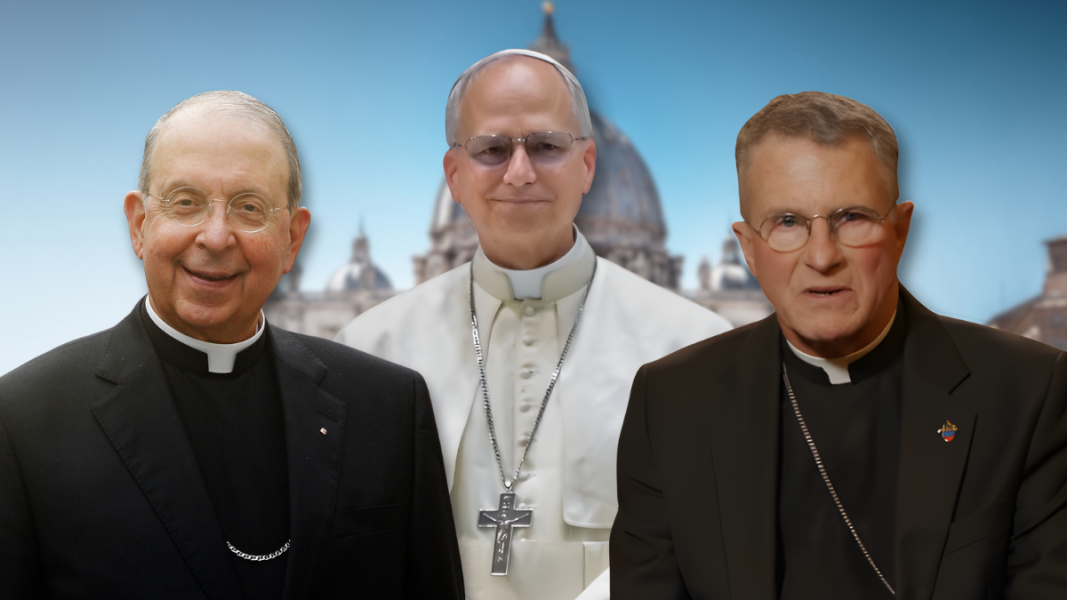
Pope Leo XIV received this Friday, October 10, the leadership of the United States Conference of Catholic Bishops (USCCB). The delegation was headed by Msgr. Timothy P. Broglio, military archbishop and current president of the episcopate, accompanied by Msgr. William E. Lori, archbishop of Baltimore and vice president. Joining them were the general secretary, Rev. Michael J.K. Fuller, and the deputy general secretary, Rev. Paul B.R. Hartmann.
The meeting took place in the Apostolic Palace as part of the papal audiences of the morning, which also included cardinals from the Curia and diplomatic representatives. The presence of the U.S. episcopal delegation underscores Rome’s interest in maintaining close dialogue with those responsible for the Church in a country that hosts one of the largest and most politically influential Catholic communities in the world.
The contrast with the Cupich audience
The meeting comes just 24 hours after the Pope received Cardinal Blase Cupich along with Chicago union leaders, following the controversy over the failed award to pro-abortion Senator Dick Durbin, although the same Vatican sources assured that the meeting revolved around issues of migration and labor dignity.
In this context, today’s audience with Broglio and Lori takes on additional significance. Both represent a distinct line within the North American Church: Broglio is known for his more conservative doctrinal profile and his firm defense of life, while Lori has played an important role in promoting religious freedom and in the public debate on policies contrary to Catholic magisterium in the United States.
Unity or tensions on the horizon
The fact that Leo XIV has received Cupich and the USCCB leadership on consecutive days can be interpreted as an attempt to balance relations within an episcopate marked by strong internal divisions. On one hand, it reinforces the figure of Cupich, close to progressive currents and aligned with the Democratic Party’s social agenda. On the other, it gives space to Broglio and Lori, references for a sector more faithful to the traditional magisterium on issues of morals and life.
Leo XIV’s strategy seems aimed at sustaining a delicate balance: showing openness to the different sensitivities of American Catholicism, but without taking an explicit public side. The risk, however, is that this gesture is perceived as ambiguity, at a time when the faithful demand clarity in the face of figures who, like Cupich, have generated scandal with their decisions.