


On November 20, 2005, on the solemnity of Christ the King, the patron of the laity and his companions were beatified in Jalisco Stadium by the delegate of Benedict XVI, Cardinal José Saraiva Martins. Thirteen martyrs were raised to the altars. Nine laymen, among them an adolescent, St. José Sánchez del Río, canonized by Francis on October 16, 2016.
That this November 22, 2026, a jubilee year should open for the centenary of the “Cristero resistance” is no small matter. The Pastoral Letter and the call of the Mexican Episcopate arrive especially at a moment when memory must give pause to reflection and witness in an age of challenges, yet of better conditions for exercising the right to religious freedom, at least in this country where there is no official declaration proscribing the right to a peaceful assembly to perform the acts that best suit those who manifest their faith, beliefs, and rites.
In the Global Pastoral Plan 2031-2033, the shepherds say they “recognize the vitality and richness of the lay faithful, who, from their apostolic commitment and life of faith, inserted in the world, have contributed and continue to contribute to the transformation of society, as well as to the evangelizing mission of the Church and to the transmission of the faith from the beginnings of our nation.” (PGP 2031-2033, No. 70)
Moreover, the recent Pastoral Letter recognizes in Blessed Anacleto González Flores the martyr of the Cristero resistance and recalls the words he himself left: “Wherever a system arises and wherever a doctrine is raised that seeks to wrest from truth its supremacy over minds and hearts, the soldiers of thought must appear, the fighters of the idea, all banners must be unfurled, all swords and bayonets must flash along the battle line, all trenches must be eliminated.”
The story of Anacleto González is one that is only beginning to be understood, but the stories of others remain forgotten, almost lost. On November 20, 2005, on the solemnity of Christ the King, the patron of the laity and his companions were beatified in Jalisco Stadium by the delegate of Benedict XVI, Cardinal José Saraiva Martins. Thirteen martyrs were raised to the altars. Nine laymen, among them an adolescent, St. José Sánchez del Río, canonized by Francis on October 16, 2016.
That distant celebration in time remains because it was the culmination of the 48th International Eucharistic Congress in which Cardinal Juan Sandoval Íñiguez spared no expense. Saraiva said of them: “In adverse situations and in different particular Churches, these faithful sons of the Church gave a praiseworthy witness to the commitments undertaken on the day of their baptism, proving capable of shedding their blood for love of Christ and His Church, which was unjustly persecuted.”
Who are the lay companions of Anacleto González beatified in 2005? Here are the forgotten stories we must rescue as they were disseminated for that ceremony:
José Dionisio Luis Padilla Gómez
Born in Guadalajara, Jalisco, on December 9, 1899. In 1917 he entered the conciliar seminary of Guadalajara and left it in 1921. He was a teacher giving classes to poor children and young people. Founder of the Mexican Catholic Youth Association, he carried out intense apostolate for social promotion. When the persecution broke out, he joined Anacleto González’s Popular Union to work through peaceful means in defense of religion. On April 1, 1927, his home was raided by a group of federal army soldiers under the orders of Ferreira, who ordered the looting of the dwelling and the arrest of Luis, his elderly mother, and one of his sisters.
Luis was taken to the Colorado barracks. Foreseeing his end, he expressed his desire to make a sacramental confession; his prison companion, Anacleto González Flores, comforted him saying: “No, brother, it is no longer time to confess, but to ask forgiveness and to forgive. It is a Father and not a judge who awaits you. Your own blood will purify you.” At the execution wall, Luis offered his life to God. He was 26 years old. Aspects subsequent to his cause of beatification and studies on his mortal remains, which, according to physicians, reflected an unusual and inexplicable glow, can be consulted here.
Jorge Ramón Vargas González
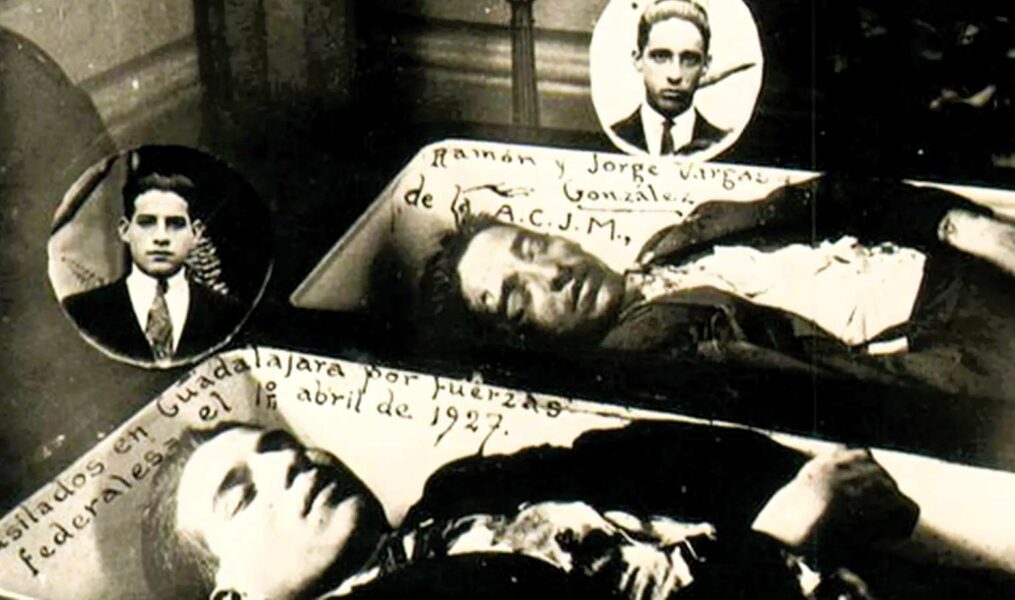
Born in Ahualulco, Jalisco, on September 28, 1899. He was the fifth of eleven siblings. During the religious persecution, in 1926, while Jorge was an employee of the hydroelectric company, his home served as a refuge for many persecuted priests. The Vargas González family received in their home the outlawed leader Anacleto González Flores, pillar of the Catholic resistance of Jalisco and its surroundings; the family knew full well what their action could cost. There they were surprised by the ambush of April 1. All—men, women, and children—amid outrages and alarms, were arrested by the chief of police of Guadalajara. The same cell served to house three of the Vargas González: Florentino, Jorge, and Ramón; their crime, having sheltered a persecuted Catholic.
Preceding Jorge’s death was some form of torture, for his corpse showed a dislocated shoulder, contusions, and traces of pain on his countenance. During the burial, when the mother of the victims embraced Florentino, she said to him: “Oh, son! How close the crown of martyrdom was to you! You must be better to deserve it”; the father, for his part, upon learning how and why they died, exclaimed: “Now I know it is not condolences that should be given me, but congratulations, because I have the joy of having two martyr sons.”
Ramón Vicente Vargas González
Born in Ahualulco, Jalisco, on January 22, 1905. Seventh of eleven siblings, he followed in his father’s footsteps by entering the School of Medicine, attending gratuitously to the health of the poor. At 22, nearing the completion of his university studies, he received Anacleto González Flores in his home with subsidiary responsibility, who soon recognized Ramón’s qualities and asked him to join the camps of active resistance as a nurse: “For you I will do whatever is needed, Maestro, but go to the hills, no,” replied the one addressed.
In the early hours of April 1, 1927, someone pounded on the door of the Vargas González home; Ramón answered the call; upon opening the door slightly, a large group of police seized the house. The dwelling was searched and its occupants arrested. When he learned he was to die, his upright manliness and Christian hope sufficed to unite his sacrifice with that of Christ. To an exclamation of his brother Jorge, he replied: “Fear not; if we die, our blood will wash away our faults.” To mitigate the cruel sentence, the divisional general Jesús María Ferreira offered to set free the youngest of the Vargas González brothers; the pardon corresponded to Ramón, but he, without admitting objections, yielded his place to Florentino. It was past midday; it was urgent to execute the prisoners as soon as possible. Before being shot, Ramón flexed the fingers of his right hand forming the sign of the cross.
José Luciano Ezequiel Huerta Gutiérrez
Born in Magdalena, Jalisco, on January 6, 1876. An exemplary husband and father of a large family, he possessed a magnificent and well-cultivated dramatic tenor voice. Very charitable, he shared his goods among the needy. He was arrested on the morning of April 2, 1927; he had two priest brothers, Eduardo and José Refugio, who were greatly respected in Guadalajara. When he was taken prisoner, he had just visited the funeral chapel where the body of the Catholic leader Anacleto González Flores was being waked. In the police station cells he was tortured until he lost consciousness. When he came to, he expressed his laments by singing the Eucharistic hymn: “Long live my Christ, long live my King.”
On April 3 he was transferred, together with his brother, to the municipal cemetery; the firing squad was formed. Ezequiel said to his brother Salvador: “We forgive them, don’t we?” “Yes, and may our blood serve for the salvation of many,” replied the one addressed; a rifle volley cut short the dialogue. Very near that place, Ezequiel’s wife heard the shots; she did not know who the victims were; nevertheless, she gathered her large family: “Children, let us pray the rosary for those poor men who have just been shot.”
Salvador Huerta Gutiérrez
Born in Magdalena, Jalisco, on March 18, 1880. A mechanic by vocation, he devoted himself to this trade, becoming one of the most competent in Guadalajara. On April 2, 1927, after the assassination of Anacleto González and his three companions, he went to the cemetery to bid farewell to the remains of the well-known leader. On his return to his workshop, police agents awaited him who, by means of a ruse, arrested him. At the general police station a most cruel torment began; he was hung by his thumbs; the executioners wanted to know the whereabouts of his brothers Eduardo and José Refugio.
On April 3 he was taken with his brother Ezequiel to the Mezquitán cemetery. Before the firing squad he asked for a lighted candle. Illuminating his bare chest he said: “Long live Christ the King and the Virgin of Guadalupe! Fire! I die for God whom I love very much!”
Miguel Gómez Loza
Born in Tepatitlán, Jalisco, on August 11, 1888. An untiring promoter of the social doctrine of the Church, he was a friend of Anacleto González in the ranks of the Mexican Catholic Youth Association, where he found school and chair for his religious and moral formation.
He entered the Free School of Law. For defending the needy, he was imprisoned and beaten. In 1922 he married María Guadalupe Sánchez Barragán. He had three daughters. Miguel joined the League for the Defense of Religious Freedom, employing all peaceful means permitted to resist attacks against religious freedom. He was appointed governor of Jalisco by the Catholic resistance, which earned him persecution unto death. He was surrounded and riddled with bullets by the federal army near Atotonilco el Alto on March 21, 1928.
Luis Magaña Servín
Born in Arandas, Jalisco, on August 24, 1902. An upright Christian, responsible and solicitous husband, he maintained his Christian convictions without denying them, even in times of trial and persecution. An active member of the Mexican Catholic Youth Association and of the archconfraternity of Nocturnal Adoration of the Blessed Sacrament in the parish of Arandas, he married Elvira Camarena Méndez on January 6, 1926, fathering two children, Gilberto and María Luisa, whom he did not know. On February 9, 1928, a group of soldiers commanded by Miguel Zenón Martínez took Arandas. He ordered the capture of Catholics sympathetic to the active resistance against the Government; one of them was Luis. When they arrived at his home, they could not arrest him because he had hidden, but they detained his younger brother.
Luis presented himself before General Martínez requesting the freedom of his brother in exchange for his own. These were his words: “I have never been a Cristero rebel as you call me, but if I am accused of being a Christian, yes, I am. And if for that I must be executed, welcome and well and good. Long live Christ the King and Holy Mary of Guadalupe!” Moments before being shot, he said: “Firing squad that is to execute me, I want to tell you that from this moment you are forgiven and I promise you that when I come before the presence of God it will be for you first that I will ask,” and he exclaimed with a powerful voice: “Long live Christ the King and Holy Mary of Guadalupe!”
Prior to their elevation to the altars, analyses in some publications pointed to the convenience of the beatification of the Cristero martyrs to strengthen political Catholicism stirred up by the right. On September 5, 2004, the weekly Proceso published an opinion titled “Beati of the extreme right” recording an interview with Édgar González Ruiz, a specialist in the Cristiada and its ideological repercussions. When asked whether those beati would have appeal and impact among the believing people, he affirmed: “Not at all! This explosive number of Cristero saints and beati has no support, no social base. They are not known at the national level. They are figures very circumscribed to the sphere of their region. And I do not see how they benefit the true religiosity of the Mexican people.”
In that distant year 2004, that so-called specialist of the Cristiada did not look ahead. Today, 100 years after what is now called “resistance,” the memory of the martyrs is the object of analysis and reflection. For the Catholic Church of Mexico, it will be to observe “the reality of Mexico demands this witness. The wounds caused by violence, unjust poverty, corruption, forced disappearances, the fragility of families, and so many forms of exclusion challenge the Church to work for justice, truth, human dignity, and peace.” (Pastoral Letter of the Mexican Episcopate on the occasion of the Centenary of the Beginning of the Cristero Resistance, No. 65)