


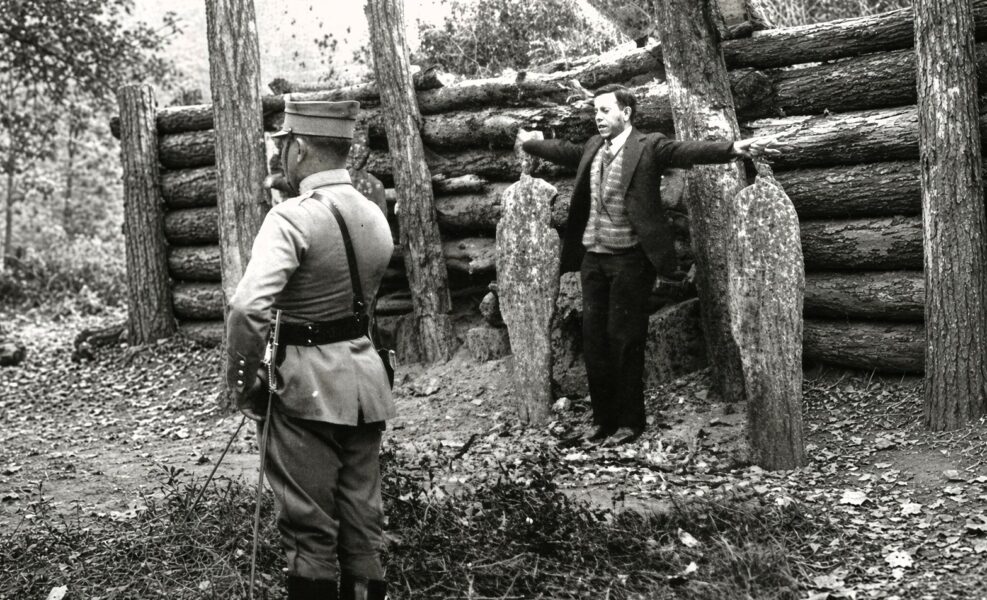
On November 23, 1927, in the backyard of what was then the central police headquarters, today the National Lottery building on Paseo de la Reforma, Jesuit priest Miguel Agustín Pro Juárez faced the firing squad with his arms open in a cross and the cry of “¡Viva Cristo Rey!”. President Plutarco Elías Calles had ordered the execution to be photographed and disseminated. The bet was to show the supposed cowardice of Catholics and deter those sustaining resistance during the Cristero War. The result was exactly the opposite. The image immediately became a national and international symbol of the conflict, and almost a century later it continues to be reinterpreted from ideologically opposed spaces.
This was explained by Dr. Marisol López Menéndez, researcher at Universidad Iberoamericana and specialist in visual sociology, in an interview conducted by the Archivo General de la Nación. López Menéndez has devoted part of her work not so much to Father Pro’s biography as to the way his death was interpreted, symbolized, and reused from 1927 to the present day. “It was a terrible bet by Calles,” the researcher maintains. “It worked in exactly the opposite direction.”
Miguel Agustín Pro was born on January 13, 1891, in Guadalupe, Zacatecas, into a deeply Catholic mining family. The third of eleven children, he entered the Society of Jesus in 1911. Anticlerical persecution forced him to continue his formation in exile: the United States, Spain, Nicaragua, and Belgium, where he was ordained a priest on August 31, 1925. He returned to Mexico in 1926, just when Calles’s regime had suspended public worship and made priestly work a crime. Pro carried out a clandestine ministry in Mexico City, especially from the parish of the Sagrada Familia in the Roma neighborhood. He disguised himself as a mechanic, laborer, or businessman to administer sacraments, hear confessions, and bring the Eucharist. At the same time, he was an active promoter of the National League for the Defense of Religious Freedom, a lay organization that openly supported the Cristeros in western Mexico.
On November 13, 1927, a failed bomb attack took place against General Álvaro Obregón, then president-elect. The car used had previously belonged to one of Pro’s brothers. Although engineer Luis Segura Vilchis turned himself in and declared that the Pros were not involved, Calles ordered the arrest of Miguel Agustín, his brother Humberto, and others. There was no trial. On November 23, by direct order of the president, Miguel Agustín Pro, his brother Humberto, Juan Tirado (a member of the League), and Segura Vilchis himself were executed. The photographs, taken by reporters whose exact identity is not known with certainty and later deposited in the Casasola archive and other collections, circulated the following day in Excélsior, El Universal, and the rest of the press. The government had invited the press precisely so that the punishment would be public.
López Menéndez highlights the decisive gesture: by opening his arms in a cross and shouting the Cristero slogan, Pro not only aligned himself with the cause but presented himself as a martyr, embodying the figure of Christ. “He makes his adherence to the Catholic faith evident and leaves no doubt about the place this execution holds in the enormous theodicy favored by the Cristeros.” That gesture, captured and reproduced, is what sustains the myth to this day. The researcher points out how the same image appears on the walls of the Miguel Agustín Pro Human Rights Center, in the museum adjacent to the Sagrada Familia parish, and at the same time in spaces of the political right that claim Father Pro from a perspective completely different from that of the Jesuits. Visual sociology, she explains, allows us to read images as documents: how they were produced, reproduced, and, above all, how the present reclaims them for purposes foreign to the originals.
The researcher admits that what most surprised her during her archival work was not the photograph of the execution itself, but that of the funeral procession. Crowds walked the streets from the wake to the Panteón de Dolores singing Marian songs and deliberately provoking Calles as they passed in front of Chapultepec Castle. “There were rivers of people… very distinguished persons in their carriages, automobiles, people on foot, peasants, workers.” That diversity of social types, documented in the photographs, shows the breadth of the immediate reaction.
The archives were essential to her research. López Menéndez consulted the Archivo General de la Nación, the UNAM archive, the Condumex archive, the Instituto de Cultura de Aguascalientes archive, and materials that were then in the parish itself (some of which may later have passed to Jesuit archives). Her interest was not to reconstruct Pro’s daily life, but to trace how his death reverberated through the 1930s, 1940s, 1950s, and into the twenty-first century. For those wishing to research with archival photographs, the sociologist’s recommendation is clear: first look at the images already circulating on the internet and then trace them in the collections to understand the moment of their production, not the other way around. Public archives, she emphasizes, allow narratives to be contrasted and are available to any researcher or curious citizen. “They belong to all Mexicans.”
The case, López Menéndez concludes, teaches something that remains relevant in the age of social media: “There are circumstances that are not always desired in people’s actions… We do not know what each image will say until we make it public.” Calles believed he could control the message by photographing the execution. The image escaped his hands and became one of the most enduring symbols of the Mexican religious conflict. In 1988, Pope John Paul II beatified Miguel Agustín Pro as a martyr. His remains rest in the Sagrada Familia parish, in the same Roma neighborhood where he carried out his clandestine ministry. The photograph of the man with his arms outstretched continues to circulate, reinterpreted and contested, as proof that the power of an image does not belong entirely to the one who produces it or the one who orders it, and it is one of the most representative icons that forged the ideal of ¡Viva Cristo Rey!
The interview can be viewed here, credit Archivo General de la Nación.