


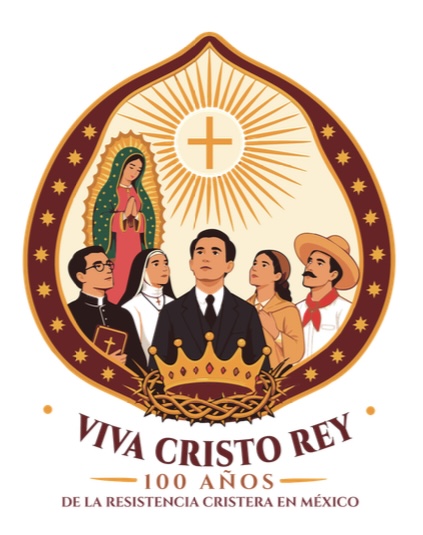
With an emblem conceived as a reliquary of memory and with convocations that are beginning to translate into concrete provisions within the dioceses, the Catholic Church in Mexico opens this Sunday, November 22, the Jubilee Year for the centenary of the beginning of the Cristero resistance. The celebration will begin on the solemnity of Jesus Christ, King of the Universe, and will continue until November 21, 2027.
The Jubilee carries the motto “Their faith, our memory and their witness, our mission”. Its purpose is not only to recall the events that shook the religious life of the country between 1926 and 1929, but also to recover the testimony of the martyrs, promote reconciliation and reaffirm religious freedom as a right of every person.
The presentation of the official emblem, presided over by the proclamation “¡Viva Cristo Rey!”, offers a visual synthesis of that purpose. The design takes the form of a medallion or reliquary inside which the Church and the people are gathered under Christ the King. The Virgin of Guadalupe, the radiant Eucharist, the royal and crown of thorns, as well as the figures of the clergy, consecrated life, young people and the lay faithful, articulate a composition built around three concepts: faith, memory and witness.
The burgundy color refers to the blood shed by the martyrs and the stars evoke the mantle of the Virgin of Guadalupe. The emblem, therefore, does not constitute merely the graphic identification of an anniversary; it seeks to express the historical continuity of a religious experience and transmit it to generations for whom the Cristero War is an increasingly distant episode.
The Jubilee Year was announced on November 9 during the opening Mass of the CXXI Plenary Assembly of the Mexican Episcopal Conference, held at the Basilica of Guadalupe. In that context, the bishop of Cuernavaca and president of the CEM, Ramón Castro, emphasized that remembering the religious persecution does not mean reopening wounds, fueling resentments or pointing out enemies.
The Christian memory of the Cristero resistance, the Episcopate explained, must lead to the recognition of suffering, reconciliation and the building of peace. This clarification is indispensable to prevent the centenary from being used as an exaltation of violence or as an argument to transfer to the present the political and religious confrontations of the past.
The Jubilee has a decree from the Apostolic Penitentiary, dated November 6, 2026, by which a plenary indulgence is granted to the faithful who fulfill the conditions established by the Church and make a pilgrimage to the shrines dedicated to the Mexican martyrs or to the jubilee churches designated by the bishops.
The Mexican Episcopal Conference requested that the decree be proclaimed in the particular Churches this November 22 and that each diocese arrange the places, celebrations and corresponding pastoral activities. The national opening is thus beginning to acquire its own characteristics in the diocesan communities.
Among the broadest convocations is that of the archbishop of Guadalajara, Cardinal José Francisco Robles Ortega. The prelate called on the entire Church that pilgrimages in that archdiocese to celebrate the Jubilee of the centenary of the beginning of the Cristero resistance.
The document notes that the solemnity of Christ the King this year coincides with the celebration of the Mexican blessed martyrs, the Day of the Laity and World Youth Day. However, it maintains that the date acquires a particular depth because it marks one hundred years since the beginning of the resistance.
The Archdiocese of Guadalajara proposes to live the Jubilee as an experience of ecclesial communion, grateful memory and renewal of the faith. The convocation remembers those who remained faithful to Jesus Christ and the Church until they gave their lives and reaffirms the right of the people to celebrate, transmit and live their faith both in the family sphere and in public life.
The disposition of the archdiocese is of singular importance because it establishes the places linked to the saints and blessed whose relics are guarded by that particular Church. Before issuing the circular, the archbishop instructed the Diocesan Commission for the Causes of Canonization to carry out a recognitio, that is, a canonical review of the mortal remains preserved in its territory.
The work was carried out from April 18 to September 15, 2026. Its purpose was to determine with certainty the location of the skeletal remains of each saint and blessed, review their condition, provide the appropriate treatment for their conservation and leave documentary evidence of the existence of the relics.
Based on that verification, the archbishop granted that the faithful may obtain the plenary indulgence, under the conditions established by the Apostolic Penitentiary, in the places where the relics of the martyrs are found. The Archdiocese of Guadalajara thus turns the geography of martyrdom into an itinerary of pilgrimage, conversion and memory.
The list includes the churches where the remains rest of Saint Cristóbal Magallanes Jara in Totatiche, Saint Agustín Caloca Cortés in El Teúl de González Ortega, Saint Román Adame Rosales in Nochistlán, Saint Justino Orona Madrigal and Saint Atilano Cruz Alvarado in Cuquío, Saint José Jenaro Sánchez Delgadillo in Cocula and Saint José Isabel Flores Varela in Matatlán.
It also includes the places where the relics are kept of Saint José María Robles Hurtado, Saint David Galván Bermúdez and the blessed José Anacleto González Flores, Miguel Gómez Loza, José Ezequiel Luciano Huerta Gutiérrez, J. Salvador Huerta Gutiérrez, Ramón Vicente Vargas González, Jorge Ramón Vargas González and Luis Padilla Gómez.
To these sites are added the cathedral of Guadalajara, the Shrine of the Mexican Martyrs, the San Máximo Confesor Desert Experience Center and the Chapel of the Martyrs of Christ the King in Magdalena. The disposition also incorporates the chapels that guard the relics of Saint María de Jesús Sacramentado Venegas, Saint María Guadalupe García Zavala and Blessed María Vicenta de Santa Dorotea Chávez Orozco.
These three religious women were not martyrs of blood, the circular specifies, but they lived heroically in fidelity and charity during the religious persecution. Their inclusion broadens the horizon of the Jubilee; alongside martyrdom, the silent service of those who sustained the faith, attended to the needy and offered a testimony of reconciliation is recognized.
In the Archdiocese of Guadalajara, the testimony of the saints and blessed will be incorporated into the Great Mission of Mercy and the diocesan pastoral process. The circular recommends promoting the prayer proper to the Jubilee Year after the post-communion prayer at Mass and asks that the memory of the martyrs also spur charitable action.
The archdiocesan decree also contemplates the sick who cannot physically make the pilgrimages. They may receive the plenary indulgence by uniting themselves from their homes to the jubilee intentions, fulfilling the provisions foreseen by the Church, and affirms that religious freedom is not a privilege of the clergy, but a right of every person, and warns that its denial has had grave historical consequences.
The opening will not be identical in all dioceses. In Monterrey, for example, the Cristero Jubilee will partially coincide with the preparation of the commemorative year for the 250th anniversary of the creation of that particular Church. The archdiocese has announced that it will differentiate the places and orientations corresponding to each celebration.
The Diocese of Nezahualcóyotl also disseminated the national convocation and explained that each bishop will designate the churches in which the indulgence may be obtained. These determinations show that the announcement of the Episcopate will not be reduced to a central ceremony, but will generate pastoral itineraries adapted to the history and circumstances of each community.
The challenge will be to prevent the centenary from becoming a commemoration that passes unnoticed, a vindication or revenges for the past, or an opportunity to reopen the wounds of the past.
That perspective makes it possible to connect the memory of the martyrs with the current problems of Mexico. The defense of religious freedom must go hand in hand with respect for freedom of conscience, human dignity, attention to victims and the work for peace.
The cry “¡Viva Cristo Rey!” returns, one hundred years later, not as a call to confrontation, but as a profession of faith and moral responsibility. The reliquary of the emblem gathers the symbols; the dioceses trace the paths; the churches and shrines preserve the memory. It will now be up to the faithful to transform that memory into reconciliation, mercy and service.
The true scope of the Jubilee will not be measured only by the number of pilgrimages or celebrations, but by its capacity to turn the memory of the martyrs into a present commitment to freedom, human dignity and peace and of witness, as the Pastoral Letter that will be widely disseminated by the Mexican Episcopate on November 22 affirms.