


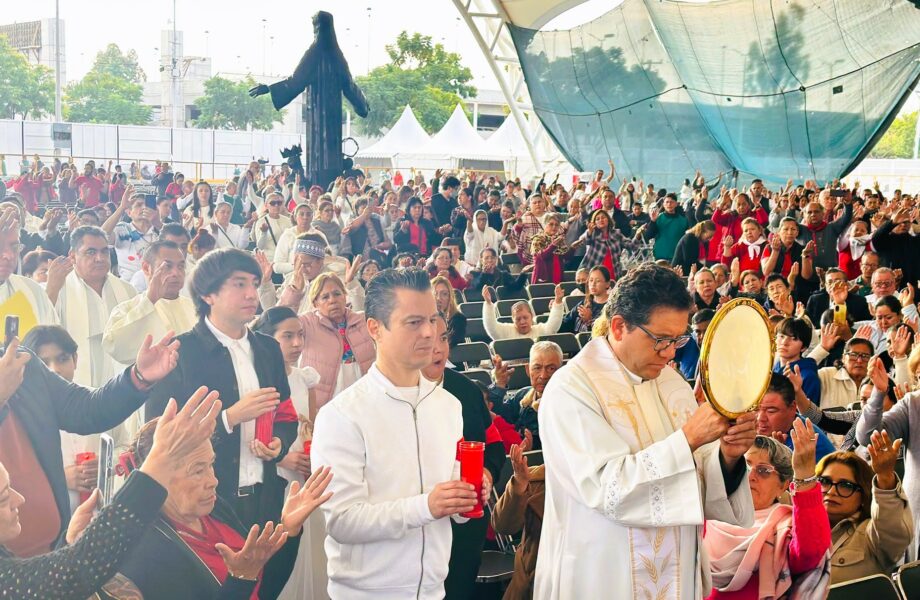
Almost five thousand Catholic laypeople from various dioceses across the country gathered on Saturday, November 21, in the velaria of the Feria de León to celebrate National Lay Day. The event, organized by the Episcopal Dimension for the Laity of the Mexican Episcopal Conference within the framework of the centenary of the Cristero resistance, had as its central moment the Eucharistic celebration presided over by the Apostolic Nuncio in Mexico, Joseph Spiteri.
The gathering took place under the motto “I die, but God does not die. Long live Christ the King!”, a phrase attributed to Blessed Anacleto González Flores, patron of Mexican laypeople. The day began with a Holy Hour, followed by the keynote lecture “Lay Identity Today” and a panel on religious freedom in a secular state, and included an act of consecration of the laity to Christ the King. Among the participants were the Archbishop of León, Jaime Calderón Calderón, and the Bishop of Colima, Gerardo Díaz, head of the Episcopal Dimension for the Laity.
As part of the celebration, the “Manifesto of Mexican Laypeople in the Face of Mexico’s Social, Political, and Economic Reality” was presented, a document drafted the previous day during the National Assembly of the Laity. The text begins with a firm statement: “Mexico is living a decisive moment.” It describes the violence that takes lives, the corruption and impunity that erode trust, the poverty that closes opportunities, and the polarization that divides. In response to this diagnosis, the laity declare: “We are willing to respond in a peaceful, democratic, and solidary manner.”
The manifesto upholds as a non-negotiable principle that “the dignity of the person must come before any political or economic interest.” “No one is propaganda. No one is just a vote. No one is a commodity or a statistic. The State exists to serve the person, never the other way around,” it states. It acknowledges progress, including the reduction of poverty, but warns that the open wounds cannot be ignored: seven million Mexicans remain in extreme poverty and twenty-three million were victims of a crime in a single year. “Mexico needs truth, not propaganda,” the document affirms.
Citing Pope Leo XIV, “It is not possible to remain disinterested spectators,” the laity list their demands: an authentic democracy and a rule of law that does not end at the ballot box, peace with justice born of truth and not of the silence of victims, an economy at the service of people, measured by families living with dignity, the defense of decent work; the strengthening of education, the family, and new generations, health and social protection for the most vulnerable, care for our common home, and the defense of migrants and indigenous peoples.
The text does not stop at denunciation. “We do not come only to demand. We come to commit ourselves,” it emphasizes. “Mexico will not change only from the government: it is up to us to organize, participate, and demand results.” It proposes understanding politics as service and as one of the highest forms of charity, and sowing a culture of encounter: “The adversary is not an enemy. Criticism does not justify humiliation. Firmness does not require hatred. Disagreement should not lead to exclusion.”
To make this commitment concrete, the manifesto assumes ten commitments, which it states as follows: forming responsible citizens, defending human dignity, building communities of peace, overseeing the exercise of power, promoting a solidarity economy, dignifying work, strengthening education, recovering democratic dialogue, caring for our common home, and turning proposals into results.
The conclusion is a declaration of rejection and hope: it does not accept that violence is destiny, that corruption is inevitable, or that indifference becomes the usual way of living together. Nor does it accept despair. “It is not enough to denounce injustices: we must help correct them. It is not enough to demand honesty: we must practice it. It is not enough to demand democracy: we must exercise it. It is not enough to ask for peace: we must build it.” The document ends with a call to move “from indifference to commitment, from confrontation to encounter, from indignation to organization, from spectators to protagonists.”
The presence of Nuncio Spiteri gave special relevance to the day. In statements to the media, the Holy See’s representative stressed that insecurity is a global problem and that believers cannot remain with their arms crossed. He insisted that prayer and personal conversion are the first weapons against violence, and left open the possibility of an eventual visit by Pope Leo XIV to Mexico, though without confirming dates.
The celebration also marks the beginning of the Jubilee Year for the centenary of the Cristero resistance granted by Pope Leo XIV. With the manifesto and the gathering in León, Mexican laypeople seek to translate the memory of the martyrs into an active and responsible presence in the country’s public life, convinced that human dignity admits no exceptions, peace requires justice, and democracy needs citizens.
Mexico needs us!, the document concludes. The response, according to its signatories, begins today, facing the nation and from the responsibility of citizenship.