


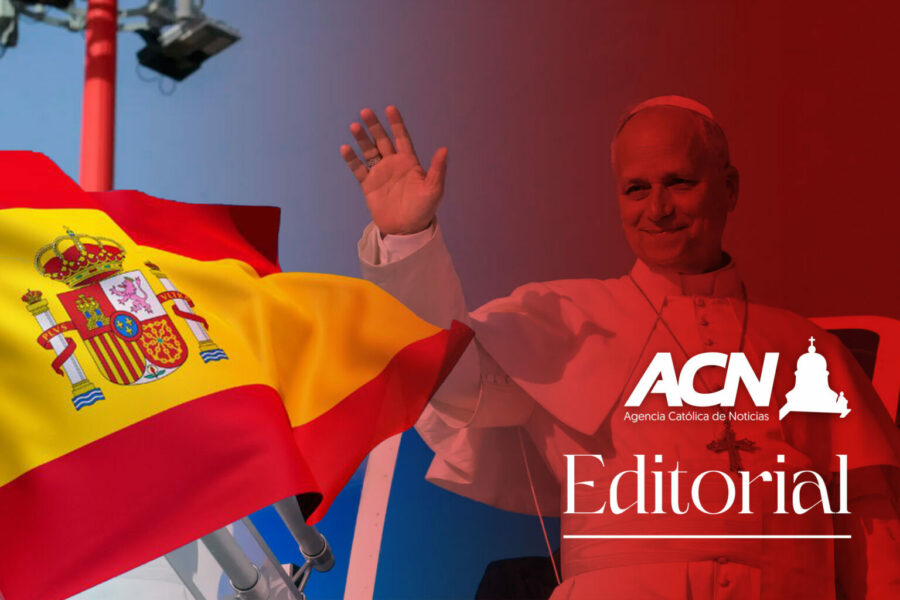
The decision of Pope Leo XIV to begin his apostolic journey in Spain, before any other Spanish-speaking nation, is not driven by diplomatic calculations or a geopolitical agenda. It is a deliberate act of memory and prophecy. By choosing the Iberian Peninsula as his first destination, rather than Mexico, Peru or Argentina, the Successor of Peter is pointing to the common roots of an identity that transcends borders: one that arose from the proclamation of the Gospel brought from Spain and that shaped, for better and forever, the soul of the Hispanic American nations.
Spain was the historical bridge through which not only a religion reached America, but an integral worldview. The missionaries did not limit themselves to baptizing. They founded universities, codified rights in the Laws of the Indies, erected cathedrals that still speak of eternity today and, above all, proclaimed the inviolable dignity of every person redeemed by Christ. This heritage is not a bygone chapter of history; it is the cultural, moral and spiritual substratum that continues to shape languages, festivals, family values and aspirations for justice throughout the continent.
Leo XIV embodies this bond in a singular way. Before becoming Pope he served as a missionary and bishop in Peru. During the prayer vigil with young people held on June 6 in Lima Square, Madrid, he recalled with gratitude those years, the witness of faith of a people “marked by many difficulties, yet full of hope”. While proclaiming the Gospel, he confessed, he himself was transformed by the life and faith of those brothers and sisters. By also evoking Saint Toribio de Mogrovejo, the Spanish bishop who in the sixteenth century evangelized Peru by studying local languages and defending the poorest against abuses, the Pope draws a fruitful circle: the roots that Spain planted in America now return, through a pontiff with a Latin American heart, to be rekindled at their original source.
The implications of this gesture for the Hispanic American world are deep and timely. At a time when certain ideological narratives seek to reduce Iberian evangelization to a mere colonial episode or “cultural imposition,” the visit of Leo XIV reminds us that that proclamation was, fundamentally, an act of humanization. It elevated the condition of the weak, sowed institutions of charity and generated a mestizo civilization in which the best of the indigenous cultures met the Christian novelty. To attempt to sever this collective memory is not progress; it is impoverishment. It weakens the moral springs that today resist relativism, utilitarian materialism and the new forms of dehumanization advancing both from the market and from the State.
In Spain itself the message takes on a prophetic tone. A country that for centuries exported faith, law and culture now faces accelerated secularization, with rates of religious practice among the lowest in Europe and legislation that openly contradicts Christian anthropology. The Pope’s presence in Madrid, on the eve of Corpus Christi, is not an exercise in mere folklore. It is a reminder that the greatness of a nation is measured not only by its economic influence or its international alignment, but by its capacity to generate persons “human as Christ is.”
Precisely there lies the core of the message that Leo XIV entrusted to the young people—and, by extension, to the entire Hispanic Church—during that vigil:
“Be human as Christ is, the perfect man, the Risen One who shares our history in every age. Cultivating this commitment, look to the Apostles, to the first Christians, inhabitants of a pagan world. Following their example, be missionaries of the Gospel before the material and spiritual poverties of our time, knowing well that our faith is a way of life fulfilled in charity (cf. Gal 5:6). This, dear young people, is the virtue that changes history more than any other. You can change history! Do it with love!”
These words do not propose a political program or a party slogan. They offer a way of life, charity made flesh in concrete service, which changes history more than any revolution or algorithm. The first Christians, a minority in a hostile empire, transformed their world with the consistent witness of love. Today, before the material poverties (exclusion, violence, forced migrations) and spiritual ones (loneliness, despair, relativism) that run through Mexico, Central America, the Andes or the Southern Cone, the same call resounds with urgency.
The visit of Leo XIV to Spain, therefore, does not end in Madrid, Barcelona or the Canary Islands. It is a milestone that reverberates from Lima Square toward Guadalajara, Lima, Bogotá or Buenos Aires. It reminds us that the Hispanic American world is not an archipelago of isolated countries, but a spiritual family born of the same proclamation. A family that, amid the crises of the present, is invited once again to be missionary of that charity which changes history because, as the Pope reminded us, we can change history. Let us do it with love.