


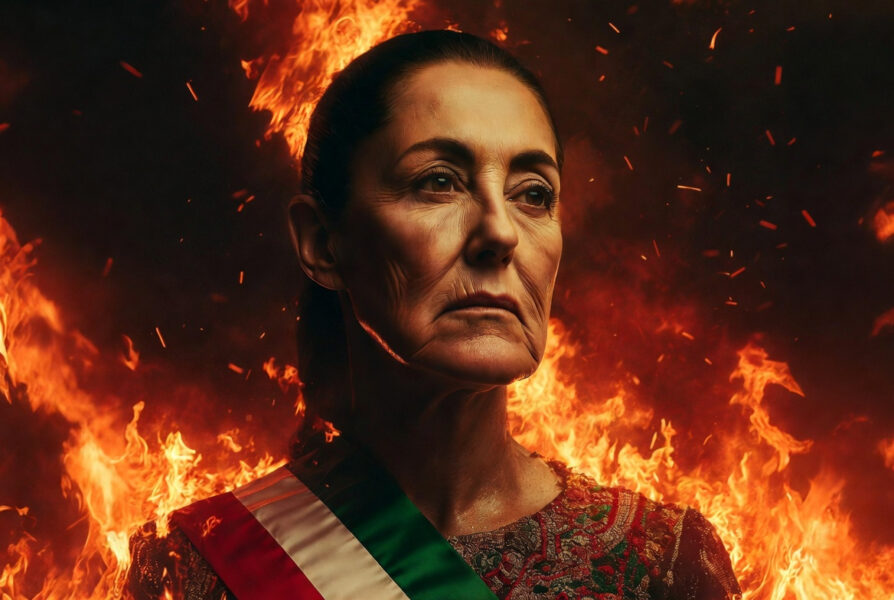
The report number 48 from Ciudadanía Católica y Análisis Social leaves no doubt: the first government of a female president of Mexico is heading toward a “resounding failure”. The 12-page document presents an economic, political, and security diagnosis that contrasts with the official discourse and poses three central questions: What distinguishes Sheinbaum’s government?, Is there a real difference between the 4T of Andrés Manuel López Obrador and the current administration?, and What can civil society do to change the course of the country?
The report opens with an ethical criterion of discernment taken from the encyclical Fratelli tutti (n. 235) by Pope Francis: “Those who seek to pacify a society must not forget that inequity and the lack of integral human development do not allow for generating peace. (…) When society abandons a part of itself on the periphery, no political programs or police or intelligence resources can indefinitely ensure tranquility. If we must start over, it will always be from the last.”
From this framework, the “Facts” section dismantles the official narrative. The Mexican economy grew only 0.5% in 2025, a figure lower than the 0.7% average of the previous seven years and well below the 2.3% annual rate recorded between 1994 and 2018, according to data cited from Forbes. Formal job creation plummeted: from 2022 to mid-2025, the annual variation in IMSS-affiliated positions tended toward zero. The report highlights that the “low unemployment” celebrated by Sheinbaum is misleading, as 55.9% of employed women work in the informal sector and 46.7% earn up to a minimum wage (INEGI, third quarter 2025).
BBVA Research projects a modest recovery in formal employment (2.1% to 2.7% annually 2026-2029), but starting from a very low base. Even including digital platforms (Uber, Rappi), the net creation of traditional jobs in 2025 was only 72 thousand, the lowest figure in five years. “The drop in formal employment in 2025 represents one of the most worrying setbacks,” the document quotes from El Heraldo de México.
Productive investment (public and private) as a percentage of GDP contracted to 18.8% in the third quarter of 2025, a level similar to that of the pandemic. Public debt rose from 10.5 trillion pesos in 2018 to 18.8 trillion in 2025 (53.1% of GDP), with an annual service of interest and commissions amounting to 1.75 trillion. “Public debt per Mexican exceeds 140,000 pesos,” recalls México Evalúa.
The external engine remains the T-MEC, whose review begins formally on March 16 in Washington and will define the economic future for decades. Trilateral trade exceeds 1.7 trillion dollars annually; Mexico depends on exports to the United States for more than 35% of its industrial GDP. However, sensitive issues (energy, autos, Rule of Law) are at risk due to the Judicial Reform, energy reforms, and the elimination of autonomous bodies.
In the “Analysis of trends and risks” section, the observatory concludes that the 4T “halted economic growth and drastically reduced it” by inhibiting private investment through abusive fiscal policy, destruction of the Judicial Power, and “sowing uncertainty and distrust.” On March 3, Juan José Sierra Álvarez, president of Coparmex, warned that six out of ten partner companies do not see a propitious moment to invest, a level comparable to the health crisis.
Politically, internal tensions grow between presidential power and the “real leader of the 4T” (implicitly López Obrador). Externally, relations with Donald Trump are straining, Mexico was rated an “enemy” on the level of Russia, China, and Iran due to narcoterrorism. The report points to a shift in security: U.S. pressure would have ended the “tolerance” toward cartels. “The big drug trafficking bosses and financiers of MORENA are liquidated or imprisoned in the US,” it states. The perception of “betrayal” of criminal financiers could generate cross-denunciations.
The electoral reform failed in Congress (neither PT nor PVEM supported it). Sheinbaum announced a constitutional “Plan B” to weaken state democracy and strengthen popular consultations with electoral content. The observatory qualifies it as a “lack of sanity”.
The central question of the report is Who governs Mexico? In the economy, Plan México lacks private backing due to lack of certainty (judicial reform, energy statism, fiscal crisis, protectionist risks with the United States and China). In security, the capture of “El Mencho” (CJNG) was operated by the Northern Command and Sedena, without informing Sheinbaum or Omar García Harfuch; Trump took credit for it. Operations exclude the federal Executive. In internal politics, nepotism initiatives, no re-election, SCJN, and CNDH clash against a “fence” led from Palenque (Rosa Icela Rodríguez, Jesús Ramírez Cuevas, Adán Augusto, etc.).
The official discourse, according to the Observatory, has reached “lies, falsehoods, and data alterations.” The economy depends 55% on the T-MEC (CCE), but does not grow or generate formal employment due to “ideological lines” that generate distrust. Governability worsens with “floor rights” demanded by cartels and highway robberies, linked to pacts with Morena politicians, according to denunciations by journalists and former secretary Julio Scherer Ibarra.
In the line of action, the Observatory calls to “foster better information among citizens” and for civil society, independent analysts, and real opposition parties to carry out an “ethical-social discernment” that leads to legal and electoral actions to “reorient the course of our Mexican Nation.”
The report closes with annexes, a chronology of the “El Mayo” Zambada case, links to El Financiero, Publimetro, Infobae, and the 2018-2024 economic balance from El Universal.
With this diagnosis, Report 48 from Ciudadanía Católica y Análisis Social is a Catholic call to discernment in the face of a reality that, according to its data and analysis, shows economic stagnation, growing labor precariousness, explosive debt, T-MEC risk, internal and external political fracture, and questioned governability. The question it leaves hanging is whether Mexico is indeed being governed from the National Palace or from somewhere else. The civil society, the bulletin concludes, has the floor.
The full report can be read here: