


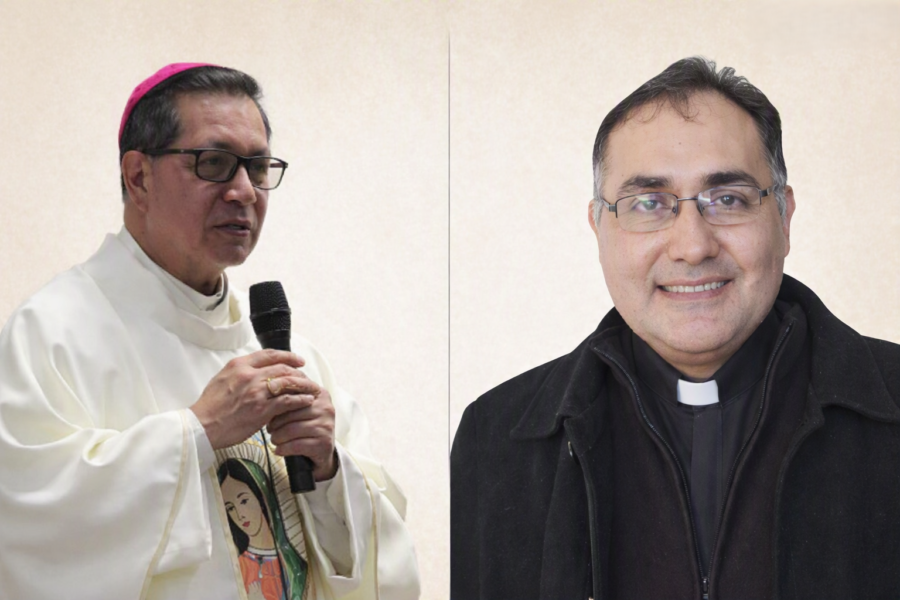
On the morning of September 29, 2026, the Mexican Episcopal Conference announced the acceptance of the resignations of bishops Florencio Armando Colín Cruz and Mario Espinosa Contreras, and the appointment of their successors, both coming from the auxiliary episcopate of Guadalajara, Héctor López Alvarado, new bishop of Puerto Escondido and Ramón Salazar Estrada for the diocese of Mazatlán.
The new bishops share a common trait, their formation and prolonged service in the Archdiocese of Guadalajara, one of the largest and most dynamic in the country. Héctor López Alvarado, born on December 13, 1973, completed his studies in Philosophy and Theology at the San José Seminary of Guadalajara between 1988 and 2001 and obtained a Licentiate in Dogmatic Theology from the Pontifical Gregorian University of Rome. Ordained a priest in 2002, his ministry developed in areas of formation, teaching, and parish life. He served as parochial vicar, formator, spiritual director, and professor of Theology, as well as pastor in two communities in Zapopan. His pastoral trajectory also includes governance responsibilities as dean in two deaneries of the archdiocese. In 2018, Pope Francis appointed him auxiliary bishop of Guadalajara, assigning him the titular see of Sereddeli. Since then, he has had a significant presence in the Mexican Episcopal Conference, where he has served as president of the Episcopal Commission for the Pastoral of Communication for two consecutive three-year terms; he is now appointed IV bishop of the diocese of Puerto Escondido.
For his part, Ramón Salazar Estrada, born on May 17, 1963, has solid formation in Moral Theology, a discipline in which he obtained a licentiate and doctorate at the Alfonsian Institute of the Pontifical Lateran University of Rome. Ordained a priest in 1993, his ministry has been characterized by teaching, spiritual direction, and accompaniment in various religious and educational communities. He has been a professor of Moral Theology at the Major Seminary of Guadalajara for more than two decades, chaplain in different monasteries and educational centers, and spiritual director in several formative institutions. In 2021 he was appointed auxiliary bishop of Guadalajara and titular of Bisarcio, receiving episcopal ordination at the Sanctuary of the Mexican Martyrs. He is currently responsible for the Episcopal Dimension of Life in the CEM (2024-2027) and the new bishop of the diocese of Mazatlán.
The appointments come at a relevant moment for both dioceses, which face pastoral and social challenges typical of growing regions, marked by economic contrasts and intense population mobility. The diocese of Puerto Escondido, erected in 2003, comprises a coastal strip of the State of Oaxaca characterized by its cultural diversity, the presence of indigenous communities, and accelerated tourist development. According to public data, the diocese serves an approximate population of 450,000 inhabitants, with nearly 30 parishes and a pastoral structure still in consolidation.
The diocese of Mazatlán, for its part, has a longer history. It was erected in 1958 and covers a strategic area in southern Sinaloa, marked by tourist, port, and commercial dynamism. With an estimated population of more than 900,000 inhabitants and around 60 parishes, the diocese has experienced sustained growth in recent decades. Its pastoral life is characterized by a strong presence of lay movements, a solid catechetical tradition, and a parish structure that serves both urban areas and rural communities.
The episcopal changes in Puerto Escondido and Mazatlán reflect a trend that has become visible in recent years, the appointment of bishops from dioceses with a strong formative tradition, such as Guadalajara, to assume responsibilities in local Churches that require pastoral consolidation, close accompaniment, and the capacity for dialogue with complex social realities. Both López Alvarado and Salazar Estrada arrive with trajectories marked by the formation of seminarians, theological teaching, and spiritual accompaniment, elements that can contribute to strengthening ecclesial life in their new dioceses.
From this blog, we wish the new bishops of Puerto Escondido and Mazatlán a fruitful episcopal ministry; congratulations.