


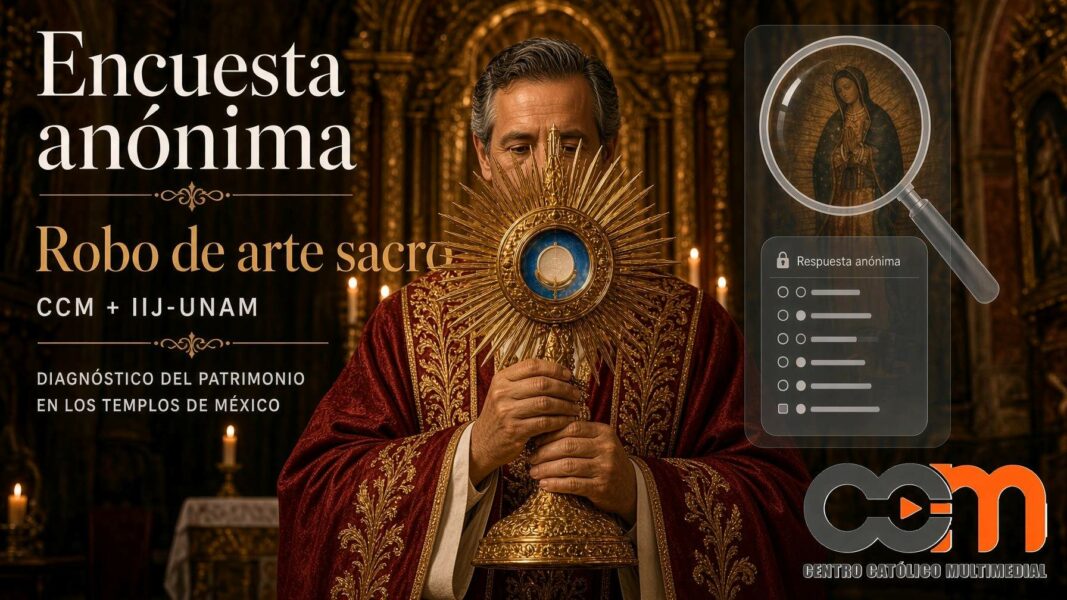
The Multimedial Catholic Center (CCM), through its Research Unit, and the Institute of Legal Research (IIJ) of UNAM have launched an anonymous study aimed at priests from the various ecclesiastical jurisdictions across the country. The instrument seeks to collect and update, first-hand, data on the incidence, vulnerability, and possibilities for preventing the theft of sacred art, a phenomenon that harms the historical, artistic, and spiritual heritage of communities and forms part of a broader violence against temples and places of worship.
The invitation, signed by Father Omar Sotelo Aguilar, director of the CCM, and Dr. Rita Sumano González, postdoctoral researcher at IIJ-UNAM, stems from an explicit recognition: priests are the main custodians of the heritage of their communities and, in many cases, face this responsibility with limited resources and scant institutional attention. The questionnaire, which can be completed in five to ten minutes via the link forms.gle/CuLzkQhWFBuE1fMWA, guarantees absolute anonymity; no parish names, addresses, or emails are collected, and the information will be used strictly for academic and statistical purposes. Participants are also invited to forward it to other priests and bishops.
The CCM Annual Report 2025 on the incidence of violence against priests and Catholic Church institutions in Mexico documents an average of 26 to 28 weekly incidents in temples and places of worship, equivalent to nearly 1,400 per year. In 2024, 1,350 specific attacks were recorded. Approximately 12% of the more than 11,000 temples in the country suffer at least one attack annually. In the 1990s, only four attacks per week were reported; the increase is nearly sevenfold.
Of these crimes, 84% correspond to common thefts, removal of religious objects, assaults on the faithful, “milking” of collection boxes or alms boxes, and theft of metals (bronze, copper) or sacred art considered a lucrative business. The report warns that sacred art—paintings, sculptures, liturgical objects, and relics from the colonial period or later—has been targeted especially in rural temples where security measures are almost nonexistent. However, there is no consolidated and specific report from the Ministry of Culture or those responsible for the cultural and religious heritage of the Mexican Episcopal Conference on this particular phenomenon.
Official data confirm both the magnitude and the dark figures. According to Interpol’s Stolen Cultural Heritage Database, consulted by various media outlets, between 1983 and November 2025, 158 art theft incidents in Mexico were documented, involving 430 stolen pieces; of these, 279 (64.8%) are religious in nature and 117 of the incidents occurred in temples. States such as Mexico, Tlaxcala, Puebla, Mexico City, and Hidalgo concentrate the highest recorded incidence.
A transparency request to INAH (folio 330018323000421), also documented by the media, revealed only 29 complaints of theft or looting of sacred art between 2015 and 2023, concentrated in seven states, with Puebla at the top (7 complaints). These official figures would represent only a fraction of the real phenomenon.
Looting is not just a heritage crime. It strips communities of symbols that articulate their cultural and spiritual identity. The recovery rate of pieces is historically low. Recent cases, such as the 2025 return of an 18th-century oil painting of St. Francis of Assisi to the parish of San Francisco Mazapa in Teotihuacán, stolen in 2001, illustrate both the possibilities of international cooperation and the exceptional nature of recoveries.
The CCM’s 2025 report recommends promoting a National Observatory on Violence against Ecclesiastical Heritage, accelerating the digitized inventory of assets and sacred art, establishing immediate response protocols, and training clergy in heritage registration. The IIJ-UNAM and CCM survey fits precisely into this logic: generating updated and disaggregated data from the direct experience of those at the forefront of the temples.
The methodological design prioritizes participants’ peace of mind. By not requesting personal or precise geographic identifiers, it reduces fear of retaliation. The analysis will be statistical and aggregated, allowing identification of patterns of incidence and vulnerability by regions or types of venues without compromising specific individuals or communities.
The participation of ministers is key so that the study does not remain limited to incomplete official figures or reports that reach the media, but instead reflects the everyday reality of Mexican temples. As the invitation states, the goal is to make this reality visible “from the direct experience of those at the forefront of the temples, in order to provide useful data for improving prevention and protection protocols.”
The launch of the survey comes at a time when the CCM’s Annual Report 2025 has already documented the persistence and mutation of violence against the sacred. Updating knowledge on the theft of sacred art is not an isolated academic and statistical exercise; it is a condition for understanding and protecting national heritage and reducing the impunity that allows temples and communities to continue being stripped of their cultural and spiritual legacy.
To respond to the survey, click on the following link: