


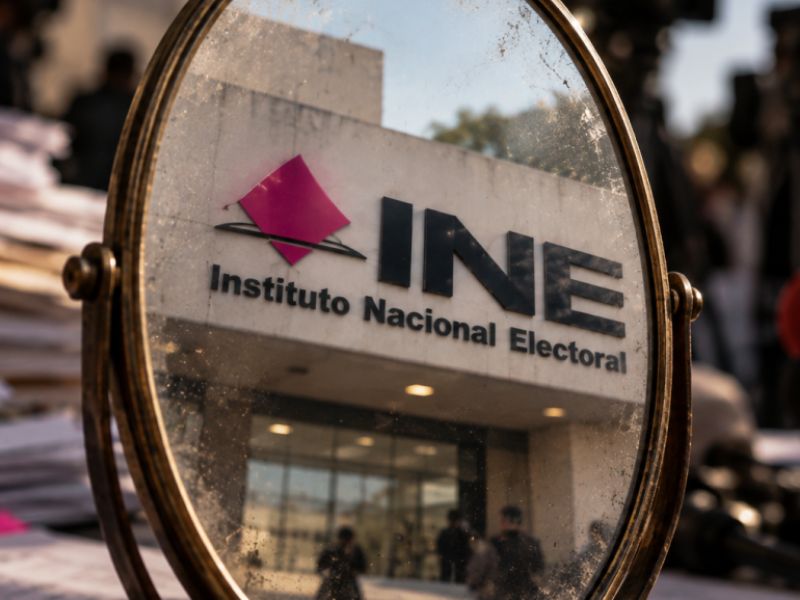
The crisis of the National Electoral Institute is not limited, according to the most recent report by Catholic Citizenship and Social Analysis, to the allegations of corruption related to the management of Guadalupe Taddei. The central problem would be deeper: the loss of the citizen character, autonomy, and credibility of the institution responsible for organizing electoral processes in Mexico.
The report, published on November 23, 2026, as number 82 of the series Elements for Discernment, is titled The Crisis of the National Electoral Institute (INE), a Critical Moment for the Self-Proclaimed Fourth Transformation. Its analysis is based on two questions: Where do the current problems of the organization come from, and what can citizens do to restore confidence in the INE and, with it, in democracy?
The political interpretation of the document is forceful. It maintains that the crisis is part of a strategy aimed at weakening the so-called “citizen INE” and subjecting electoral institutions to the interests of the Government and Morena. The report links this purpose to the “Plan C” promoted by Andrés Manuel López Obrador and considers that its continuity seeks to expand political control over the INE and the Electoral Tribunal of the Federal Judiciary.
These statements constitute the thesis of the report and should not be confused with judicial resolutions or determinations by an investigative authority. The document supports them in its reading of legal reforms, appointments, electoral decisions, and journalistic publications cited throughout the text.
One of the axes of the report is the crisis caused by the allegations against Guadalupe Taddei and other directors of the Institute. As part of its argument, it reproduces journalistic information according to which, during two years of her administration, the INE awarded 96 percent of more than 13,300 contracts for services, leases, and acquisitions through direct adjudication. The amount of those contracts exceeded 2,829.7 million pesos.
The analysis considers that the damage is not limited to possible personal or administrative responsibilities. In its view, the allegations have affected the essential element on which electoral authority rests: public trust. To underscore the significance of the problem, it recalls that Article 41 of the Constitution recognizes the INE as an autonomous public body and establishes certainty, legality, independence, impartiality, maximum publicity, and objectivity as guiding principles of the electoral function.
Another concern highlighted is the incomplete integration of the General Council. The report warns that maintaining it with ten members, instead of the eleven required by the Constitution according to its exposition, could cause ties and produce “deadlock” or “paralysis” in the institution’s legal procedures. The risk becomes especially relevant, it argues, because the 2027 electoral process is already underway.
The document recovers the statement of November 18, 2026, signed by José Woldenberg, Luis Carlos Ugalde, Leonardo Valdés, Lorenzo Córdova, and other former councilors. In that declaration, they ask the Legislative Branch to initiate as soon as possible the appointment of the new president of the INE and to conduct it in accordance with the Constitution. The signatories propose that knowledge, capacity, competence, and especially the trust of the political forces represented in Congress should prevail.
The report shares its defense of dialogue and agreement as ways to recover institutional credibility. It also includes the proposal to reconfigure the General Council and to reach a consensus appointment, although it notes that this possibility was ruled out by Morena and Ricardo Monreal. In its interpretation, a decision determined exclusively by the parliamentary majority would not resolve the crisis of confidence.
Another factor highlighted is the October 2024 reform to Article 45 of the General Law of Electoral Institutions and Procedures. According to the report, the modification empowered the presidency of the INE to directly appoint heads of executive directorates and technical units, without the approval of the plenary of the General Council. The document interprets this concentration of powers as part of the weakening of internal checks and balances.
The analysis extends its questioning to the behavior of the INE and the Electoral Tribunal in decisions related to the integration of Congress, electoral infractions attributed to the ruling party, and allegations about the intervention of organized crime in various processes. In all these points, the article must maintain an indispensable precision: these are accusations, assessments, and conclusions formulated by the report, not facts whose independent accreditation emerges from the PDF itself.
The consequences identified by the document focus on the loss of credibility of the electoral arbiter, the weakening of its autonomy, and the risk this represents for the legitimacy of the elections. The report maintains that if citizens and political forces stop trusting the institution, a basic condition for the functioning of democracy deteriorates.
Faced with this scenario, the proposed solution involves informed citizen participation in the 2027 elections and the organization of mechanisms for observation, oversight, and alternative citizen counting of results, with the collaboration of opposition parties, civil organizations, media outlets, and national and international specialists.
Its line of action calls on the Chamber of Deputies to renew the structure of the INE, restore its independence from the ruling party and any other political force, renew its personnel, and recover the professional electoral career service developed by the IFE and the INE. The conclusion of the report is unequivocal: overcoming the crisis requires restoring institutional autonomy, rebuilding public trust, and returning to citizens an effective participation in the defense of electoral integrity.
The analysis can be read here: