


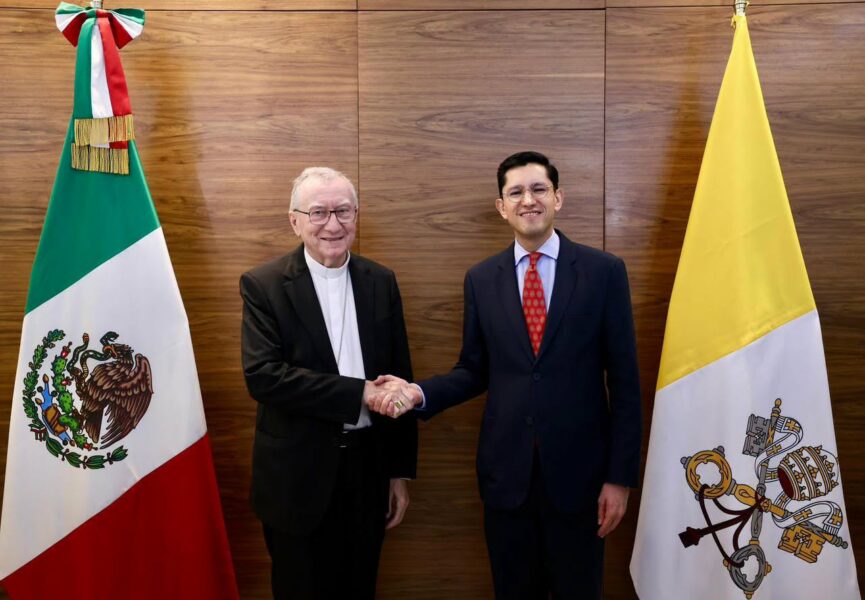
Pietro Parolin, Secretary of State of the Holy See, arrived on the night of Tuesday, August 4, in Mexico for an official three-day visit (from August 4 to 6) aimed at strengthening diplomatic ties between the Vatican and the Mexican State, on the eve of the anniversary of the reestablishment of relations in 1992. The agenda, confirmed by the Conference of the Mexican Episcopate (CEM), includes meetings with federal authorities, leaders of the National Dialogue for Peace and the Presidency Council of the CEM, as well as a solemn Mass at the Basilica of Guadalupe.
The first official activity was the dinner hosted by the Secretary of Foreign Affairs, Roberto Velasco Álvarez, at the headquarters of the Ministry of Foreign Affairs. The meeting, framed by the SRE within the shared tradition of support for the peaceful resolution of disputes, international law, and multilateralism, serves as a prelude to higher-profile political meetings. This Wednesday, August 5, Parolin will hold a meeting with President Claudia Sheinbaum Pardo at the National Palace. According to official reports and those from the CEM, meetings with the Secretary of the Interior, Rosa Icela Rodríguez, are also planned. At 12:00 p.m., he will preside over the Eucharist at the Basilica of Guadalupe, the spiritual heart of Mexican Catholicism. In the afternoon, he will have a private lunch and a meeting with the leaders of the National Dialogue for Peace, a space for civil society, the Church, and experts that for years has worked to understand the causes of violence and rebuild the social fabric. On Thursday, August 6, he will conclude with a lunch with the Presidency Council of the CEM before returning to Rome.
In its statement, the CEM emphasized that the cardinal’s presence “fosters the closeness of the Holy See with the people of Mexico, demonstrates the Catholic Church’s commitment to building peace, and rekindles in our hearts the longing to have the direct presence and blessing of His Holiness in our Mexican homeland.” The episcopal institution took the opportunity to reiterate the invitation to Pope Leo XIV to visit the Virgin of Guadalupe and Mexico. The longing is first directed toward the horizon of the 500th anniversary of the Guadalupan apparitions (2031), a jubilee that is already generating theological and pastoral preparations in the country and which the pontiff himself has mentioned in recent messages as a model of inculturation and encounter.
Parolin’s visit is not an isolated event. The cardinal knows the Mexican terrain well. In June 2021, he presided in Izamal, Yucatán, over the episcopal ordination of Fermín Sosa Rodríguez, appointed apostolic nuncio to Papua New Guinea. During that stay, he celebrated Mass at the Basilica of Guadalupe, met with then-President Andrés Manuel López Obrador, and received from Mexico City Mayor Claudia Sheinbaum the recognition of “Distinguished Guest” of Mexico City. A year later, in April 2022, he returned to ordain Javier Herrera Corona and appoint him nuncio to Congo and Gabon. On that occasion, within the framework of the 30th anniversary of the reestablishment of diplomatic relations, he toured with López Obrador and Sheinbaum the replica of the Sistine Chapel installed in the capital’s Zócalo, a symbolic gesture of cultural and diplomatic rapprochement.
These previous visits illustrate a line of continuity in Church-State relations that, after decades of historical tensions, was consolidated from 1992 onward; it is also worth noting that in recent days, the Mexican Episcopate has commemorated the centenary of the Cristero War. Parolin, who had already resided in Mexico in the late 1980s and early 1990s as secretary of the apostolic delegation, has insisted in previous messages on the need to overcome polarization, promote positive secularism, and build a culture of fraternity and peace. In the current context, the meeting with the National Dialogue for Peace takes on special relevance; the organization has put on the table issues such as the crisis of the disappeared, domestic violence, and the recomposition of the social fabric—matters that, according to sources close to the agenda, could be addressed in private conversations.
The presence of the Vatican’s number two comes at a time of crossed expectations. On one hand, the Sheinbaum government has insisted since 2025 on the desirability of a visit by Pope Leo XIV to project a message of peace in a predominantly Catholic country. On the other, the Episcopate sees in this stop by Parolin—who arrives after a visit to Guatemala for the 90th anniversary of diplomatic relations—a concrete opportunity to reiterate the invitation and present the pastoral and peacemaking work that the Mexican Church is carrying out. Although no date has been announced for an eventual papal trip, the language of the CEM is unequivocal: the Secretary of State’s visit “rekindles” the longing and brings closer the possibility that Leo XIV may one day walk the Tepeyac.
The agenda for these three days reflects the centrality that the relationship between the Holy See and Mexico continues to hold. Parolin is not only the main architect of Vatican foreign policy; he is also an interlocutor who knows firsthand the Guadalupan devotion, the country’s social wounds, and the complexity of its secularism. His Mass at the Basilica of Guadalupe, recently in the eye of the storm following allegations of financial and economic scandals, will be the moment of greatest spiritual depth of the visit, and the meeting with Sheinbaum, the one of greatest political weight. Between these two poles, the balance of a relationship that, 34 years after its formal reestablishment, continues to seek paths of dialogue, peace, and mutual closeness will once again be expressed.
The CEM closed its statement with a prayer: “May God guide his steps on this visit and allow us to strengthen the path toward achieving an unarmed and disarming peace.” In that longing, as Mexican as it is evangelical, the profound meaning of this brief agenda after his stop in Guatemala is summarized.