


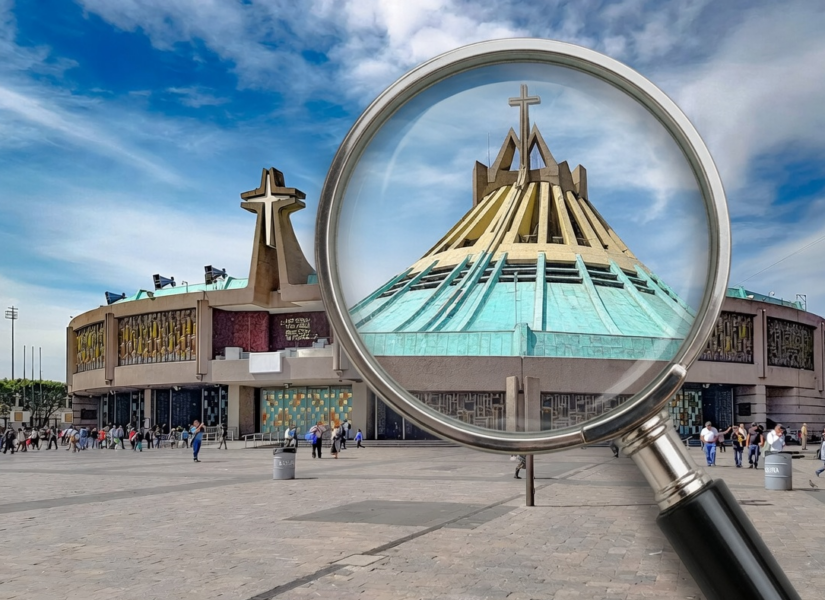
After the recent reinstatement of father Efraín Hernández Díaz to the rectorship of the Basilica of Guadalupe, attention has been drawn to the mention by Archbishop Carlos Aguiar Retes of an audit completed on the finances of the Insigne y Nacional Basílica de Guadalupe, placing one of the world’s most important Marian shrines at the center of public attention. Amid previous questions about the administrative management of the site, the involvement of the internationally renowned firm Deloitte would, in principle, represent a significant step toward accountability and the generation of trust among the faithful, the clergy, and society.
The confirmation of the firm’s name came from the archbishop himself, in a segment of a meeting whose dissemination circulated and has been fully verified and is reproduced below:
Involving the name of this company is no amateur matter and could have serious consequences. However, it would not be the first time Aguiar Retes has bandied about the names of firms that audit everything, without concrete results, and especially when he claims that “they do it all for free.” At the beginning of his episcopal government, he swore to an Ernst&Young audit of the finances of the Archdiocese of Mexico and each of its parishes; however, nothing was ever heard of it, not even a brief report.
Deloitte is one of the world’s leading firms in professional services for audit, assurance, consulting, tax, and financial advisory. It is part of a global network of independent member firms connected under the name Deloitte Touche Tohmatsu Limited (DTTL), known as Deloitte Global. In Latin America it operates through Deloitte Spanish Latin America, an integrated structure covering 16 countries, including Mexico, and providing audit and assurance services through local legal entities subject to the regulations of each jurisdiction. Its reputation is based on issuing independent opinions on financial statements, with a strong emphasis on quality, ethics, and service to the public interest, as detailed in its own Transparency Report on Audit Quality 2024.
According to information from the company on internet sites, the financial audit carried out by Deloitte follows a rigorous and standardized process, designed to provide reasonable—though not absolute—assurance that the entity’s financial statements faithfully reflect its patrimonial, financial, and economic situation. The process begins with a planning phase in which the auditors gain a deep understanding of the business, identify risks of material misstatement (whether due to fraud or error), and design specific procedures. Subsequently, they evaluate the organization’s internal control system to determine its reliability and effectiveness.
Next, the professionals perform detailed substantive tests, obtain external confirmations from third parties such as depositories or custodians, verify the actual existence of assets, contrast valuations with observable market sources, and thoroughly review supporting documentation. One of the most relevant elements is the identification and communication of the key audit matters, those risks considered most significant.
Once the tests are completed, the auditors evaluate the overall presentation of the information, the reasonableness of accounting estimates, and the consistency of the management report with the financial statements. Finally, they issue the Independent Auditor’s Report, the culminating document in which they declare their ethical and professional independence, confirm compliance with current auditing standards, and express a clear opinion.
This technical rigor does not operate in a vacuum. Deloitte backs it with a robust institutional framework of quality and ethics, detailed in its Transparency Report on Audit Quality 2024 for Deloitte Spanish Latin America. The document underscores the firm’s commitment to the public interest, integrity, and professional excellence. Among its pillars are absolute independence—prohibiting services incompatible with the audit—, the existence of a quality governance body, independent quality reviews of engagements, mandatory rotation of partners and key professionals, and continuous monitoring both internal and external.
The firm also promotes a culture of constant professional skepticism and uses advanced technological tools such as the Deloitte Omnia platform, which improves efficiency, collaboration, and security controls in audits, protecting data and ensuring segregation of duties. All of this is aimed at raising professional standards and generating confidence in markets and institutions.
Applied to the specific case of the Basilica of Guadalupe, an audit conducted under these parameters would have a potentially revealing impact. It could provide objective certainty about the handling of collections, donations, assets, and financial resources of one of the most visited religious sites on the planet. A clean and public opinion would help dissipate doubts, strengthen the credibility of the administration before the millions of faithful who visit the shrine each year, and align ecclesiastical management with the principles of transparency and accountability that today’s society demands.
However, to date the corresponding report has not been made public. Aguiar Retes said that nothing negative had been found; that therefore places him under obligation to demonstrate, first to the CEM and the nunciature, that the Basilica of Guadalupe under the management of father “Efra” has impeccable finances and a well-protected patrimony. The mere mention of the audit by the archbishop, without accompanying it with the complete documentation—including the independent opinion, the key matters identified, and the detailed conclusions—creates a notable contrast with Deloitte’s usual practice of issuing accessible and exhaustive reports. This absence keeps alive the questions previously raised by the Guadalupe chapter and leaves open the possibility that the results have not been fully communicated to internal bodies or to the public. And another question is valid: How much did it cost? Or will he again claim that they are faithful who did everything out of “love for the Church”?
In a broader context, Deloitte’s participation in the Basilica of Guadalupe could set a relevant precedent for the Church in Mexico. Religious institutions, which manage resources of a fiduciary and donative nature, face increasing demands for transparency. A high-level audit not only meets technical standards, but also embodies ethical values of honesty and service to the common good, consistent with the Church’s social doctrine and the synodality promoted in recent years, but which seems to be merely a cliché or corporate slogan of Archbishop Aguiar to save face.
The expectation now lies in the Archdiocese of Mexico and Archbishop Carlos Aguiar Retes taking the logical next step: publishing the audit results in full. Only then will Deloitte’s involvement fully serve its purpose and contribute to restoring or strengthening the faithful’s trust. Ultimately, beyond the numbers and technical opinions, an audit of this nature represents a historic opportunity to demonstrate that the management of ecclesiastical assets can—and must—be governed by the highest standards of professionalism, ethics, and accountability.
The Basilica of Guadalupe is not only a spiritual center; it is also an institution with a complex and significant economic responsibility. That a firm of Deloitte’s caliber has participated in its financial review opens a window of opportunity for transparency to cease being mere rhetoric. The true impact of this audit will ultimately be measured by the willingness to make its results public and by the Church’s capacity to use them as an instrument of improvement and service to dispel all doubt. And if the archbishop does not do so, in keeping with his word, then he will be in serious trouble.