


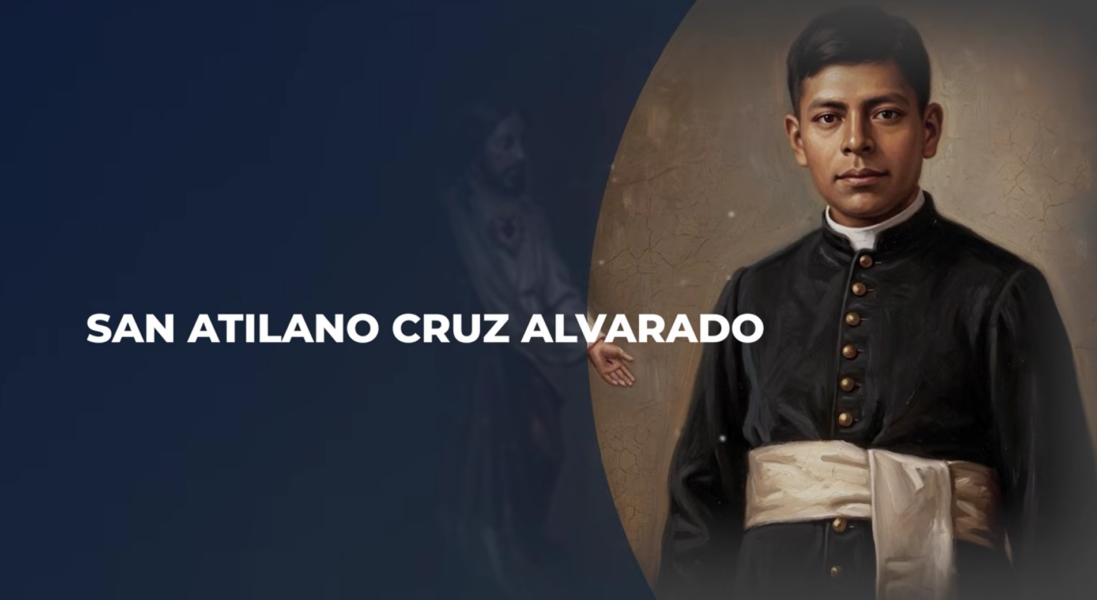
The catechetical series Witnesses of the Kingdom, promoted by the Mexican Episcopal Conference in the context of the centenary of the Cristero resistance, has added a new chapter dedicated to the figure of St. Atilano Cruz Alvarado. On this occasion, the Bishop of Cuernavaca and president of the Mexican Episcopal Conference, Ramón Castro Castro, presented the reflection titled “Remaining Faithful to the Truth”, focused on the life and witness of the young priest from Jalisco, whose brief yet intense existence became an example of evangelical fidelity unto martyrdom.
During the catechesis, the prelate began with one of the most demanding teachings of the Gospel, Christ’s invitation to become like children in order to enter the Kingdom of Heaven. From this premise, he explained that St. Atilano Cruz embodied in an extraordinary way that attitude of trust, simplicity, and abandonment in God. Although he died young and already a priest, his life was marked by a purity of heart that enabled him to face religious persecution without losing joy or hope.
The president of the CEM recalled that St. Atilano was born in 1901 in Ahuetita de Abajo, in the municipality of Teocaltiche, Jalisco. Coming from a humble family dedicated to agricultural work, he entered the seminary at the age of fifteen, when religious persecution was already severely affecting priestly formation. His training had to take place in secrecy and amid constant risks, as formation centers were discovered more than once by the authorities, leading to the arrest of seminarians and formators. However, far from being overcome by fear, the young man maintained a joyful and trusting attitude that those who knew him described as that of a playful, singing person, close to others.
Ordained a priest in 1927 in a ravine, due to the impossibility of holding public ceremonies, he exercised the priesthood for only one year. That short period was enough for him to live pastoral service with intensity, sharing the difficulties of persecuted communities and accompanying the poorest.
The catechesis recalled that on July 1, 1928, he was martyred at the ranch of Las Cruces together with his pastor, St. Justino Orona. For the bishop, the key to his witness lies in having turned his entire priestly existence into an offering marked by poverty, sacrifice, and love for others. “He lived his only year of ministry as an offering”, the prelate emphasized, evoking the unwavering trust the young priest maintained even in the face of death.
Another central moment of the reflection was the reference to St. Atilano’s response when asked if he feared the federal troops who were pursuing him. “I fear God’s justice more than that of the federals”, the priest then affirmed. For Ramón Castro, this expression summarizes the hierarchy of values that guided his life: an existence centered on God rather than on material interests or the pursuit of human security.
The bishop linked this teaching to contemporary challenges, recalling the warning issued by Pope Leo XIV about the current tendency to identify happiness exclusively with economic prosperity or limitless pleasure. In the face of this logic, he pointed out that St. Atilano lived an authentic spiritual countercurrent characterized by austerity, simplicity, and the joy of knowing himself to be a child of God.
Likewise, he highlighted that the holiness of the Jalisco martyr was not manifested in great visible works, but in daily fidelity. He loved the poor, administered the sacraments, and remained with his pastor until the end, becoming an example of silent service and generous self-giving. Such was the impression he left among his contemporaries that, upon hearing the news of his martyrdom, the bishop who had ordained him exclaimed: “They killed an angel”.
The reflection on St. Atilano is part of a broad catechetical journey that, throughout this year, has recovered the memory of martyrs, priests, laity, and witnesses of the faith linked to the period of religious persecution in Mexico. The series has addressed topics such as the Christian meaning of martyrdom, perseverance, courage, forgiveness, prayer, hope, freedom, the holiness of marriage, and daily self-giving as a path of following Christ.
Among the figures remembered are St. José Sánchez del Río, St. Toribio Romo, St. Miguel de la Mora, St. David Uribe Velasco, St. Luis Batis Sáinz, Blessed Miguel Agustín Pro, Blessed Anacleto González Flores, the first Mexican saint María de Jesús Sacramentado Venegas, and various martyrs and witnesses of the religious persecution.
Each chapter has sought to present concrete virtues capable of illuminating the lives of believers today, showing that holiness can be embodied both in heroic sacrifice and in daily fidelity. The published chapters are:
- “What does it mean to be a martyr?”, which distinguishes Christian martyrdom—an act of perfect charity according to St. Thomas, which gives life, forgives, and does not hate—from fanaticism or terrorism, citing Benedict XVI: the martyr is a man transformed by the love of God.
- The one dedicated to St. Sabás Reyes Salazar, “martyr of perseverance,” vicar of Tototlán who, bound for three days without water or food and with his palms burned, was shot on April 12, 1927, without renouncing his people or his faith.
- “Called to be brave for Christ”, about St. José Sánchez del Río (“Joselito”), the fourteen-year-old boy from Sahuayo, patron of youth, who with the soles of his feet flayed cried out “Long live Christ the King!” until the end.
- “The forgiveness that heals and liberates”, centered on St. Toribio Romo González, martyr of forgiveness and patron of migrants, who offered his blood for the peace of the Church and died repeating “Father, forgive them.”
- “Prayer, the strength of the witness”, about St. Miguel de la Mora, protomartyr of Colima, who before the firing squad took out his rosary and prayed; his strength came from interiority.
- “Inner peace that transforms the world”, about St. José Isabel Flores Varela, a man of prayer and the Eucharist who, betrayed and tortured, maintained serenity until the end.
- “Hope: a sure support in the storm”, about St. David Uribe Velasco, who rejected a “Mexican church” separated from the Pope and preferred to be anointed with his own blood.
- “Evangelizing audacity”, about Blessed Miguel Agustín Pro, the Jesuit who, with arms outstretched, cried out “Long live Christ the King!” and whose photographs ignited the faith.
- “Being a witness”, about Blessed Anacleto González Flores, a layman, lawyer, and catechist, patron of Mexican laity, a model of peaceful resistance and the formation of consciences.
- “Freedom to serve, freedom to love”, about St. Luis Batis Sáinz and the laymen Manuel Morales, David Roldán, and Salvador Lara, who chose to remain together until heaven.
- “Marriage: a vocation to perfect love”, about Blessed Salvador Huerta Gutiérrez, a mechanic whose family was a domestic church.
- “The strength of God in weakness”, about Blessed José Trinidad Rangel, a fragile and scrupulous priest whose holiness reveals that strength is not of iron, but of God.
- “Witnesses without shedding blood: the holiness of daily self-giving”, about St. María de Jesús Sacramentado Venegas (Mother Naty), the first Mexican woman canonized, a model of white martyrdom in daily service.
- “Strength in trial”, about Tranquilino Ubiarco, a priest, of whom 99 years of his martyrdom were commemorated when he was hanged in Tepatitlán, Jalisco.
- “Patience and Strength of the Witness”, about the lay blessed Luis Magaña Servín, a worker by trade and martyr of Arandas, Jalisco.
- “Purity of heart to see God”, St. Julio Álvarez Mendoza and St. Agustín Caloca Cortés, martyred priests.
- “The gift of oneself, the holiness of sacrifice”, the first chapter dedicated to a laywoman, the Servant of God María de la Luz Camacho González, a catechist and member of Catholic Action, murdered while defending the parish of St. John the Baptist, Coyoacán.
- “Long live Christ the King, echoes of a brave faith”, on the occasion of the solemnity of Christ, King of the Universe, and the opening of the Jubilee Year on the centenary of the Cristero War.
The catechesis dedicated to St. Atilano Cruz Alvarado concludes by taking up the evangelical invitation to live with a clean and trusting heart. In the framework of the centenary of the Cristero resistance, the figure of this young priest emerges as a reminder that fidelity to the truth and commitment to the common good can be built through simple, persevering gestures deeply rooted in faith.