


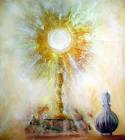
Tantum ergo Sacramentum
Veneremur cernui;
Et antiquum documentum
Novo cedat ritui:
Praestet fides supplementum
Sensuum defectui.
Fresh morning in Rome, a timid sun illuminates the grand façade of St. Peter’s and the melody of Bernini’s fountains brightens the morning stroll. Today we celebrate the feast of Corpus Christi in the Vatican, and on Sunday the celebration will be transferred in Rome; this year the Pope will be in Madrid, where he will preside over the procession.
Wednesday audience.
Rain was threatening, attendance was decent; we continue with the obelisk as the limit and hope it lasts. Continued the series of catecheses dedicated to the Documents of the Second Vatican Council, and in particular the second series, begun in recent weeks, which focuses on the Constitution on the Sacred Liturgy, Sacrosanctum Concilium. Today’s catechesis presented a third piece, entitled “The rite, the sign, the symbol.” The Pope invited reflection on some of the constitutive elements of sacred liturgy: Christian rites are not an external cloak of the sacramental mystery, nor a set of arbitrary ceremonies, but the ecclesial mediation through which the divine gift reaches humanity. The rite gives form to the liturgical action and, through it, to the very life of the believer, provided the latter does not remain a silent and detached spectator but participates with his whole being—body, mind and heart.
Leo XIV contrasted the logic of the rite with our individual inclination toward spontaneity. The solemn sobriety of its rhythms interrupts frenetic activity and returns us to what is essential: in the rite we experience “a logic of generosity,” a pause that regenerates the heart and teaches us to live in a time inhabited by the Holy Spirit, far from productive calculations. He then carefully distinguished between sign and symbol, terms often used as synonyms. A sign, he clarified, becomes symbolic when it does not refer to a simple idea but to an entire system of meanings and values: thus the sprinkling of holy water revives awareness of the gift of baptism and of adherence to new life in Christ.
To conclude, Leo XIV indicated that the first task of liturgical formation is to make man “once again capable of symbols.” Hence the call to cultivate the beauty of celebrations with a refined hand and without arbitrariness, and to commit to an authentic mystagogy: the experience of a living and devout liturgy remains the best resource for rekindling that openness to the encounter with God which, in the logic of the Incarnation, involves man in his totality—spirit, soul and body.
After the summary in different languages and the greetings to the various groups, the Holy Father addressed the Italian faithful, the young, the sick and the newlyweds, recalling the upcoming Solemnity of the Most Holy Body and Blood of Christ, which we will celebrate tomorrow here in the Vatican. In the Eucharist, he said, we contemplate Jesus, bread broken and given for each one of us; and he encouraged them to keep alive the public witness of faith expressed in the processions with the Blessed Sacrament that these days animate the streets of many cities.
The earthquake in Vatican media.
It is, without doubt, the most significant appointment so far of Pope Leo XIV’s pontificate, one before which it is impossible to remain indifferent. María Montserrat Alvarado is the current president and chief operating officer of EWTN News, the news division of the Eternal Word Television Network. The appointment was announced on 2 June by the Holy See Press Office; Alvarado will assume the post on 1 November. “I received the news with deep gratitude, humility and trust in the Lord.”
Michael Warsaw, president and chief executive of EWTN, expressed satisfaction with the appointment: “Montserrat’s trajectory in international media, public affairs and relations with the Church has helped shape EWTN’s work at a crucial moment: the transition toward greater interaction with the digital space.” The network “offers her its prayers, its support and the full backing of the EWTN family as she undertakes this important mission in the service of Pope Leo XIV and his pontificate.”
A displaced Paolo Ruffini, the outgoing prefect, who will turn 70 next October, said he has known Alvarado “for some years” and that he will work closely with her in the coming months “in the spirit of communion that unites us in the Church.” Yesterday was a heart-stopping day at the Piazza Pio headquarters; the appointment is news that the entire current management, whose succession plans have been completely ignored by the Pope, is struggling to digest. The entire Macarrist tribe considers Mother Angelica’s group the work of the devil, a definition coined by Pope Francis himself. Even many bishops, following Pope Francis’s diabolical perceptions, suppressed EWTN programs in their dioceses, and now we suppose they will look for someone to blame and will joyfully resume the diabolical programs.
Almost five months remain until the installation—plenty of time, and we will see how affections are repositioned. The Vatican is full of generous closets with every variety of jacket the human being is capable of wearing. There are those eager to resume a path, both technical and doctrinal, for Vatican media. Let us hope Alvarado can exercise the necessary freedom and cut the umbilical cord with the Secretariat of State. We suppose that by November we will have a new Secretary of State and the matter will be settled. The Dicastery for Communication is a solemn name but without real content; the media operate on their own and are complicated parcels of power to unify; it is another of the great challenges: achieving truly effective and coordinated Vatican communication.
Mother Angelica enters the Vatican.
Mother Angelica, a cloistered Poor Clare nun, founded a large communications group and, during the twelve years of Pope Francis’s pontificate, was repeatedly accused of conspiring against the Pope. Marco Damilano recently criticized EWTN in his book “We Are the Times,” written to support the thesis of continuity between Francis and Leo XIV.
Leo would probably have made this change anyway, but the age factor made it easier, and therefore, knowing that Ruffini would retire naturally in October, he preferred to wait until now to avoid one of the surprise exits to which his predecessor had accustomed us. Discontent with the management of Vatican communications is very high in the Sacred Palaces. The arrival of the president of EWTN News in the most important post of the Dicastery for Communication marks an unmistakable break with the previous stages of Ruffini and Viganò, who had to resign after the scandal of Benedict XVI’s letters in 2018. It remains to be seen whether Andrea Tornielli, the influential editorial director of Vatican media, will remain in his post long after November.
The trip to Spain.
These are very turbulent times in Spanish politics; these days an immense network of criminality affecting the entire government and the heads of many state institutions is coming to light. Pope Leo arrives at this moment, and his planned themes are: peace, disarmament, migrants, family. Bruni, at yesterday’s press conference, Spain is a “country with an ancient Christian tradition,” “it has been a laboratory for dialogue between different worlds and is the land of great saints.” It is expected that the Pope will deliver twenty-two speeches, all in Spanish (with some passages in Catalan), except one, at a migrant reception center in the Canary Islands, where the majority of the population speaks French.
The trip includes stops in Madrid, Barcelona, Montserrat and the Canary Islands. Especially important at this time is the address to the Spanish Parliament on 8 June—the first Pope to deliver it—and the inauguration of the Tower of Jesus Christ of the Sagrada Familia, work of the “architect of God” Antoni Gaudí, venerable since 2025.
On Saturday, 6 June a welcome ceremony will take place at the imposing Royal Palace of Madrid, followed by a courtesy visit to the Royal Family and a meeting with authorities, representatives of civil society and the diplomatic corps. In the afternoon the Pope will visit the workers and beneficiaries of the social project “Cedia 24 Horas,” and in the evening he will preside over a prayer vigil with young people in Plaza de Lima. On Sunday, 7 June, in the morning the Pope will preside over Mass in Plaza de Cibeles, followed by a Corpus Christi procession. The day will conclude with dinner at the residence of the Cardinal Archbishop of Madrid. On Monday, 8 June, the agenda includes institutional meetings with the Prime Minister and members of the Spanish Parliament in the Congress of Deputies, where Leo XIV will deliver an address. With the Spanish bishops at the headquarters of the Episcopal Conference and lunch with them. In the afternoon he will go to the Cathedral of the Almudena for a moment of prayer and homage to the Virgin Mary, before meeting the diocesan community at Santiago Bernabéu Stadium. On Tuesday, 9 June, the Pope will meet with IFEMA Madrid volunteers before traveling to Barcelona. In the afternoon he will lead the midday prayer at the Cathedral of the Holy Cross and Saint Eulalia. That same night a prayer vigil will be held at the Lluís Companys Olympic Stadium. On Wednesday, 10 June, in Barcelona the Pope will visit Brians I Prison and later go to Montserrat Abbey to pray the Rosary. In the afternoon he will meet with diocesan charitable organizations at the Church of San Agustí. The day will conclude with Holy Mass at the Basilica of the Sagrada Familia, during which the inauguration of the Tower of Jesus Christ is scheduled.
On Thursday, 11 June, the trip will continue to the Canary Islands with the migrant reception centers at the port of Arguineguín and at the Cathedral of Santa Ana. In the evening he will preside over Mass at the Gran Canaria Stadium. On Friday, 12 June, with the transfer to Tenerife, where he will meet with migrants at the “Las Raíces” center. He will celebrate Mass at the port of Santa Cruz de Tenerife.
Terrorist threat in Spain.
The upcoming visit of Pope Leo XIV to Spain will take place under heavy security measures after threats circulated by environments linked to the Islamic State became known. The warnings alerted Spanish intelligence services and security forces, which are working within a broad operational framework to guarantee the protection of the Pope and of the thousands of faithful expected to participate in public events. The Spanish government, mired in an unprecedented corruption crisis, decided to strengthen coordination between the National Police, the Civil Guard, intelligence services and local authorities.
Terrorism specialists recall that jihadist organizations often use high-impact media to try to gain international visibility. The figure of the Pope represents one of the most recognized religious symbols in the world, turning any event related to the pontiff into a potential target for extremist Muslim propaganda. The main objective of the operation is to ensure that religious and public acts can be celebrated safely and without disturbances.
The real-estate arm of the Vatican Bank.
The real-estate subsidiary of the IOR, the Vatican bank, closed the financial year with a profit of more than one million and nearly tripled its liquidity. The recovery was due to the repayment of Italian government bonds, but the real challenge remains the prudent management of the Vatican bank’s Roman assets.
In the Vatican real-estate sector it is complicated to follow the trail of rents, Roman palaces and coffers that grow silently. It was there that Sgir (Rome Real Estate Management Company), 100 % controlled by the IOR, closed an apparently solid financial year.
The company, headquartered on Via della Conciliazione, manages its own properties and the assets entrusted to it: rentals, management, maintenance, development and accounting.
The Vatican, at least in this financial sphere, does not appear to be playing games. It opts for clear, liquid and short-term instruments within a manageable risk framework. While Treasury bonds lack the appeal of large international investments, they offer something that, for an ecclesiastical institution, is almost as valuable as profitability: predictability. The IOR seeks to present itself as an increasingly capitalized and digitized bank, with more organized controls and less exposed to the opacity that has marked its history, and wants to be judged by its figures, not by the ghosts of the past.
The Vatican’s real-estate assets constitute a historical resource, but also a permanent cost: buildings to maintain, returns often below market levels, and institutional ends that cannot be treated like any private portfolio. The real challenge will be to transform this budgetary discipline into a strategy: to make assets profitable without distorting their function, to protect the mission without sacrificing transparency, and to use finance not as a shortcut but as an infrastructure of accountability.
The clown priests.
While Pope Leo continues to recall that it is the Catholic liturgy, there are those eager to make fools of themselves and distort everything sacred. The faithful endure all kinds of barbarities amid the indifference of many bishops who do not dare to remove those who fail to observe even minimal dignity. Sexual abuses are terrible; liturgical ones are no less so; playing with God himself cannot be a minor or indifferent matter.
One more example comes to us from Argentina, one of the countries that holds the record for unspeakable bishops. After the Mass of 24 May at the parish of Our Lady of Mercy in the diocese of Río Cuarto, Argentina, videos circulated. During the celebration, Father Carlos Costale associated specific fruits with the traditional fruits of the Holy Spirit (for example, an apple to represent love and a banana to represent joy) before distributing the fruit salad prepared among those present. Costale carried out the activity wearing an apron with the logo of the Argentine football team Boca Juniors and a yellow-and-blue Minions hat. The visual presentation was part of an explanation directed at the children attending the Mass. The promoters of the initiative stated that the activity was designed to “help the younger participants understand the meaning of Pentecost through images and examples adapted to their age.”
The Wanderer described the scene as a clown act and raised a series of public questions to Adolfo Uriona, bishop of Río Cuarto, about liturgical oversight in the diocese. “Do you believe that the clown acts performed by this priest, accompanied by some catechists, have any pastoral effect?” Not the first time Costale has carried out similar activities during Mass. According to the Instagram profile of the parish, Costale “performs” almost every Sunday.
Leo XIV, during a general audience on 27 May, reminded the faithful that liturgical norms must be observed without exception and that the Mass cannot be altered on one’s own initiative, to avoid creating confusion among the faithful. According to Redemptionis Sacramentum, approved by Pope John Paul II in 2004, which regulates the celebration of the Eucharist and seeks to prevent liturgical abuses: “in some places, abuses committed in liturgical matters are an everyday occurrence, which obviously cannot be tolerated and must cease.” “The Mystery of the Eucharist is too great for anyone to treat it with personal caprice, which would be a lack of respect for its sacred character and its universal dimension. Whoever acts in this way—even a priest—following personal inclinations, harms the substantial unity of the Roman rite, which must be firmly safeguarded.” “The reprehensible practice by which priests, deacons or even the faithful alter at will the texts of the sacred Liturgy they pronounce must cease. In doing so, they destabilize the celebration of the sacred Liturgy and often distort its authentic meaning.”
They touch the supernatural on a regular basis and are very bothersome to bishops with overly worldly outlooks. Cardinal McElroy dismissed Monsignor Stephen Rossetti as exorcist of the Archdiocese of Washington after the renowned priest said he believes demons can disguise themselves as extraterrestrials or UFOs. A press release from the archdiocese adds that McElroy, known for his heterodoxy on homosexuality and other issues, has “terminated all relationship” between the archdiocese and Monsignor Rossetti’s St. Michael Center for Spiritual Renewal (SMC) in Washington, D.C. “Cardinal McElroy stated that Monsignor Rossetti’s statements linking UFOs with demonic presence, and the Center’s recent use of social media, seriously undermine the Church’s accurate teaching on the devil, demons and exorcism.”
Rossetti responded to Cardinal McElroy’s action by apologizing for “any way in which he has not been faithful to the teachings of the Church’s Magisterium,” but did not explicitly repent of anything specific mentioned in the video. He noted that SMC “plans to continue its ministry elsewhere.” “I thank you for my 19 years of ministry in the Archdiocese of Washington as exorcist and thank the Archdiocese for its support and blessing throughout these years. We will remember the Cardinal and everyone in the Archdiocese of Washington in our prayers for their important ministry and plan to continue our ministry elsewhere.
The video to which McElroy referred has already been removed; in it he said: “Personally, I have not the slightest doubt… I firmly believe that many, if not most, of these UFO sightings are in fact the work of demons,” said Monsignor Rossetti, adding that demons can perform feats impossible for humans, such as those observed in UFO sightings—for example, changing trajectory at apparently impossible speeds. He stated that while the existence of extraterrestrials is theoretically possible, he does not believe in their existence. He stressed that the danger of considering this idea lies in the fact that “demons like to hide.” “They do not want us to know who they are or what they are doing,” the exorcist said, “because they are more effective when we do not realize it.” Disguising themselves allows demons to “manipulate things in the world to influence us and incite us to do evil.”“The struggle we have in this world, the spiritual battle, is against the evil one.” “Demons can indeed break into the physical world and, at times, can be seen,” the priest said, noting that there are documents and photographs of demonic sightings.
Catholic doctrine and extraterrestrials
Catholic philosopher and professor Daniel O’Connor has also argued that UFO phenomena are of demonic origin and has for years warned of an impending extraterrestrial deception. O’Connor emphasizes that the creation account in Genesis shows that God created the physical universe only for man and the earth: “In the beginning God created the heavens and the earth” (Genesis 1:1). Everything the account subsequently describes is for man on earth, with the exception of an allusion to angelic beings, some of whom fell and became demons. Already Pope St. Zachary, in an eighth-century letter to St. Boniface concerning Virgil of Salzburg, condemned as “perverse and abominable… contrary to God and harmful to his own soul” the teaching that there exists “another world and other men beneath the earth, or even beneath the sun and the moon.” Pope Pius II, in his encyclical Cum sicut accepimus, condemned the propositions of Zaninus of Solcia, among them that “God created another world distinct from this one, and in his time there existed many other men and women, and consequently Adam was not the first man.” He described these claims as “extremely pernicious errors” and as “a sacrilegious attempt against the dogmas of the holy Fathers.”
The false mass graves of Canada.
The Globe and Mail, a major Canadian newspaper that followed the case, is self-critical, admitting that it did not exercise “sufficient critical thinking in the early stages of the news” and recognizing that the duty of journalism is also to “verify claims concerning real and documented historical injustices.” Exactly five years ago, an indigenous Canadian group from British Columbia called the press to make a statement of national importance: the remains of 215 indigenous children had been discovered on the grounds surrounding the Kamloops Indian Residential School, one of the largest Catholic boarding schools in the country’s history, closed in 1969. The discovery was made possible by ground-penetrating radar.
Then Prime Minister Justin Trudeau also called journalists and, “as a Catholic,” spoke out against the Church for its positions “both current and of recent years,” even Pope Francis was brought before the court of public opinion. Already in 2017, Trudeau recalled, a “formal apology” had been requested, even for the four thousand students who died of “disease or malnutrition.” Francis, at the end of the Angelus on Sunday, 6 June, relying on the Columbia ground-penetrating radar, expressed his “closeness to the Canadian people, traumatized by the shocking news.” He added that “the sad discovery further increases awareness of the pain and suffering of the past.” Pity it was not true.
Two years ago already, after years of drilling and excavations and prior condemnations of the Church, experts were very cautious. Geologists spoke of “irregularities in the terrain,” and anthropologist Sarah Beaulieu, one of the first to intervene on site, no longer spoke of buried children but of “probable burials,” adding, however, that what was visible could only be a “movement of the roots.” Not a single bone had been found. The campaign against the Catholic Church was brutal: “Colonizers,” “murderers,” “if you harm or kill children, you should be burned alive.” Even the infamous Trudeau condemned the actions and the burnings, but partly justified them: it was the voice of the people expressing its anger.
They turned over the earth everywhere, around churches and Catholic schools, even where (as near the Shubenacadie residential school) the presence of up to sixteen corpses was taken for granted. Nothing. In Alberta, on the grounds of Charles Camsell Hospital, they excavated thirty-four times. In vain. But the damage was already done. In 2022 the Pope traveled to Canada and spoke of “cultural genocide,” referring to the nineteenth- and part of the twentieth-century practice of separating indigenous children from their communities to begin a process of assimilation. The photo of the Pope in a wheelchair, praying in silence on the shores of Lake St. Anne, became famous.
Today the Globe and Mail is self-critical, admitting that it did not exercise “sufficient critical thinking in the early stages of the story” and recognizing that the duty of journalism is also “to verify claims about real and documented historical injustices.” The editorial continues: “The fact that crimes were committed against indigenous children in residential schools for many decades does not automatically validate the claims that hundreds of students were buried in unmarked graves at Kamloops and other residential schools.” This “is an unfounded claim that requires evidence.” Which, after five years of investigation, does not exist.
“Let us adore so great a Sacrament
And let us all worship it on our knees;
Let the old rite yield to the new rite,
And what our eyes do not see
May our most firm faith clearly see.”
“Which is the first of all the commandments?”
Good reading.