


Este verano fue un periodo especialmente intenso de información, lo de septiembre está siendo inabarcable. Cada día nos enfrentamos a una avalancha imprevisible de acontecimientos y temas que nos van dando la temperatura de una situación cambiante llena de interrogantes por lo civil y lo eclesiástico.
Leo XIV sends a message on the occasion of the proposal to nominate the «Gestos de Bienvenida» of Lampedusa as Intangible Cultural Heritage of UNESCO. The Pope began his video message with a greeting to the participants gathered in Lampedusa: «Dear brothers and sisters: ¡Oscia! Breath, breath: this is what they wish when greeting each other in their dialect. And so our beloved Pope Francis greeted you in 2013 when he was among you: it was his first visit». «You know that in biblical language ‘breath’ is what we translate as ‘the Spirit’. And so, in greeting each other—today from afar, but I hope soon in person—as believers, we invoke the Holy Spirit, the breath of God, for one another»
«You are a bastion of that humanity that shouting arguments, atavistic fears, and unjust measures tend to undermine. There is no justice without compassion, no legitimacy without listening to others’ pain». «So many victims—and among them, so many mothers and children!—cry out from the depths of the Mare Nostrum not only to heaven, but to our hearts. Many migrant brothers and sisters have been buried in Lampedusa and rest in the earth like seeds from which a new world awaits the emergence of life. Thank God, there are no shortage of faces and names of people who today live a better life and will never forget your charity. Many of them have in turn become workers for justice and peace, because goodness is contagious». « May the breath of the Spirit never fail you !», the Pope urged. «It is true that, with the passing of the years, fatigue can appear. Like in a race, one can run out of breath. Fatigue tends to question what we have done and, sometimes, even divides us. We must react together, staying united and opening ourselves again to the breath of God. All the good you have done may seem like drops in the ocean. It is not so; it is much more!»
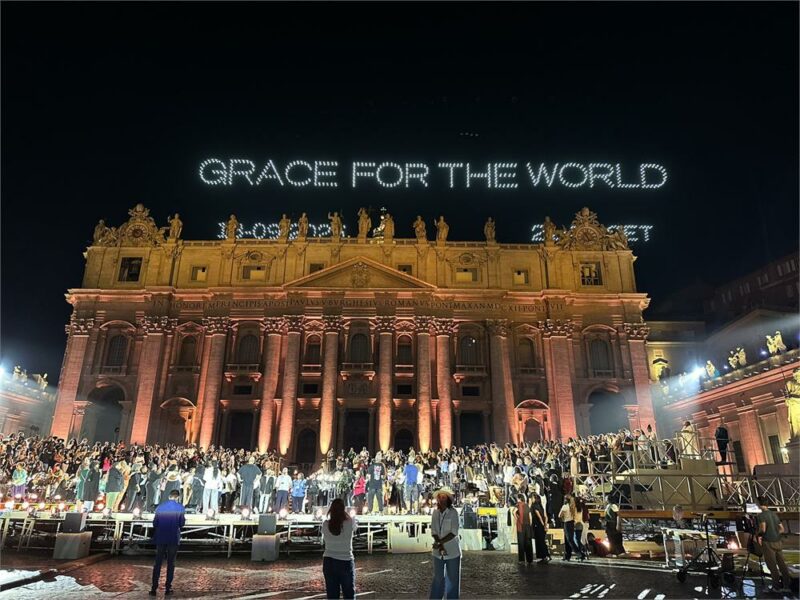
The night of Thursday, September 11 the dome of St. Peter’s was invaded by 3,000 drones and beams of light . A «celestial» show organized by the Basilica of St. Peter itself. What does all this have to do with faith? With the mission that Christ entrusted to Peter? How much do these gimmicks cost? What is their purpose? El Vaticano se ha visto invadido por pallets with thousands of bottles of water, drones, boxes with various instruments. A deployment worthy of a military mission, while the world is burning the Vatican plays with the same machines that serve to kill, as if they were technological fireworks. Is this really the response of the Holy See to a world in flames? An aerial choreography while in other places the sky is torn apart by bombs? Today the grand finale is expected, the megaconcert «Grace for the World» in St. Peter’s Square. Many artists from the celebrity world, some controversial like Karol G (Carolina Giraldo Navarro) , accused of spreading an artistic message explicitly sexual , linked to substance use and a secularized vision of female empowerment, also supported by her foundation, which promotes the use of contraceptives among adolescents .
The Vatican Museums have seen fit to organize another gala dinner for friends and illustrious guests. Tables full, bright lights, luxury catering. The question is always the same: who pays? Not a shred of attention to spirituality and faith, not a moment of prayer. Masses have been canceled, prayers are increasingly scarce, but the flash of cameras and VIP access have increased. In a world ravaged by wars , with people increasingly distant from evangelical teaching, a clergy increasingly disillusioned and angry, with their bishops and with the devastating situation in various dioceses around the world , the Vatican delights in drones, lights, and concerts that cost millions of euros. Some demand that priests donate part of their miserable salaries to the needy, but inside the Vatican Museums champagne flows freely surrounded by select canapés. We have a Church that, instead of guiding the people of God, seems to have opted to compete with Las Vegas.
The Vatican issued a statement this Friday made on Thursday to a group of 192 bishops by the Pope, adding that he had also informed the bishops on several internal matters. Today’s headlines report that he told the bishops that “abuses in the church cannot be swept under the rug”. The Italian media immediately thought of an extraordinary mystery that has troubled the Holy See for 42 years: the disappearance of Emanuela Orlandi. Her brother comments that Pope Francis had requested the secret dossier strictly guarded in the Holy See, but never entered the topic. In the note issued this Friday, the Vatican explains that “in addition, the Pope continued to review the challenges and problems faced when beginning a new ministry. ‘In that context he referred to abuses’ and adds the need to ‘be prudent’. ‘There are moments when reaching the truth is painful but necessary’. So it seems to take the statement that ‘the Church’s abuses cannot be swept under the rug’ a bit too far.
Four ships of the Global Sumud Flotilla set sail to reach the port of Augusta, where the other 14 ships are that will set sail toward Gaza. The 18 ships departing from Italy will join another 16 from Tunisia and Greece. The motto is «Gaza, we’re coming», with more than 500 activists who thank the support of Parolin: «all humanitarian operations that can help are useful; we value them positively». It is important to end «the hunger suffered by the population of Gaza». The Global Sumud Flotilla has been cautious and has asked for diplomatic support from the Italian government: «We request protection for Italian citizens in case they are kidnapped or imprisoned by the Israelis. We do not want escorts, but diplomatic dialogue with Israel.
Parolin reported having received assurances from the Israeli president, Isaac Herzog, that Israel has no intention of occupying Gaza: «He spoke explicitly about it, I believe him, but we need to see the facts». News of bombings and destruction arrives daily, making it difficult to distinguish between military aggression and a long-term political project. The response regarding the definition of genocide seemed equally cautious, perhaps too cautious. Parolin explained that the Holy See has not yet taken a position, emphasizing that «we need to study, we need to see if the conditions exist to make such a declaration». Leo XIV from the beginning of his pontificate has used much more forceful language than that of his Secretary of State. The pontiff spoke without hesitation of a «people reduced to hunger and massacre», calling for «a disarmed and unarmed peace» and describing the siege of Gaza as «a wound that concerns all humanity».
Parolin is in Portugal on the occasion of the «Jubilee of Authorities» at the Fatima Sanctuary, tomorrow he will go to the site of the Lisbon funicular accident for a prayer, where 17 people died. He will meet with Prime Minister Luis Montenegro, followed by a commemorative event with civil authorities. A courtesy visit to President Marcelo Rebelo de Sousa will not be missing.
El acuerdo secreto con el gobierno comunista chino parece que procede y the Press Office of the Holy See: «We are pleased to learn that today, on the occasion of the taking of possession of the office of Auxiliary Bishop of Zhangjiakou by His Excellency Mons. Giuseppe Ma Yan’en, his episcopal ministry has also been recognized for civil law purposes. Likewise, the episcopal dignity of His Excellency Mons. Agostino Cui Tai, Emeritus Bishop of Xuanhua, has also been recognized for civil law purposes. These events, the fruit of dialogue between the Holy See and the Chinese authorities, constitute a significant step on the common path of the new Diocese». Well, we don’t know, neither more nor less, the agreements are secret and everyone seems happy.
El Papa recibió en audiencia a Fabio Panetta, gobernador del Banco de Italia. El Vaticano anunció la noticia, revelando que se trataba de una audiencia privada. No se dieron más detalles sobre la audiencia, que tuvo lugar durante una mañana ajetreada para el Papa León XIII, ni sobre la duración de la reunión ni sobre los temas tratados.
Los hay que se quejan del silencio del Vaticano con el reciente jubileo arco iris. «And the Pope? I don’t see him; he’s not there. Or rather, yes he is, but his expression (very inexpressive) makes me think he’s not there. He seems asleep. That inert face, that hieratic but empty gaze, is there so that others can open the doors of evil, so that Lucifer can act freely and interfere in the Holy Church of God. Not a word about the indecent influencer priests who ridicule the Lord with their whimsical and vulgar videos, with their Stallone-style biceps and tattoos borrowed from Fedez. Not a word of condemnation for the horrible homosexual procession that burst through the Holy Door of St. Peter. Nothing, a silent fish that allows everything again and again. It is his tactic, very different from the violent and hysterical style of his predecessor, but the bow always points to the ruinous north of the Church, to the ice in its heart. The icing on the poisoned cake was the appointment of an art historian who, on her Instagram profile, proclaimed her faith to the world: that it was men who invented God».
La Iglesia Católica describe con precisión las inclinaciones homosexuales como “objetivamente desordenadas”, y la ciencia apoya esa enseñanza: la sodomía es antinatural y gravemente dañina. Al igual que el aborto, la homosexualidad se ha catalogado erróneamente como una variación normal de la actividad humana. La Iglesia Católica describe con precisión las inclinaciones homosexuales como «objetivamente desordenadas», esta es una afirmación moral, también cuenta con respaldo científico. Al igual que con el aborto, más personas podrían oponerse a la homosexualidad y al matrimonio falso, conocido como «matrimonio homosexual».
Adriano Bernardini , titular archbishop of Faleri and former apostolic nuncio in Italy and the Republic of San Marino , passed away yesterday afternoon, Thursday, September 11, in the Villa del Rosario nursing home, where he had been hospitalized for a month and a half. He was 83 years old . Born in Piandimeleto (diocese of San Marino-Montefeltro) on August 13, 1942, Bernardini dedicated his life to the service of the universal Church, distinguishing himself as a diplomat of the Holy See in complex and often delicate contexts. His first assignments took him to Pakistan , Angola —from which he was expelled in 1975 during the civil war— and later to Japan, Venezuela, Spain, and Taiwan. John Paul II appointed him archbishop and nuncio in Bangladesh in 1992. LaterMadagascar, Mauritius, Seychelles, Thailand, Singapore, and Cambodia , as well as apostolic delegate in numerous Asian countries. In 2003, he took up the post of nuncio in Argentina , during years marked by strong internal conflicts within the local Church and tense relations with the then Cardinal Jorge Mario Bergoglio. In 2011, Benedict XVI called him to a prominent role as nuncio in Italy and San Marino , in a delicate phase in relations between the Holy See and the Italian episcopate. During his nunciature in Buenos Aires, he did not stop launching harsh criticisms at Bergoglio, Pope Francis did not elevate him to the cardinalate. He has left us one of the custodians of the best-kept secrets of Pope Francis in his beloved Argentina. In the early moments of the turbulent pontificate of Pope Francis, he always said that the cardinals knew who they were voting for, that they were well informed.
Gibraltar no deja de ser una anormalidad política y eclesiástica. Leo XIV has appointed Rev. Monsignor Charles Azzopardi Bishop of Gibraltar. Vincent Nichols, president of the Episcopal Conference of England and Wales to which he belongs: «I welcome with satisfaction the appointment of Monsignor Charles Azzopardi as the next bishop of Gibraltar, in succession to the Most Reverend Carmel Zammit. Monsignor Charles’s many years of priestly ministry in Gibraltar will be very useful to him as he assumes this new vocation as bishop». He was rector of the Shrine of Our Lady of Europe that stands overlooking the Strait of Gibraltar and the Mediterranean Sea. The bishop-elect Azzopardi will be the ninth bishop of Gibraltar. The Diocese was formed on November 19, 1910 when the Apostolic Vicariate of Gibraltar was elevated to the rank of diocese immediately subject to the Holy See. About 80% of the 34,000 people living in Gibraltar are Catholic, it has 8 priests, one religious sister, no religious brothers, and five parishes, as said, an abnormality.
Y nos vamos, no faltan, con artículos de fondo. On this 1700th anniversary of the Council of Nicaea, it is worth highlighting, along with Father Gerald Murray, that if a synodal approach similar to those proposed today had been adopted then, today there would be no universally professed Creed in the Church. In Nicaea, the tensions in the Church were resolved not dynamically, but definitively: the Arian denial of the divinity of Christ was rejected with authority and Christian orthodoxy was affirmed with authority .
«The decline in the number of priestly candidates was foreseeable and quickly became evident. As a young man, I had an unqualified attitude toward the Council, and later studied its documents with faithful trust. However, from my twenties, several things caught my attention: the desacralization of the choir, the priesthood, and the Holy Eucharist, as well as the reception of Communion, and the ambiguity of certain conciliar document passages. I quickly realized all this, being a young layman with little theological training. Although the priesthood was the strongest option in my heart since childhood, I was not ordained a priest until I was forty. I grew up with the Council, I grew and have witnessed its impact from its beginnings. Today I am 70 years old and a bishop».
«I must say: the spring of the Church did not materialize; what followed was an indescribable decline in the practice and knowledge of the faith, widespread informality, and liturgical arbitrariness (to which I myself contributed in part, unknowingly). From the current perspective, I see everything with growing skepticism, including the Council, whose texts most have already abandoned, always invoking its spirit. The hallmark of its reform is its fluidity in doctrine, morals, and liturgy, its alignment with secular standards, and the ruthless post-conciliar break with everything previous. For them, the Church was founded mainly after 1969 (Editio Typica Ordo Missae, Cardinal Benno Gut). The previous can be overlooked or has already been revised. There is no going back. The most revolutionary reformers were always aware of their revolutionary actions. But their post-conciliar reform, their processes, failed in every respect. They lacked inspiration».
«I myself celebrate Holy Mass according to the New Rite, even privately. However, thanks to my apostolic work, I have rediscovered the ancient liturgy of my childhood and perceive its differences, especially in the prayers and postures, and of course also in the orientation. In retrospect, the post-conciliar intervention in the liturgical form, nearly two thousand years old and very consistent, seems to me a rather violent, almost commissarial reconstruction of Holy Mass in the years following the Council’s conclusion, associated with great losses that must be addressed. Many forces, including Protestant ones, participated directly in harmonizing the traditional liturgy with the Protestant Eucharist and perhaps even with the Jewish Sabbath liturgy. This was done in an elitist, disruptive, and ruthless manner by the Roman Liturgical Commission and imposed on the entire Church by Paul VI, not without causing serious fractures and fissures in the Mystical Body of Christ, which persist to this day».
«One thing I am clear about: if a tree is judged by its fruits, an urgent, rigorous, and truthful reevaluation of the post-conciliar reform is needed: historically honest and meticulous, non-ideological and open, like the new generation of young believers who do not know the conciliar texts. Nor are they concerned with nostalgia, for they only know the Church in its current form. They are simply too young to be traditionalists. However, they have experienced how parishes function today, how the liturgy is celebrated, and what remains of their religious socialization through the parish: very little! That is why they are not progressives». Why is tradition on the rise among young people? What makes it so attractive to them? Think about it for a moment! They vote with their feet, not with councils. Perhaps we should simply change course! Understood?
No less interesting the long conversation with Cardinal Sarah on the occasion of his eighty years. «Leo XIV is highlighting the indispensable centrality of Christ, the evangelical consciousness that ‘without Him we can do nothing’: neither build peace, nor the Church, nor save our souls. Moreover, he seems to have an intelligent attention to the world, with a spirit of listening and dialogue, always with a deep consideration of Tradition». «I don’t understand the uproar caused by this choice. The mozzetta is a sign that indicates the Pope’s jurisdiction, but also that of bishops. Perhaps the uproar is due to the fact that Pope Francis did not wear it on the day of his election. But that doesn’t seem like a valid reason for so much surprise».