


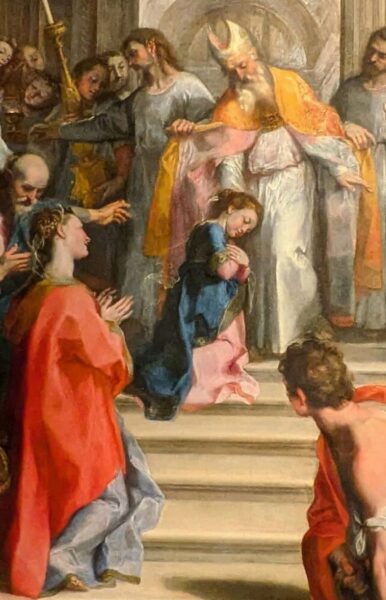
We ended the week with the feast of the Presentation of the Blessed Virgin, Saturday with an avalanche of paper. Yesterday the Pope received the Catholic Near East Welfare Association on the centenary of its foundation, and it is worth looking inside the agency: it is presided over by right by the Archbishop of New York and declared twenty-eight million dollars in revenue last year. In Luxembourg, meanwhile, the Grand Chamber of the Court of Justice has on the table whether a baptized person can demand that their name be removed from the baptismal register, and the European bishops have published a document to explain why a sacramental register is not a commercial database. From today’s in-flight press conference comes the issue of spiritual abuse, which the Pope acknowledged remains “a very vague concept” and which has gone two years without being defined. La Nación counts the eleven times Leo XIV did not say “social justice” in Argentina, the Pew Research Center projects that Muslims will outnumber Christians by 2035, and the death of Corrado Augias has left the day after that it is worth more than the obituary. We go with everything trying to be brief.
The CNEWA turns one hundred, and what it sustains
Yesterday morning the Pope received a delegation of the Catholic Near East Welfare Association, CNEWA, in the Consistory Hall on the centenary of the foundation desired by Pius XI, and the phrase that everyone has headlined is the one that measures the loss: “when a Christian family is forced to leave its homeland, much more is lost than a place to live: a community is weakened, a living tradition is put at risk, and the presence of the Church diminishes”. He recalled that Eastern Christians continue to suffer the effects of war, persecution, instability and poverty, and that many have had to leave the lands where their Churches have proclaimed the Gospel since the first centuries. Accompanying them there, he said, is “an essential work of hope.” He spoke in English.
The other half of the speech is the definition of what they do: “the assistance you offer is not only humanitarian: it is also an expression of Christian fraternity and of the communion that unites the members of the Body of Christ across nations, cultures and continents”. He thanked the support for the Dicastery for the Eastern Churches and, in the month of the dead, commended those “who lost their lives in the midst of war and violence, especially those who remained faithful to their communities and to their Christian heritage in the midst of great suffering”.
And here is what no audience report tells: CNEWA was born on 11 March 1926, when Pius XI brought together in a single body the American Catholic associations that raised funds for Russia and for what was then called the Near East. The two main ones were a society constituted in Pennsylvania in 1924 by Msgr Richard Barry-Doyle, which supported the Greek-Catholic exarch of Constantinople, George Calavassy, and the Catholic Union, which favored reunion between Catholics and Orthodox; and according to the agency’s own official history, the merger was also pushed by the American bishops, tired of the coming and going of foreign priests who went from parish to parish begging alms. Pius XI entrusted it to the Archbishop of New York, who has since presided over its board of directors by right; the operational president today is Msgr Peter Vaccari. Since 1949 it has also managed the Pontifical Mission for Palestine, created by Pius XII after the first Arab-Israeli war, and in 2024 it declared some twenty-eight million eight hundred thousand dollars in revenue. It is a founding member of ROACO. In other words: the first American Pope in history received yesterday, on the centenary, the pontifical agency presided over by the Archbishop of New York and which pays for seminarians, support for the clergy and restoration of churches where those Churches would have no other way of sustaining themselves. American money is not a detail of the pontificate; it is beginning to be one of its main foundations.
Baptismal registers before the Grand Chamber in Luxembourg
On 26 June 1955 a child was baptized in the parish of the Bijloke, in Ghent. On 25 March 2021, that man asked the diocese to erase from its registers and archives all reference to his person, invoking the General Data Protection Regulation; the diocese recorded his abandonment of the Church by crossing out the data but leaving them legible, and from there was born case C-12/25, Bisdom Gent, now before the Grand Chamber of the Court of Justice of the European Union. In December 2023 the Belgian Data Protection Authority ordered the cancellation; the diocese appealed, and the Brussels Court of Appeal asked Luxembourg whether someone baptized as a minor can make their data disappear and whether a marginal note is sufficient. Seven governments, including the Italian one, have submitted observations. On 1 October Advocate General Laila Medina concluded that the right to erasure “may, in principle, apply to personal data contained in baptismal registers,” that it is for the Church to demonstrate “compelling legitimate grounds” on a case-by-case basis, and that crossing out the name while leaving it legible does not amount to erasing it: the data must be made illegible until the person is no longer identifiable, although the date and place of baptism may remain.
The Commission of the Bishops’ Conferences of the European Union published its position paper yesterday, and its fundamental objection is that the conclusions treat the register as proof of current membership: “the register does not attest to present membership,” but rather “documents a historical and sacramental fact, that is, that a baptism took place at a precise time and place.” The books do not serve only to avoid a second baptism: they certify canonical status, accommodate subsequent annotations beginning with marriage, and protect parents, godparents and the minister. Regarding canon 876, which the conclusions propose as an alternative because it allows proof of baptism by a witness or by the oath of the baptized person as an adult, COMECE replies that this norm “addresses the insufficiency of evidence, it does not authorize its intentional creation.” And the jurist Emanuele Bilotti, of the Università Europea di Roma, cited in the document, puts forward the argument that hurts most: “the historical fact is not simply that a baptism took place in a certain place and at a certain moment, but that a specific person was baptized in that place and at that moment.”
Hence the warning to the judges: they may have to apply canon law, but “they must not isolate a canonical norm from its legal and doctrinal context” nor attribute to it a meaning contrary to the Church’s authorized interpretation. COMECE says it is surprised that the conclusions do not cite the Explanatory Note of the Dicastery for Legislative Texts of April 2025, according to which “it is not permitted to modify or cancel the data entered in the Register, except to correct possible transcription errors.” And it warns of the practical consequences: a “heavy proceduralization,” legal uncertainty for ecclesiastical entities and an increase in litigation, which would ultimately fall on the parishes.
The rest of the document fights the comparisons. Covering names with opaque stickers is “particularly problematic” and clashes with the principles of authenticity and integrity of archives; the parallel with commercial databases is inappropriate, because the books do not serve to contact anyone or to raise funds and are normally consulted at the request of the baptized person; “the Church cannot be treated like any association or company”. They add that the value of an archive lies in its integrity, that baptismal registers are among the most valuable sources for genealogy—historical research that the Regulation itself protects—and that name, surname and date of birth are not excessive data: removing them empties the entry. The risk that the bishops point out, and that must be followed, is formulated by the text itself: if emotional distress were enough to erase a true datum, the principle could extend to school records, professional records, civil status and the books of Jewish and Muslim communities.
Spiritual abuse remains undefined
Damiano Cavallaro today reads the reply that Leo XIV gave to Jean-Marie Guénois, of Le Figaro, on the flight from Lima to Rome on 16 November: to the question whether the Holy See is preparing a document on spiritual abuse with canonical sanctions, the Pope said that it is “a very serious issue in the Church” and that it is being studied in the Vatican, but that there is no text ready; and that to exercise justice “one must have, so to speak, a codification or a legal expression of how to apply it,” and that “remains a very vague concept”. The dates give the measure of what is missing: on 22 November 2024 Pope Francis approved in audience the Foglio by which the Dicastery for the Doctrine of the Faith stated that “it is possible to define a crime of ‘spiritual abuse’” and entrusted a working group with concrete proposals; in January 2025 Cardinal Fernández told Alfa y Omega that the intervention was “necessary and urgent” but that the definition was “the most complex point.” Two years later, the Pope confirms that that precision has not arrived.
The canonical analysis made by the article is what explains why, and it deserves attention because it is not a partisan objection: penal law punishes an external act imputable by malice or by fault, and canon 221 §3 recognizes the faithful’s right to be sanctioned only in accordance with the law, so that a figure built on the perception of the offended party would leave any spiritual director at the mercy of whoever years later rereads a demanding counsel as an outrage. Abuse, it maintains, is a way of acting rather than an act with its own object, and that is why canonical tradition placed it among aggravating circumstances: the 1917 Code spoke of “abuse of authority or office to commit the crime,” and the current canon 1326 preserves the aggravating factor. The Foglio of 2024 itself admitted, referring to article 16 of the Norms of May 2024, that the use of supposed supernatural experiences “as a means or pretext to exercise dominion over persons or to commit abuses” could be assessed as an aggravating factor “if it occurs together with crimes.” The author’s conclusion is that the work lies in jurisprudence, in the concrete case, and that there one sees where legitimate demand ends and where using another’s conscience as an instrument of dominion begins.
How Leo XIV rereads Francis
Cooperatores Veritatis publishes in its own translation an article by the Argentine Ruben Perito Rivas, whom it presents as an active member of the movement for the liberalization of the ancient Roman rite, and the thesis is the most articulated we have read on the matter: that Leo XIV is rereading the previous pontificate “in the light of Tradition,” without rupture or uncritical continuity. The datum it provides is countable: during the trip to Latin America he literally affirmed fifteen times that he is the successor of Peter. And the underlying argument is that an institution does not possess its history as one possesses a library, from which volumes that are no longer liked are discarded, because an institution is its history; hence it discards posthumous condemnation—citing the trial of Formosus—and reads the resignification of “make a mess,” of “everyone, everyone, everyone” and of synodality as assumption, not as denial.
EWTN Italia, with signature of Matteo Ciofi, summarizes the same from the other end: that the Pope does not for now intend to expand the ordination of married men because extending it “could sharpen divisions in some parts of the Church,” and that regarding Masses according to the Missal prior to the reform he recalled that the current norms already allow them to be authorized and that for now he does not intend to relax the restrictions. The reason he gives is one and the same for both answers: that the priority of his ministry is to recompose divisions and promote the unity of Catholics. Those who expected a gesture and those who feared a rupture therefore receive the same phrase.
Social justice, the two words he did not say
Diego Cabot recounts today in La Nación that there were eleven speeches in four days and that in none did it slip out: the Pope spoke of work, of dignity, of unemployment and of the poor, but “social justice” appeared only once, at the UCA, and not from his own mouth, but quoting his predecessor when recalling that informal workers claim “those three ‘T’s’: land, roof and work, which many times Pope Francis indicated as demands of social justice”. They arrived in quotation marks, says the author, “like someone delivering a package that does not belong to him.” The recipient of the care is evident: Milei defined the concept at the IDB as “an aberration from the moral point of view,” and before him, in the Palacio Libertad, the Pope preferred to ask that private initiative be stimulated and that growth reach those who have the most difficulties.
The part that interests us is the genealogy, and the article has it well done: the expression was coined by the Italian Jesuit Luigi Taparelli d’Azeglio in the 1840s, Pius XI turned it into doctrine with the Quadragesimo anno of 1931 and in 1919 it already figured in the preamble of the International Labour Organization, which affirms that universal and lasting peace can only be based on social justice. Hence its symmetrical reproach: Kirchnerism emptied social justice and Milei extends its death certificate for that same cause, confusing the concept with the use made of it by a faction. The Pope, he points out, refuted the shortcut without naming it, citing Leo XIII, subsidiarity and private property “encumbered by a social mortgage,” and leaving in the Palacio Libertad the most applauded phrase of the trip: “the economy must be at the service of the person, and not the person at the service of the economy.” That he did not name it, he concludes, does not mean that he did not say it.
The hymn of Pucallpa and the sessions with the shamans
Gaetano Masciullo maintains that the welcome song of the papal Mass on 15 November at the regional sports complex of Pucallpa, in the apostolic vicariate, invokes pagan spirits: the lyrics say “mothers of the mountain and the water, they care for young and old, so that our face may not forget,” and the sachamamas are, in Amazonian cosmology, the mothers of the forest and of the water, represented as great boas. The planes must be separated because the headline, from Pachamama to Sachamama, is from the outlet. What is on record is what the author of the hymn himself has said: Father Segundo Gaviria Sandoval told Infobae that he participated in “shamanic sessions with the shamans” among the Asháninka, Shipibo and Cocama, that he had himself invited “to see, try and experience” what ayahuasca produces, that from it he drew “a clearer vision” and “more tranquility,” and that what remained engraved on him were the notes and tones of the ícaros, which he defines as “the invocation to the spirits, to God… for the healing of the sick.” With that he worked more than four months adapting those melodies to the official greeting to the Pope.
What there is not, and it is worth saying, is any pronouncement by the vicariate, the Peruvian Episcopal Conference or the Holy See on the hymn. So the verifiable fact is that a priest composed the official greeting adapting ayahuasca ceremony songs and has explained it himself in an interview; whether that is inculturation or syncretism is exactly the discussion that the Amazon Synod left open in 2019 and that no one has closed.
Universal Elder Brother of the Lord of Miracles
The Brotherhood of the Nazarenas named Leo XIV Universal Elder Brother of the brotherhoods of the Lord of Miracles and granted him the Nazarene Order in the degree of Grand Cross, which is its highest decoration and which, according to steward José Sotelo, is awarded for the first time to a Pope. Sotelo recalls that the Moreno Christ is not unknown to him: he received the image and carried it during his time in Chiclayo and also as prefect of the Dicastery for Bishops, and he celebrated Mass in the church of the Nazarenas. To Pope Francis, when he visited that church, the brotherhood gave a souvenir, not a decoration. Of the moment of the presentation he recounts that the Pope was moved, gave thanks and himself asked for the photograph: he with the medal and Sotelo with the decree.
Castillo and the legacy of the trip
Cardinal Carlos Gustavo Castillo Mattasoglio, Archbishop of Lima, recounted the day before yesterday in Rome, by remote connection, his version of the visit: “the Pope is really a very sweet and calm person. He is not in a hurry, he listens a lot and when he says something he knows how to be incisive and fruitful”. He was speaking at the press conference that opened the way to the V National Missionary Congress of Italy, scheduled in Fiuggi from 11 to 14 November 2027. He quoted from the Pope the phrase that summarizes his bond with the country: “if I have become pastor of the universal Church it is also because you have formed me. I have allowed myself to be taken by you and you have listened to me: I am part of you.” And he summarized the legacy in four words: “we have to humanize ourselves more.”
The World Jewish Congress, schools and artificial intelligence
Yesterday the Pope received the bishops of Ecuador on their ad limina Apostolorum visit and, in another audience, a delegation of the World Jewish Congress, according to the bulletin of the Press Office. Of that second audience, the first private one between the Pope and the president of the WJC, Ronald S. Lauder, what is known are Lauder’s words, not the Pope’s, and the distinction matters because the headlines mix them: “we wish young Jews and Catholics to understand the history of our relationship and recognize their own responsibility toward their future,” and collaborating in the field of education “can help counter the prejudices that fuel antisemitism.” He was accompanied by Executive Vice President Maram Stern, Commissioner for Interreligious Dialogue Claudio Epelman and Viktor Eichner, head of the WJC office to the Holy See. According to the note, Lauder thanked the Pontiff’s repeated condemnations of antisemitism and encouraged him to continue using his moral authority; and on artificial intelligence he proposed a common front between the Church and the WJC that would include sitting directly with the leaders of technology companies. That last proposal, if it takes hold, is more relevant than the photograph.
Parolin in Ankara, one year after the trip
On 18 November Cardinal Parolin was received by Recep Tayyip Erdogan at the presidential complex in Ankara, with Foreign Minister Hakan Fidan and Turkish Ambassador to the Holy See Fahrettin Altun present at the meeting. And what is not there deserves to be underlined: the Turkish authorities have not disseminated the content of the colloquium and the Presidency of the Republic limited itself to officially confirming the meeting, without making public an agenda of the topics discussed. It would be premature to attribute to the two interlocutors agreements or concrete initiatives regarding a meeting of which none has been published.
What can be situated is the calendar, and it is what gives meaning to the visit: it comes almost a year after Pope Leo XIV’s apostolic journey to Turkey, at the end of November 2025, when the Pope entrusted to the Turkish authorities a message that the outlet recalls with his words, that the country may be “a factor of stability and of rapprochement among peoples, at the service of a just and lasting peace”. Parolin’s stay in Turkey was also due to COP31 in Antalya, where he spoke on behalf of the Pope. That is: the Secretary of State was in the country for the climate and took the opportunity to sit with the president. For the Holy See, Ankara is at once the channel to Gaza and the Palestinian question, an interlocutor that keeps an open line with Moscow while being a member of NATO, and the government on which depends that the Christian communities of the country, few but historic, can continue to live and work there. The three dossiers fit into an audience without a published agenda.
Vietnam: the demolition of L’Accueil
Anna Bono recounts that the municipal administration of Hue, the former imperial capital, began on 17 November the demolition of L’Accueil, a historic building owned by the Redemptorists, to make a public park and a parking lot. The provincial chapter maintains that the congregation bought the property in 1930 and that in 1971 the municipal authorities recognized its ownership; it is more than twenty thousand square meters, and the building today houses a library, an auditorium and a reading room. According to local sources collected by AsiaNews, the municipality cut the electricity in the area and the police blocked the streets leading to the monastery and the church of Our Lady of Perpetual Help, preventing a group of Catholics from reaching Mass; at the tolling of the bells, priests and parishioners began to pray and prepared banners asking for its return.
The context is an old lawsuit, and the piece recalls its chapters: the lands of the parish of Thai Ha, near Hanoi; the destruction of a monastery; acts of vandalism against a church in Saigon; the investigation of the provincial superior, who was prevented from leaving the country. AsiaNews also points out that the dispute between the authorities and the Redemptorists has several times been on the table in conversations between Vietnamese and Vatican delegations on the way to full relations, meetings in which Hanoi’s representatives would have claimed “full religious freedom” enjoyed by Christians in the country. It is being demolished while negotiations continue.
Venite ad me, or the faith that is transmitted in dialect
Marie-Lucile Kubacki reads in Fides the document of the Dicastery for the Doctrine of the Faith published on 22 October, “Venite ad me. Considerations on the transmission of the faith in the change of epoch,” which starts from a phrase of Pope Francis to some parents in the Sistine Chapel in January 2018: the transmission of the faith can only be done “in dialect,” that of the family, of dad and mom, of grandfather and grandmother. The text collects a memory of the French Jesuit Aimé Duval, who learned that dialect by seeing his father kneel after a day in the field and his mother pray with the little one in her arms: “my father’s hands, my mother’s lips, those are the things that taught me about the good God more than the catechism.” And the question the document asks is the good one: where and from whom is that dialect learned when it is no longer spoken at home.
The answers are provided by the dicastery itself collecting what bishops from different countries have told it, and the map is uneven: the family continues to be decisive in parts of Africa and Asia, but in many places the passage from one generation to another “has been interrupted”; in Europe, the United States, Canada, Australia and New Zealand it is attributed to an “advanced phase of secularization”; in the territories of the former Soviet Union, to state atheism, with cases in which faith passed from grandmothers to grandchildren without the parents; in Latin America and the Caribbean the organic continuity between family and society has broken above all, and the Chilean bishops recall when continuity between family, school, culture and ecclesial community was taken for granted; in Korea, Malaysia, Singapore and Brunei the academic and professional career of the children weighs, and in Japan marriages between different religious traditions. In Africa, the dicastery points to Western lifestyles and “an inculturation of the Gospel not fully realized.”
Islam, Christianity and what Pew projects
On 18 November the Pew Research Center published its religious population projections for 2020-2070, and the headline is that by 2035 Muslims could surpass Christians and become the largest religious group in the world for the first time. The figures we have been able to verify are these: by 2070, more than three thousand six hundred million Muslims compared to just under three thousand million Christians, 36 percent of the world’s population against 29; Muslims started from 26 percent in 2020. The explanation does not lie in conversions but in demography: between 2020 and 2025 Muslim women had an estimated average of 3.1 children compared to 2.0 for non-Muslim women, and in 2020 the median age was twenty-four among Muslims and thirty-three among the rest. In Europe, the proportion of Muslims would go from 6 to 13 percent and of those who do not declare a religion, from a quarter to a third.
Christianity will continue to grow in absolute numbers, especially in sub-Saharan Africa, so what the report describes is not a global decline but a shift in the center of gravity. The European figures circulating in the summaries—the passage from 67 to 52 percent Christians, the loss of one hundred eighty-one million people, the drop from 69 to 41 percent in Spain—come from the report itself according to the versions that have reached us, but we have not been able to check them one by one in the source, and we say so. What is necessary is to read this together with Venite ad me: when the dicastery says that transmission “has been interrupted” and Pew projects thirty-five million European Christians lost through abandonment, they are describing the same fact from two different tables. The difference is that one calls it secularization and the other measures it.
Twenty-nine out of a hundred
A study published in September in the academic journal Sociological Inquiry, on 1,049 Catholics, finds that only 28.8 percent believe that bread and wine truly become the Body and Blood of Christ; 58.8 percent say they are “only symbols” and 12.4 percent are not sure what happens. Among those who attend Mass every Sunday it rises to sixty percent. One of the authors, Mark Regnerus, wrote on 11 November that there is no statistically significant difference from the 31 percent given by Pew in 2019, nor from the 30 percent of a Gallup survey of 1992.
Between 2022 and 2025 the bishops of the United States deployed the National Eucharistic Revival, with a congress in 2024 that brought together tens of thousands of people, and the figure has not moved. The reading the house makes is the predictable one, that those who do not go to Mass were not going to go to the congress either, and it reinforces it with the 2024 Real Presence Coalition survey, sixteen thousand responses, in which the most voted advice to the bishops was to restore communion on the knees and on the tongue; it is worth recalling that 97 percent of those who responded to that survey attended Mass every week and believed in the real presence, so it measures the convinced, not the others.
Jundiaí, Father Martin and the prophetic sign
On 18 November Father James Martin shared on X a phrase from Brazilian Bishop Arnaldo Neto: “LGBT+ Catholic groups can be prophetic signs for the whole Church. They remind us that faith is not the property of those who have never known conflict, but the path of those who allow themselves to be found by Christ”. The words are from a June intervention at a meeting of Brazil’s National Network of LGBT+ Catholic Groups, and in it the bishop also said that there is no cure for something that “never was, is not and never will be a disease.” The outlet that collects it reproaches him for having omitted the teaching on the moral disorder of homosexual acts; that is its judgment, and we give it as such.
What neither of the two parties says, and we fix it here because the character will return: Arnaldo Carvalheiro Neto is bishop of Jundiaí, in the state of São Paulo, since 15 June 2022, transferred from the see of Itapeva, which he occupied since October 2016. He is the bishop whom the Brazilian Episcopal Conference designated a year ago as reference for LGBT groups, and the one who in March hosted in his own house a meeting of those groups. It is not, therefore, an isolated declaration, but the umpteenth step of a diocesan policy that the conference endorsed.
Burke opens five years toward Guadalupe
On 12 November Cardinal Raymond Burke announced on X “Semper Virgo,” a program of daily contemplations by email that will begin on 12 December, the feast of Our Lady of Guadalupe, and will last until the fifth centenary of the apparitions to Saint Juan Diego at Tepeyac, on 12 December 2031. He presents it as spiritual preparation for the jubilee: contemplations “founded on Sacred Scripture, Sacred Tradition and the perennial teaching of the Church,” traversing the Immaculate Conception, perpetual virginity, divine motherhood, the Assumption and maternal mediation. Burke founded the Guadalupe shrine in La Crosse, Wisconsin, and the initiative fits with what he has been doing for twenty years. Five years in advance, that is a lot of advance: it is the way to be on the 2031 calendar from today.
The relics, finally censused
On 18 November the first results of “Reliquiae Sanctorum,” the national project of the National Office for Ecclesiastical Cultural Heritage of the Italian Episcopal Conference and the Department of Cultural Heritage of the Church of the Gregorian, were presented at the Pontifical Gregorian University, and the datum is that the census, begun in 2025, has received responses from ninety-one of the two hundred twenty-six dioceses involved. The idea, explains art historian Francesca Maria D’Agnelli, is “to turn the point of view around”: until now the reliquary was studied, which has evident historical-artistic value, and much less what it contains, although the reliquary owes its existence to the relic. There is also a lack of a glossary and guidelines for the conservation and exhibition of goods that are res sacrae.
Ottavio Bucarelli, director of the Gregorian department, summarizes the objective in “to know in order to conserve, to protect, but above all to keep always alive the flame of devotion and worship in the Christian people,” and specifies that the research focuses on the notable relics and the so-called holy bodies, coming mostly from the Roman catacombs and often kept in anthropomorphic compositions. There is the most honest phrase of the entire presentation, and it is his: in some cases the identification as martyrs is due to devotional tradition rather than to certain historical documentation. Also speaking at the day was Lieutenant Colonel Diego Polio, of the Carabinieri Group for the Protection of Cultural Heritage of Rome, on the recovery of stolen relics and reliquaries, and Agata Lunardini, of the Museum of the Mummies of Borgo Cerreto, on what bioarchaeology can extract from remains.
A monsignor painter, the Chancellery and a chapel at five thousand meters
Franca Giansoldati recounts that on 28 November, at twelve thirty, Cardinal Parolin will inaugurate at the Palazzo della Cancelleria “La misericordia dello sguardo,” an exhibition by Msgr Americo Ciani curated by Sandro Barbagallo, and that what is raised from the sale of the works will go to the charitable initiatives of Leo XIV. At the vernissage there will be music: Cardinal Lorenzo Baldisseri at the piano with Chopin, Bach and Mozart, accompanied by mezzo-soprano Margherita Ciani, the artist’s niece. Ciani is a canon of Saint Peter’s, a jurist of the Roman Rota and was secretary general of the Lateranense, and has been painting since 1962, when he held his first exhibition in Bellegra, his village, to raise funds for the missions.
The inventory of what his paintings have paid for is worth more than the chronicle of the event: wells in Ethiopia and Congo, a hospital in South Sudan, the Italian hospital of Karak, in Jordan, run by the Combonians and attended by Christians and Muslims, and in 2005 a chapel in the Peruvian Andes, at five thousand meters, for the Augustinian mission of Father Marco Morasca, in which years later Robert Francis Prevost would pray. And his latest models are the homeless around the Vatican: every morning, after Mass at Santa Ana, he stops to talk with them and then paints them. One of the portraits on display is of Willy Herteleer, the Fleming who lived for years between Borgo Pio and Porta Sant’Anna, to whom the monsignor himself obtained a funeral in the Vatican and burial in the Teutonic Cemetery.
The Santa Marta dispensary fills with animals
Archbishop Luis Marín de San Martín, prefect of the Dicastery for the Service of Charity and president of the Pediatric Dispensary Foundation, inaugurated and blessed yesterday the cycle of drawings that artist Silvio Irilli, founder of “Ospedali dipinti,” has hung on all the walls of the Pediatric Dispensary of Santa Marta: fawns, pandas, squirrels and bears bathing in the Fontana di Trevi and flying over the Colosseum in a balloon, guided by a rabbit named Superjoy. The prefect’s phrase is what justifies the expense: that there each child is recognized for what he is, “not a number or a social problem, but a person with his own dignity,” and that beauty “is not a luxury reserved for a few.”
Sister Raffaella Petrini, president of the Governorate, added that for a child a colored and familiar place “can make the difference, attenuating fears,” and the director, Sister Anna Luisa Rizzello, recalled what the house is: a dispensary born in 1922 with the blessing of Pius XI, entrusted to the Daughters of Charity and served by volunteer doctors from the Bambino Gesù and other Roman hospitals, which attends free of charge families with small children without an Italian health card. That is, undocumented immigrants, one hundred meters from the Casa Santa Marta, for one hundred four years.
Francis’s diary is published on Tuesday
On 19 November Cardinal Víctor Manuel Fernández announced on X the date: Pope Francis’s personal diary is published on Tuesday the 24th, with unpublished writings of Jorge Bergoglio ranging from 20 December 1992 to 18 August 2024, in ninety-four countries and five languages. “The heart we did not know,” he titled it. The Italian edition is by the Vatican Publishing House, Penguin Random House publishes the Spanish, English and Portuguese, and Albin Michel the French; and Fernández himself, who signs the work, will be the one to present it. From the Vatican the material has been described as “a text of exceptional value and importance to know even more the person” of the Jesuit Pope. Thirty-two years of private annotations of a Pope, edited by the man who was his doctrinal hand: the question will not be what they say, but who has chosen what is published.
Savino publishes his testament
On 30 November Msgr Francesco Savino, vice-president of the Italian Episcopal Conference and bishop of Cassano allo Jonio, publishes “Cristo 5.0. Vescovo nel tempo della complessità,” forty-two chapters and more than four hundred pages in Luigi Pellegrini Editore, with presentation by Cardinal Tolentino de Mendonça and epilogue by biblical scholar Marinella Perroni. The book, which ANSA calls a testament-book, is born from the questions of journalist Francesco Kostner and covers the crisis of the Church, the no to the death penalty, civil rights, the values of the Constitution, violence against women, the protests of transporters, breeders and fishermen over fuel and the person in the era of artificial intelligence. “It is the book to which I entrust my testimony.”
Hollerich and the Carvoeiro apartment
The Portugal News recounts that Cardinal Jean-Claude Hollerich, Archbishop of Luxembourg, appeared on 15 November at the Sunday Mass of the chapel of Our Lady of the Incarnation in Carvoeiro, in the Algarve, before some fifty people, and spoke of his retirement: he is sixty-eight years old, bishops retire at seventy-five and added with a smile that the Pope could allow him to resign a couple of years earlier. He has an apartment there and hopes to spend his retirement in Carvoeiro; asked what would happen if he died before retirement age, he replied jokingly that paradise is probably still more beautiful than the Algarve. The note is local and friendly, but the datum is not: a member of the Council of Cardinals and general rapporteur of the Synod says out loud that he is thinking of retiring before seventy-five.
The trinitarian plot of the common home
SettimanaNews takes from L’Osservatore Romano of 29 October the presentation signed by theologian Lubomir J. Žák, of Palacký University of Olomouc, of the latest document of the International Theological Commission, “Prendersi cura della nostra Casa comune. Risposta responsabile e fraterna al Dio trinitario,” published on 2 September. The presentation by the secretary general of the Commission, Msgr Piero Coda, says that the theological foundation of care for the common home is “inscribed in God’s design for creation” and does not depend on the gravity of the crisis. The step the text takes, according to Žák, is that interconnection ceases to be a characteristic of the environment and enters the very way of understanding reality: it assumes the category of “relational ontology” and recognizes an analogy between the relational structure of the cosmos and the trinitarian imprint of creation, traversing the vestigia Trinitatis of Augustine, Thomas, Bonaventure and Hildegard of Bingen. If the Christian God is not solitude but communion, he asks, what does it mean to confess him creator of all that exists. A document on ecology that begins with the Trinity and not with emissions is appreciated.
The tree will be lit at five thirty
The time is set: on 7 December at 17:30, and it will be lit by children in treatment in Italian oncology services, simultaneously with the tree of Monte Ingino in Gubbio for the first time, a link that recalls the eight hundred years since the death of Saint Francis. The fir is the one from Pollino we reported on Tuesday: twenty-four meters, white fir, Pollino National Park, in Basilicata. That day the nativity scene in the square is also inaugurated.
The bishop of Xiamen already has a name
We complete what we gave halfway: the new bishop of Xiamen, ordained on 18 November, is Giuseppe Liu Heng-ping, appointed by the Pope in October and ordained a priest for that same diocese in 1999. On Wednesday we recounted the ordination without the name; here it is. The appointment enters into the Provisional Agreement of 2018, and the role of the Chinese authorities in the selection of candidates continues to be what is discussed.
The four points of Shenzhen, in detail
Gianandrea Gaiani unpacks the declaration of the four points and adds what was not in the dispatches: in the thirty-five or forty-minute bilateral prior to the trilateral, Trump called Putin “my friend” before the cameras; Xi put Taiwan as the main red line and obtained, according to Beijing, the assurance that Washington “does not support Taiwan’s independence”; and on artificial intelligence he requested coordination so that it always “remains under human control,” while Trump reiterated his opposition to any “globalist regulation”. The war in Ukraine does not figure in the declaration. Yuri Ushakov, Kremlin adviser, said that Putin came out “in excellent humor.” Of the summit and what it means for the Holy See we wrote on Wednesday; this completes it: the consensus of the States and the immunity of their leaders, in the third point, is the part that should interest Rome most, because from there comes the warning that international courts “must not abuse their jurisdiction.”
Emanuela Orlandi and the financial trail
Yesterday in Rome “Vatican Files,” by Emanuele Fucecchi, with preface by Luca Telese, was presented in an event moderated by Mariagrazia Gerina and with the intervention of former magistrate Giancarlo Capaldo, who conducted the investigation into the disappearance of Emanuela Orlandi in June 1983. The author’s thesis is the financial one: that the disappearance coincides with the height of the Banco Ambrosiano crisis and with a settling of accounts over money from parallel accounting, and he recalls the tapes delivered to the Vatican in which for seven minutes the screams of a girl are heard.
What Capaldo said, who opposed in 2014 the archiving of his own investigation, deserves to be cited with care because it qualifies the author he was presenting: he agrees that the kidnapping “was blackmail against the Pope, with internal contrasts in the Vatican,” but maintains that “the financial matrix has been used, but is not the motive for the kidnapping,” that there were elements of disinformation and that the intervention of mythomaniacs cannot be excluded. And he closes with a phrase that is common sense and one that cannot be refuted: that if someone had had Emanuela, they would have shown her in a photo. These are hypotheses, from a book and from a retired magistrate; none is a proven fact, and that is how they must be read.
Augias, the day after
Adnkronos publishes the long portrait: born in Rome on 26 January 1935, entered Rai in 1960, correspondent in New York between 1966 and 1968 and then in Paris, columnist for L’Espresso and Panorama, correspondent for Repubblica from November 1975 and one of the last founding fathers of the newspaper, inventor of “Telefono giallo” in 1987 at the invitation of Angelo Guglielmi, and later “Babele,” “Enigma,” “Le storie,” “Città segrete” and, since 2023, “La torre di Babele” on La7. From 2001 to 2021 he ran the readers’ letters section of Repubblica and answered almost six thousand. He was ninety-one years old and had a maternal Jewish grandmother.
And Americo Mascarucci writes in Stilum Curiae what no one said in the Catholic obituaries: that R.I.P. is fine, but let us not speak of an atheist in search. His objection is to “Inchiesta su Gesù,” the 2006 book with biblical scholar Mauro Pesce, of which he maintains that it presents a strictly historical Jesus, who does not leave the Jewish religion and resembles a philanthropist, and who denies the virginal conception, divinity, redemption by the cross and resurrection in the flesh. He recalls that Cardinal Ravasi called that work “crude” and wrote that amputating from the history of Jesus the complex and mysterious dimension “is not a sign of scientific rigor, but of hasty simplification,” and that Cantalamessa asked how a Jesus who brought nothing new with respect to Judaism, performed no miracles and did not rise could have changed the world. Yesterday we said that before a dead person what is fitting is to pray, and we maintain it; but Mascarucci is right about one thing: turning discrepancy into praise is a polite way of not having read the book.
The polygamous father and the family allowance
Daniele Trabucco analyzes a judgment of the Ordinary Tribunal of Prato which, according to the press, has recognized a Senegalese worker the arrears of allowances for family nucleus for his eleven children, including the nine resident in Senegal and born of unions different from the marriage transcribed in Italy. It must be said at the outset that the full motivations have not yet been published and that the case refers to the previous regime of allowances, so what is discussed is the reasoning as it is known. His legal objection is the leap from accredited paternity to the right to the benefit: the allowance is calculated according to the composition of the nucleus and the income conditions of its members, so proving filiation does not prove the economic requirement.
The underlying problem it raises is the other, and it is what gives the article its title: that paying the allowances does not amount to recognizing those marriages, but that separating the judgment on the union from the judgment on its economic effects leaves open the question of what support it is just to place on the community, when the conjugal organization from which the children come allows the male several wives and imposes on each woman a single husband, an asymmetry that clashes with the moral and legal equality of the spouses of article 29 of the Italian Constitution. The equality of the children, he summarizes, does not make just the inequality between the adults.
The Covid commission and the nineteen scientists
Nineteen Italian scientists, among them Matteo Bassetti, Massimo Ciccozzi, Giuseppe Remuzzi and Walter Ricciardi, have directed an appeal to the president of the Republic and to the presidents of the Chambers asking that science not be subjected to politics, on account of the way the parliamentary commission of inquiry on Covid is conducting its hearings. Andrea Zambrano interviews immunologist Maria Rita Gismondo, of the Sacco hospital in Milan, who does not sign and explains it without mincing words: that it is the same initiative as the “transversal pact for science” at the beginning of the pandemic, that the complaint that was then filed against her for saying supposedly unscientific things came to nothing, and that a researcher cannot be denounced for expressing doubts, “and doubts are the foundation of science.” The rest are her judgments on colleagues and on what, in her understanding, is coming out in the commission; we give them as what they are, the opinions of an interviewee, and not as established facts.
«God is not a God of the dead, but of the living, for to him all are alive.»
Good day.