


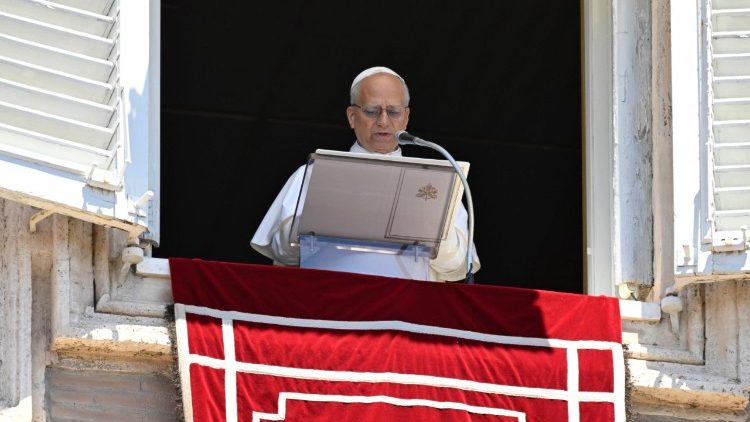
Pope Leo XIV presided over the recitation of the Angelus this Sunday, November 29, from St. Peter’s Square, on the first Sunday of Advent. He began with the day’s Gospel, in which Christ exhorts his disciples: “Be watchful” (Mk 13:33). With this passage from Mark’s eschatological discourse, the new liturgical year opens, and the Pope read it in its twofold sense: preparation for Christmas and the expectation of the Lord’s definitive return “at the end of time.”
A vigil that is not an escape
The Pontiff asked what it truly means to “be watchful” and began with an observation: today it is quite common, “especially among young people,” to stay up late into the night. He added that many people, after days filled with commitments, find themselves at night “restless and empty” and try to escape reality through distractions and entertainment.
“Certainly, this is not the ‘vigil’ to which the Word of God invites us,” he stated. Pope Leo XIV described Christian vigilance as a time of stillness in which, once external noises are silenced, “the ear of the heart becomes sharper” to make room for the deepest questions and to hear God’s voice in response.
From this perspective, he presented Christmas as “a night of silence and waiting, of tenderness and simplicity.” The Incarnation, he said, is a historical event that took place more than two thousand years ago and, “by grace,” remains alive and present. To understand this mystery, practice and patience are needed, because the Lord, respecting human freedom, “does not shout, does not break down doors, but knocks.” At this point the Pope cited the Book of Revelation (Rev 3:20) and the episode of Elijah on Mount Horeb, when God reveals himself in a whisper and not in the hurricane or the fire (1 Kgs 19:11-13).
The practices the Pope asks us to recover
Pope Leo XIV defined vigilance as training: “To be watchful means training ourselves to listen to his voice and welcome his presence.” He listed the concrete means to do so: prayer, participation in the Eucharist, confession, listening to the Word of God, and works of charity.
The Pope called Advent a “precious opportunity,” not to be wasted, to recover these practices. According to him, they allow us to pause and reflect on what is happening, to discern better the decisions that need to be made, and, before the Lord, “to create unity in our life and cultivate peace of heart.”
To illustrate this, he turned to St. Augustine, one of the authors he cites most frequently, and read a passage from the Confessions (X, 40.65): “But in none of these things that I survey, consulting you, do I find a safe place for my soul except in you.” The address ended with a request to the Virgin Mary, who “in silence welcomed and carried in her womb the Word of God,” to live this time of grace fruitfully.
The martyrs of Madrid and the prayer for peace
After the Marian prayer, the Pope recalled the beatification celebrated on Saturday of the martyrs Ignacio Aláez Vaquero, a seminarian, and ten companions, whom he described as diocesan priests, seminarians, and laypeople. He asked that their example, “who gave the supreme witness to Christ,” sustain the work of missionaries throughout the world.
The ceremony took place in the Cathedral of Santa María la Real de la Almudena in Madrid. It had been planned that Cardinal Marcello Semeraro, Prefect of the Dicastery for the Causes of Saints, would preside. On December 18, 2025, Pope Leo XIV authorized the decree recognizing their martyrdom. The group consists of nine young men preparing for the priesthood, the father of one of them, and the priest-uncle of another. Aláez was arrested for refusing to enlist in the army and wanting to become a priest, and he was killed along with his father on November 9, 1936. With the recognition of martyrdom, the beatification did not require a miracle attributed to their intercession.
Among the greetings to the pilgrims, Pope Leo XIV mentioned the faithful of the Archdiocese of Barcelona and the groups from Poland, “always numerous, always welcome.” He also greeted several Italian groups, including pilgrims from the Bologna area who had come to celebrate the feast of St. Andrew.
Before bidding farewell, the Pope asked for prayers that the journey toward Christmas may bring “concrete steps toward peace in all places where there is war,” and that the devastated populations may receive the necessary aid. He did not mention any specific conflict.