


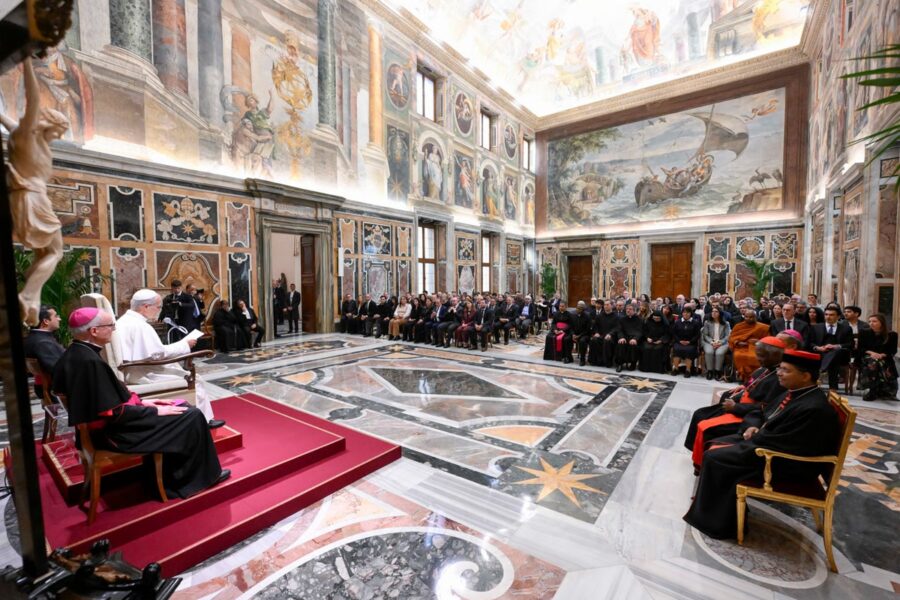
The international congress, titled The Search for Truth: The Spirituality of Saint Augustine, a Bridge for Interreligious Dialogue, was organized by the Dicastery for Interreligious Dialogue and the Pontifical Patristic Institute Augustinianum, the Roman center for studies on the Church Fathers run by the Order of Saint Augustine. That the chosen theme was the bishop of Hippo and that it was presented by an Augustinian Pope did not go unnoticed.
The Pontiff began by describing the current moment. “The times we are living in are complex,” he said, and added that injustice and the lack of hope are “clear symptoms of a spiritual crisis that wounds our magnificent humanity.” The expression recalls the title of his encyclical Magnifica Humanitas. In light of this panorama, he presented the example of Saint Augustine as “an even more luminous guide” so as not to lose faith and to keep our eyes fixed on Jesus Christ.
According to the Pope, the great teaching of the saint “encourages us to involve everyone in the search for Truth,” a path that, in his view, particularly challenges “the religious experience of peoples.”
Christ, the “Inner Teacher”
The central affirmation of the address was Christological. “The Truth that dwells within man is not a human idea, but the very Person of Christ, the only-begotten Son of God made man,” declared Leo XIV before an audience of markedly interreligious character. In that Truth, he continued, Augustine discovers “the source of charity” and the deepest root of the human being. He called it “the Inner Teacher who dwells in the heart of the human being,” who “transcends him and gives meaning to his desire.” It is an idea that the saint of Hippo developed in his dialogue De magistro.
The Pope recalled Augustine’s experience of conversion, in which he found God as interior intimo meo et superior summo meo, more intimate than his most intimate self and higher than his highest self, according to the formula in the Confessions. From that experience, he explained, was born in the saint a “feeling of compassion even toward those farthest from the faith.” He also cited an Augustinian saying: “whatever life one leads, no one lives without these three sentiments of the soul: faith, hope, and love.”
Leo XIV also drew on a study by the International Theological Commission on the new social weight of religious belonging. He warned that such belonging requires “careful discernment,” so that it does not become a pretext for hardening one’s own certainties, extinguishing dialogue, and fueling division. The search for Truth and the profession of faith, he affirmed, “are never a cause for hatred, but rather paths to be walked together, with honesty and respect.” According to the ACI Prensa report, the Pontiff also noted that the fullness of that Truth is safeguarded by the Catholic Church.
Differences that “Must Not Be Softened”
The congress included a round table with voices from the Jewish, Buddhist, Hindu, Muslim, and Chinese traditions. Each presented how, from its own perspective, truth is sought and served. The Pope identified some points of contact: the restlessness of the human heart before mystery, the desire for a wisdom that guides life, and the awareness that truth is not possessed as an object but welcomed as a gift. At the same time, he made clear that differences exist and that “they must not be softened.”
The Pontiff framed his intervention within the conciliar declaration Nostra aetate, which often recognizes in other religions “a ray of that truth which enlightens all men.” In his reading, the document had already glimpsed that ray in the spiritual heritage shared with the Jewish people, in the worship of Muslims of the one God, in the contemplative search of Hinduism and Buddhism, and in “the discipline and piety proper to the Chinese traditions.” Nostra aetate explicitly names Hinduism and Buddhism, but refers to the other religions only in generic terms. The mention of the Chinese traditions is therefore the Pope’s reading, not a quotation from the conciliar text.
For Leo XIV, this approach must be lived from the charity poured out by the Holy Spirit. Its goal, he said, is “a convergence that does not erase anyone’s identity, but purifies it of the temptation to self-sufficiency and opens it to encounter.”
The Doctrinal Framework: Christ, the Way, the Truth, and the Life
The Pope’s insistence that Truth has a proper name links with a well-established magisterial line. The same Nostra aetate, in the passage that speaks of the “rays of truth,” adds that the Church proclaims and is obliged to proclaim unceasingly Christ, “who is the way, the truth, and the life.” Decades later, the declaration Dominus Iesus (2000) recalled that interreligious dialogue is part of the evangelizing mission and does not imply placing the different religions or their founders on equal footing. It also reaffirmed Christ as the one and universal mediator of salvation.
The published report of the address does not include explicit references to missionary proclamation. It does, however, contain a clear affirmation: the end of dialogue is not a shared idea, but a Person.
Leo XIV concluded by encouraging the participants to “allow themselves to be guided by the style with which Saint Augustine cultivated the search for Truth, a goal that attracts the mind and heart of every human being.”