


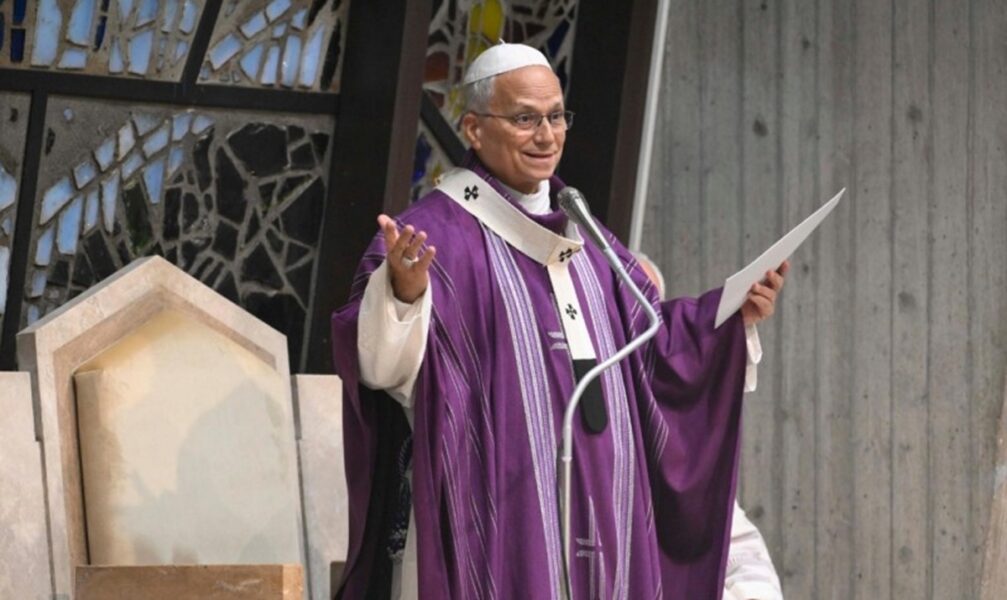
Pope Leo XIV began this Sunday, November 29, the first Sunday of Advent, with a pastoral visit to the parish of San Carlo da Sezze, in the Roman neighborhood of Acilia. The community is preparing to celebrate next year the fortieth anniversary of the dedication of its church. The Pontiff presented himself to the faithful “as your Bishop” and said he had come to share in prayer and to “confirm you in the journey of faith.”
Before Mass he greeted the children of the parish. He reminded them that the Diocese of Rome is carrying out this year a “review” of its pastoral life, and that one of its focuses is the encounter with Christ: how each person lives it and how they help others to find it. The Pope noted that, in some cases, the children have been the ones who have brought their parents back to the parish, and he told them that they too have the mission Jesus entrusted to all the baptized.
In his homily, the Holy Father began with the plea of the prophet Isaiah: “Oh, that you would rend the heavens and come down!” (Is 63:19). He described it as the cry of a people bearing the wounds of its history. Yet he added that faith teaches that this invocation “has already been heard,” because in Jesus God entered “definitively into our history.” Christ came in the humility of the flesh, is awaited in his glorious return, and each day meets man “with his Word, in the Sacraments and through our brothers and sisters.”
Prayer and vigilance, two inseparable attitudes
The Pope pointed out that the day’s readings propose two attitudes for Advent: prayer and vigilance. They are inseparable, he explained, “because whoever prays learns to sense the Lord’s closeness, and whoever keeps watch trains himself to guard the desire to encounter him.”
On the first, he returned to Isaiah: “We are the clay, and you are the potter” (Is 64:7). To pray, he said, is “to surrender oneself to the Lord.” Prayer does not always change circumstances, but it gives light and strength to face them, and teaches us to present the world’s pain before the Father. The Pope cited peoples wounded by war, families struck by precariousness, those who have neither work nor housing, and those who feel that no one is waiting for them. “Prayer does not cancel suffering. But it prevents us from growing accustomed to it,” he affirmed. He invited the faithful to pray as a family, to frequent the sacraments, and to make space for the Word of God and for silence.
The second attitude is vigilance. The Pope commented on the Gospel of Mark (13:33-37) with a warning: “In our frantic world one can be very busy, yet have a sleeping heart.” Like the man in the parable who entrusts his house to his servants, God entrusts to each person their existence and their gifts so that they may collaborate in his work of salvation. At this point he cited number 8 of Magnifica humanitas, his first encyclical, published in May and dedicated to the human person in the age of artificial intelligence, to urge working together “without seeking our own prestige.” To keep watch, he concluded, is “to remain faithful to the good without needing to appear”: keeping promises, reconciling, visiting the sick, and working honestly. “We do not know the hour of his return, but we know how to await him: by loving as he has loved us.”
The parish, “a house in the midst of houses”
Pope Leo XIV applied the image of the house in the parable to the parish. He described it as a “house” among the houses of the neighborhood, whose walls, raised by the generosity of many families, hold “sacrifices, prayers, gestures of trust.” He asked the community to make room for those who arrive, to seek out those who have drifted away, and to go out into the neighborhood to meet also those who “perhaps will never enter spontaneously” into its spaces. All of this, he stressed, with the Eucharist at the center, as the patron of the parish taught. Saint Charles of Sezze was a seventeenth-century Franciscan brother known for his eucharistic devotion and canonized by John XXIII in 1959.
He then addressed a few words to the young people linked to the youth formation center Madonna di Loreto – Casa della pace. He told them that the Church, before proposing activities, wants to know what they are living and to welcome their questions. He also invited them to help her discover “the new solitudes” and to find suitable languages for transmitting the faith. “Do not be afraid to respond to the Lord’s voice,” he told them. To the community he asked that they trust the young people and offer them “responsible educational relationships, safe environments,” and a closeness that respects their freedom.
The memory of Fr. Mario Torregrossa
The most personal moment of the homily was the remembrance of Fr. Mario Torregrossa, promoter of the parish’s youth work. According to the Pope, the inspiration came to him before the Holy House of Loreto. On November 24, 1996, while praying in that same church, he suffered what Pope Leo XIV called “a very serious assault.” The press of the time reported that he was set on fire and suffered burns over 40 % of his body; a 28-year-old man was arrested and charged with attempted homicide.
The Pontiff explained that the memory of that wound is kept so as not to forget his suffering and the closeness of those who supported him, and “above all to make our own his model of perseverance in charity and in forgiveness.” “The evil he received never extinguished his desire to live, to serve, and to love,” he added.
Pope Leo XIV concluded by thanking the catechists, volunteers, and those who sustain the community “with hidden prayer.” He entrusted everyone to the Virgin Mary and closed with the invocation of the Book of Revelation: “Amen. Come, Lord Jesus” (Rev 22:20).