


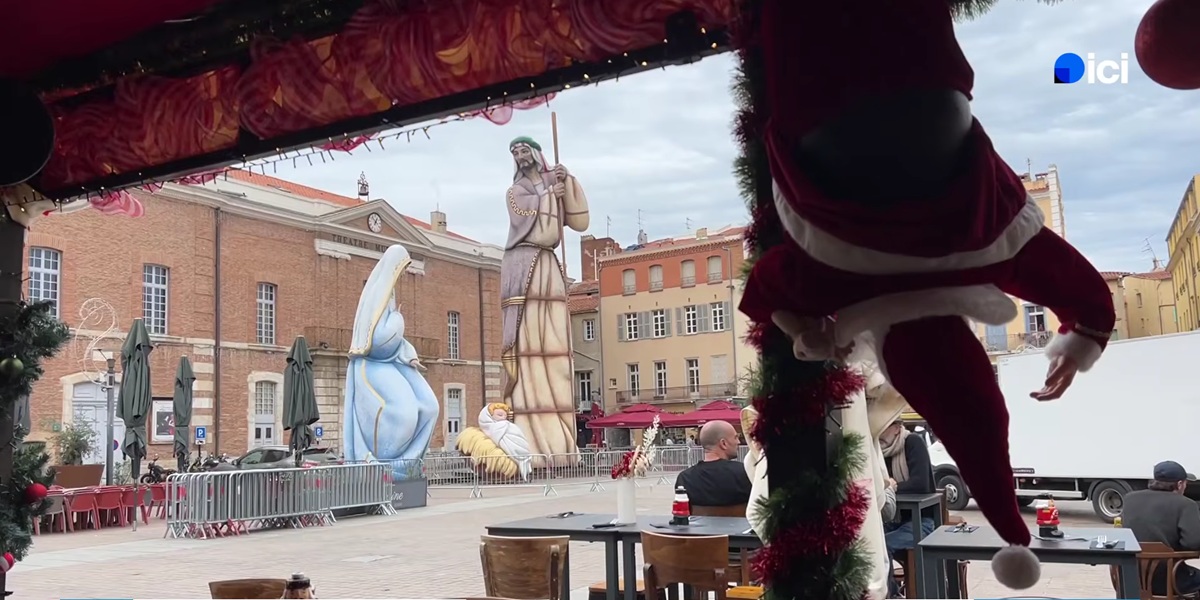
Perpignan, capital of the French department of the Pyrénées-Orientales, has been displaying a Holy Family of a size never seen before in the city since this week. The figures were placed starting Tuesday, November 24, in the Place de la République, in front of the municipal theater. They include a Saint Joseph over 14 meters tall, a Virgin Mary about 8.5 meters tall, and a Child Jesus 3 meters tall.
The ensemble is the work of the Spanish artist Pachi, the artistic name of José Manuel García Esquiva, creator of the giant nativity scene in Alicante. According to the AFP news agency, the City Council led by Louis Aliot, vice-president of the Rassemblement National (RN), paid around 120,000 euros for it. The council bought it, rather than renting it, to set it up every winter. The mayor himself stated on BFMTV that the investment is planned “for at least twenty years.”
The official inauguration is scheduled for December 4 at 6:00 p.m. There will be lyrical singing to “celebrate the magic of Christmas,” according to the municipal program. The city hall also plans to purchase new figures in the coming years.
“Everyone is delighted”
At the end of September, the mayor’s chief of staff, Farid Belacel, explained to AFP the two objectives of the city council. The first is to “satisfy the Catalan tradition of displaying a nativity scene during the end-of-year festivities.” The second is to increase the city’s tourist appeal.
Aliot emphasizes its cultural and popular character. “Today Christmas is secularized; it is a celebration that everyone enjoys, including non-believers,” he said this Friday on BFMTV. In that interview, he recalled that “we are in Catalan country” and that this representation “is present in every village.” In statements to Aleteia, he maintained that “we must ensure this cultural presence in our streets and in our lives.”
The mayor attributes to the nativity scene a message of “calm, happiness, peace, and love.” He hopes it will attract “thousands of people” who will stroll through the city and shop in its stores. Regarding critics, he was blunt: in his view, everyone is delighted “except the far-left grumblers and some secularists, such as the freethinkers or the Human Rights League.”
This emphasis on presenting the nativity scene as shared heritage, rather than as an expression of faith, aligns with the criteria of French justice. The courts only allow these representations in public spaces when they are not presented as a religious claim.
What the courts said in 2025
The nativity scene in the Place de la République comes after a judicial setback. In February 2025, the Administrative Court of Montpellier prohibited the installation of a nativity scene in the courtyard of Perpignan City Hall. It based its decision on the 1905 separation law and the principle of neutrality of public administrations. However, the same ruling considered it “possible” to place it in “other public locations,” provided it does not constitute “an act of proselytism or a claim of a religious opinion.”
This criterion follows the doctrine established by the Council of State in November 2016. In buildings that house an administration, a temporary nativity scene is only permitted if particular circumstances give it a cultural, artistic, or festive character. In other public places, the context of the end-of-year festivities allows its installation, unless it is an act of proselytism. The background is Article 28 of the 1905 law, which prohibits, with exceptions, the placement of religious signs or emblems on public monuments and sites.
The LDH and the opposition, against it
The Human Rights League (LDH) already announced in 2025 that it would challenge what it called the “illegal and provocative” practices of far-right mayors. According to the organization, these mayors are instrumentalizing the Catholic religion for partisan purposes, and the nativity scene violates the 1905 law. Henri Saurine, president of the LDH in the Pyrénées-Orientales, described the project on RTL as “poudre aux yeux,” a mere publicity stunt. He also recalled that the State and local authorities must remain neutral regarding religions.
In the municipal opposition, Agnès Langevine (Place publique), vice-president of the Occitanie region, described it to AFP as an “asserted ideological act, contrary to secular universalism.” She also criticized the spending at a difficult time for residents’ purchasing power.
On the street, residents interviewed by AFP are divided. Some reject the idea that the institutions of a secular state should fund religious figures with public money, or lament the cost and the constant surveillance of the ensemble. Others applaud the initiative because, in the words of a resident of Espira-de-l’Agly, it serves to “maintain our traditions.” The sources consulted do not indicate that the LDH has already appealed this year’s installation.