


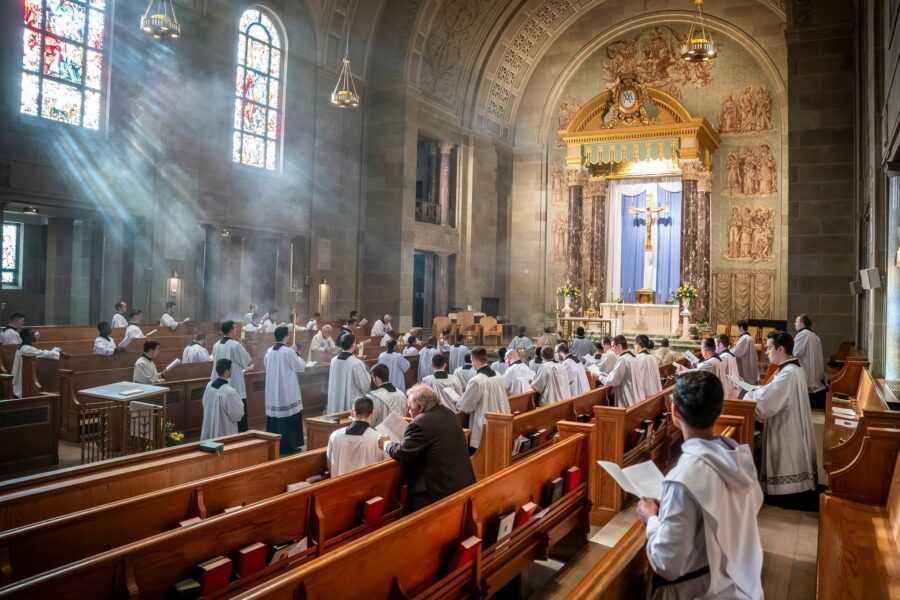
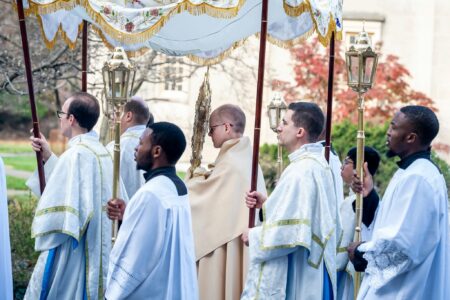
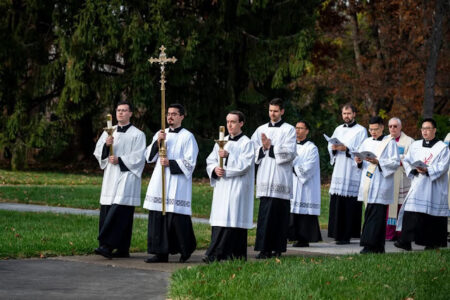
The American priest Allan J. McDonald, author of the blog Southern Orders, has published a testimony about the seminary where he was formed. The photographs of the Forty Hours at Saint Mary’s Seminary and University in Baltimore, shared on Facebook, made him cry. He recounts this himself in a post dated November 23. The images show seminarians wearing cassock and surplice and a procession with the Blessed Sacrament. For McDonald, none of that would have been possible in the house he knew in the 1970s.
Saint Mary’s carries great symbolic weight. The Sulpician priests, who arrived from France, founded it in 1791, and it is the oldest Catholic seminary in the United States. Generations of North American clergy have passed through its halls. That is why what happens there often serves as an indicator of the evolution of priestly formation in the country.
A seminary without cassocks or adoration
McDonald’s account of his years as a seminarian is very clear. According to him, the students did not wear cassock or surplice in the choir, nor alb to serve at the altar. There was no dress code, smoking was allowed in class, and priest-professors were called by their first names. Neither the Rosary nor the full Divine Office was prayed, and no one encouraged adoration before the Blessed Sacrament. Private devotions, and in general everything prior to the Council, were frowned upon.
In his four years of formation, the priest recalls only one Benediction with the Blessed Sacrament. According to him, it was organized to appease a group of «conservative» classmates who were causing problems for the formators. There was no monstrance. A paten with the consecrated Host, made of bread with honey, and a chalice with consecrated wine were used.
The detail is not minor. Church discipline requires that the bread for the Eucharist be of pure wheat and recently prepared (canon 924 of the Code of Canon Law). The instruction Redemptionis Sacramentum (2004) expressly lists honey among the substances whose addition constitutes a grave abuse.
McDonald says he has good memories of that stage and that he grew in faith. But he was formed in a «progressive» faith, in the so-called spirit of the Council, and came to think he was preparing for a Church with priestesses and homosexual marriages. He also denounces liturgical abuses, pressure in favor of the ordination of women, and tolerance of sexual immorality. In his opinion, that pastoral theology, which he considers revived during the pontificate of Francis, condoned sin instead of calling for conversion.
A new Sulpician rector
The priest attributes the change to the new rector, also Sulpician, who according to him carries the Blessed Sacrament in the procession in the photos. This is Fr. Shawn D. Gould, PSS. He was appointed by the provincial council of the Company of Saint Sulpice and assumed the position on July 1, 2026. On September 2 he was installed at a Mass presided over by the Archbishop of Baltimore, William E. Lori. Gould succeeds Fr. Phillip J. Brown, who retired after ten years at the head of the seminary.
«This would never, never have happened in that seminary of the 1970s,» writes McDonald, who ends his text with praise to God.
A devotion recommended by Church law
The Forty Hours consist of the solemn and prolonged exposition of the Blessed Sacrament. They originated in Milan in the sixteenth century and Pope Clement VIII regulated them for Rome in 1592. In the United States they were spread by Saint John Neumann, who in 1853 organized them on a rotating basis in the parishes of Philadelphia.
The practice is not a mere aesthetic preference. Canon 942 recommends that in churches where the Eucharist is reserved, a solemn exposition be held each year for an appropriate length of time. Recovering these customs in a historic seminary means, above all, returning to applying what the Church already asks.