


The Almudena Cathedral, dressed in martyr’s red and filled with incense, hosted this Saturday, November 28, the beatification of Ignacio Aláez Vaquero and ten companions, murdered out of hatred for the faith in Madrid between 1936 and 1937. Nine were seminarians aged 18 to 24; the other two, an elderly priest and a father who refused to be separated from his son. Nearly 2,000 faithful packed the church, while many more followed the Mass on the screen set up on Bailén Street.
The celebration was presided over by Cardinal Marcello Semeraro, Prefect of the Dicastery for the Causes of Saints, on behalf of Leo XIV. Hundreds of priests concelebrated, wearing red chasubles and stoles, along with more than twenty bishops: Cardinal José Cobo, Archbishop of Madrid; the bishops of Alcalá de Henares and Getafe, Antonio Prieto and Ginés García; the Archbishop of Burgos, Mario Iceta; the Bishop of Jaén, Sebastián Chico; the emeritus cardinals Antonio María Rouco Varela and Carlos Osoro; the auxiliaries Juan Antonio Martínez Camino and Vicente Martín; and the auxiliaries-elect Fernando Murga and Andrés Martínez. The Diocesan Choir of Getafe provided the music.
Eleven palms and a single relic
The Mass began shortly after noon with an entrance chant proclaiming the blood of the martyrs as the seed of Christians. Cardinal Cobo solemnly requested the beatification, and the postulator, María Victoria Hernández, gave a brief profile of each Servant of God. Semeraro then read the Apostolic Letter by which the Pope grants that the eleven, who died forgiving their executioners, “be henceforth called by the name of blessed.”
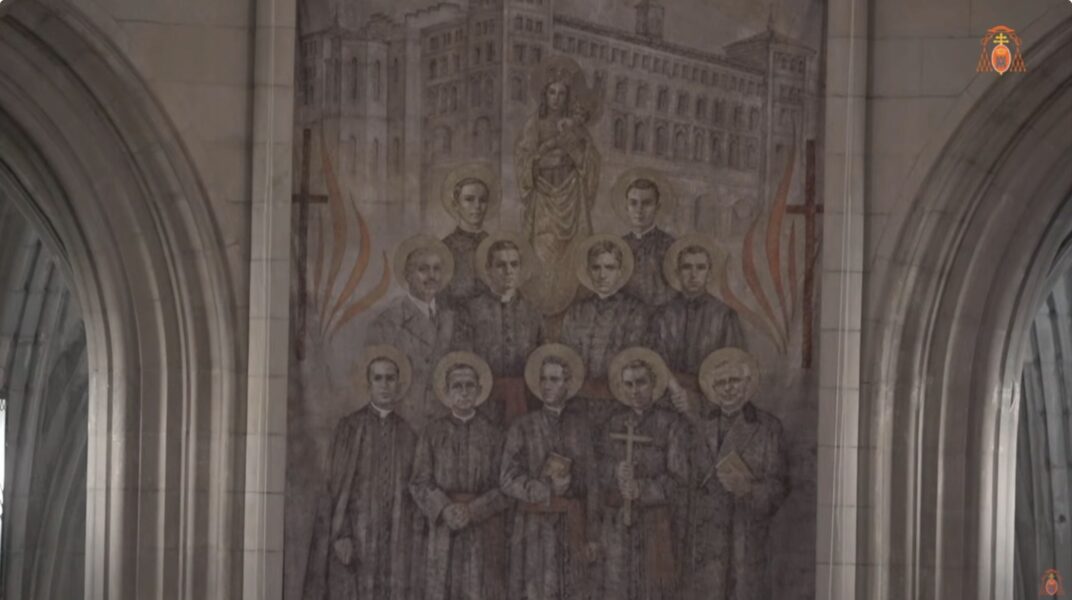
Two seminarians then slowly removed the cloth covering the painting of the new blesseds, placed in the central arch of the sanctuary, behind the Crucifix and beneath the Pantocrator. The canvas depicts them beside the Virgin and the Seminary of Madrid. The cathedral erupted in a long, emotional applause.
A deacon carried in procession the relic of Ángel Trapero, the only one of the eleven whose body could be identified. He was escorted by eleven palms, borne by a priest, nine seminarians, and the father of a seminarian: the same portrait of the group the Church has just glorified. The Gloria then resounded beneath the vaults. In the front pews sat the martyrs’ relatives, mostly nephews and nieces, alongside some 150 residents of Socuéllamos (Ciudad Real), the hometown of Cástor Zarco, who had arrived that same morning with their priests.
“Stronger than fear”
Semeraro’s homily began with Saint Paul’s question to the Romans about who could stand against those with whom God is, and paused on the youth of the seminarians, who turned their few years into an offering. With Saint John of Ávila, patron of the Spanish clergy, he recalled that the priest must burn with love for God and zeal for souls; with Saint Teresa, that God alone suffices. He also quoted Leo XIV’s words to the young people in Lima about the fire of faith that spreads.
The Prefect warned that martyrdom is a singular grace whose fidelity is forged daily in prayer, listening to the Word, and charity without reserve, and he asked for vocations that do not fear to give their lives to Christ. The new blesseds, he affirmed, bear witness that Christ’s love is “stronger than fear, than violence, and even than death.”
The Archbishop of Madrid closed the ceremony with words of gratitude. He spoke of eleven Christians from whom “an unjust violence sought to strip everything they had bet on,” without succeeding in separating them from Christ; he presented their testimony as a path of forgiveness and reconciliation, and thanked the work of the Delegate for the Causes of Saints, Alberto Fernández, the Rector of the Seminary, Antonio Secilla, and the families who safeguarded their memory for ninety years.
The assault on the Seminary
On Saturday, July 18, 1936, the Conciliar Seminary of Madrid was holding a retreat. While they were eating, the porter warned that a group of armed militiamen was storming the building. The retreatants ran to the chapel to consume the sacred hosts, hid the painting of the Immaculate Conception in an organ pipe, and, dressed in civilian clothes, escaped through the garden gate. The archives, containing the addresses of the 215 seminarians, were later used to hunt them down at their homes.
Seven of the new blesseds belonged to the then diocese of Madrid-Alcalá and had entered the Seminary as boys, between the ages of 11 and 16.
Ignacio Aláez (22), the son of a barber, had always lived on Calle del Oso in Lavapiés. He was arrested with his father, Evelio, a member of the Nocturnal Adoration. At the walls of the Fuencarral cemetery they offered him, because of his youth, the chance to save his life if he renounced the faith. He returned to the firing squad and died shouting “Long live Christ the King!”
Antonio Moralejo (19), the youngest of five brothers, had been discovered days earlier defending the parish of El Carmen, near Puerta del Sol, from desecration. When they came for him at his home in Argüelles, his father, Liberato Moralejo (60), declared that the boy would not leave without him. They shared a cell in Modelo Prison and martyrdom in Paracuellos.
Ángel Trapero (20), the son of a watchmaker from Navalcarnero, was arrested at the family home and shot alongside three priests from the Porlier checa. His father moved heaven and earth to free him and finally identified the body by its clothing. His remains have rested since 2017 in the Seminary chapel.
Miguel Talavera (18), the youngest, was from Boadilla del Monte. His parents visited him every Sunday at the Seminary; they saw him for the last time on October 7, 1936, when he was taken from home. Jesús Sánchez (21) was arrested at the building on Calle Donoso Cortés where his parents worked as porters.
Pablo Chomón (21), born in Burgos and a brilliant theology student, spent his final weeks in Ciempozuelos with his uncle, the priest Julio Pardo Pernía (63), chaplain of the Hospital Sisters, who encouraged his own by reminding them that executioners can kill the body but can do nothing against the soul.
Cástor Zarco (23), already a subdeacon, returned that summer to Socuéllamos. His father, Timoteo, took him out of the village hidden in a cart and entrusted him to a family in a nearby town. He was murdered in Alcalá de Henares in 1937. The street where he was born is now called Beato Cástor Zarco.
Two seminarians from other dioceses complete the group. Mariano Arrizabalaga (21), from Barbastro and a student at Comillas, was living in Madrid with his family because of his father’s illness; he was arrested on October 5, 1936, in an apartment on Calle Apodaca. Ramón Ruiz (24), a seminarian from Toledo, was imprisoned in the cathedral of Jaén with Bishop Manuel Basulto, arrived in the capital on one of the “death trains,” and fell at the Pozo del Tío Raimundo.
A fifteen-year cause
Except for Trapero, all were thrown into mass graves; most now rest in the cemetery of the Martyrs of Paracuellos or in the basilica of the Valley of the Fallen. The cause was opened in 2010, sent to Rome in 2014, and Leo XIV recognized the martyrdom on December 18, 2025. With them, there are now 34 Spanish seminarians from that persecution raised to the altars, out of the approximately 110 who lost their lives. In their joint pastoral letter, the bishops of the ecclesiastical province stressed that the martyrs “are not ‘hostages’ of any political denomination.”
The chapel of the Conciliar Seminary, where the painting of the blesseds has also been unveiled, remains open to venerate the tomb of Ángel Trapero this Saturday until 8:00 p.m. and on Sunday from 10:00 a.m. to 2:00 p.m. The liturgical feast will be celebrated each November 6. Thanksgiving Masses will be held this Sunday, the 29th, at 12:00 p.m. in the Almudena, presided over by Cardinal Cobo; on December 4 at the monastery of San Bernardo in Alcalá de Henares; on December 11 at the Cerro de los Ángeles; and on December 13 at the cathedral of Burgos.