


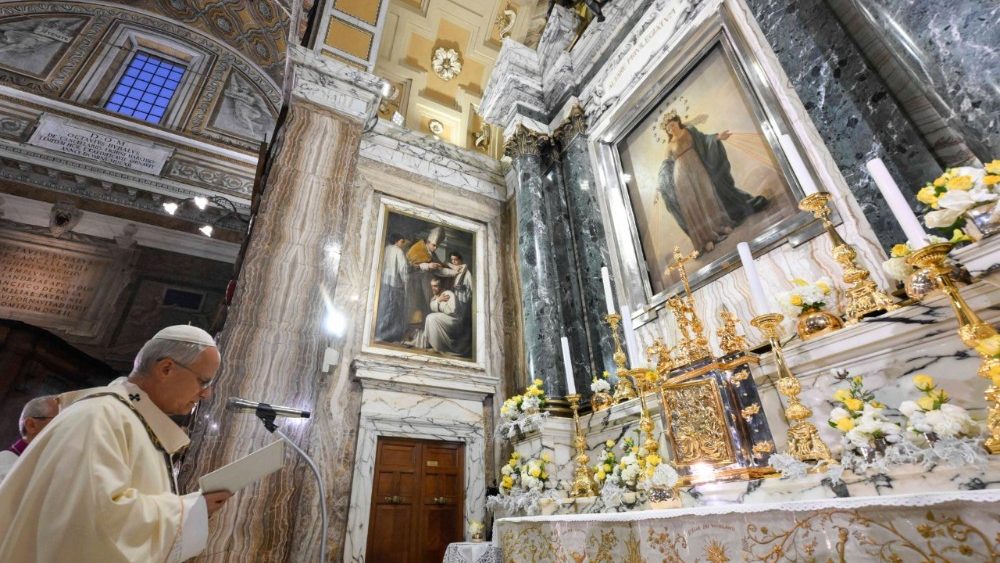
Pope Leo XIV presided over the Holy Mass on November 27 at the Basilica of Sant’Andrea delle Fratte, in the historic center of Rome, on the occasion of the feast of Our Lady of the Miraculous Medal. According to EWTN News, the Pontiff arrived around four in the afternoon. Before the celebration, he prayed at the main altar and recited a supplication before the image of the Madonna del Miracolo.
The feast commemorates the apparitions of 1830 to Saint Catherine Labouré, a religious of the Daughters of Charity, in Paris. In them, the Virgin asked her to mint the medal that popular devotion would eventually call “Miraculous,” one of the most widespread Marian images in the world.
The Roman church holds a unique connection with this devotion. In it, in 1842, Alfonso Ratisbonne, a French Jew, was converted; he declared having seen the Virgin as she appears represented on the medal, and would later become a priest and missionary. Because of this episode, the church is popularly known as “the Lourdes of Rome.” Leo XIV opened his homily by recalling that conversion.
“I come as a pilgrim, to invoke the help and intercession of the Virgin Mary in a difficult moment for the history of humanity, marked by wars and unjust inequalities that attack human dignity,” the Pope stated, inviting those present to join his prayer.
Cana, Calvary, and the altar
The Pontiff centered his homily on the Gospel of the Wedding at Cana. He presented Mary as the attentive mother who notices what is lacking and places it in the hands of her Son. When she says “They have no wine,” he explained, she is concerned because that banquet, “a sign of the covenant of love between God and his people, risks ending in a disappointing way.”
Jesus’ response (“my hour has not yet come”) refers, according to the Pope, to Calvary. There the “Woman” gathers the water and blood that flow from the side of the Crucified. “That blood is the Blood of the new covenant that we offer today on the altar in the Eucharistic Celebration. That water evokes the gift of the Holy Spirit,” said Leo XIV, explicitly linking the sign of Cana with the sacrifice of the Mass. In the death and resurrection of Christ, he added, “the nuptial banquet reaches its fullness.”
The Pope summarized the Virgin’s mission in three verbs: “to give us the Son, to point him out, to lead us to Him.” The key to that mission is obedience, which he defined as “the strength that sets in motion again situations that seem blocked.” He also warned against the spiritual lethargy of those who sit at the table without truly participating in the banquet prepared by God.
Jesus, he recalled, starts from the ordinary: six stone jars filled to the brim. Leo XIV asked the faithful to offer him “the little we have: a humanity tested by the loss of peace, young people who have difficulty building their own future, families in which dialogue has been lost, the loneliness of so many people in the cities,” so that “in our obedience his abundance may find space.” He described conversion as a change of gaze: reading history with the eyes of the risen Christ.
The invisible ones in the center of Rome
In the final part of the homily, the Pope brought that gaze to the neighborhood surrounding the sanctuary. He described the historic center as “a table set before the eyes of the world,” full of monuments, shops, tourists, and pilgrims, where many people go unnoticed.
“The poor sleep in the streets, the elderly are left alone; there are many foreign brothers and sisters, and workers whose wages wound their dignity,” he stated, according to the version released by EWTN News.
Leo XIV asked the parish community to place the artistic and spiritual beauty of their church at the service of those most in need, so that Marian devotion may lead to a faith that becomes charity.