


At six minus five in the morning on Tuesday, Ràdio Estel broadcast the prayer of the day, in memory of Saint Andrew Dung-Lac and companion martyrs, with the letter that one of them, Saint Paul Le-Bao-Tinh, wrote in 1843 from prison to the students of his seminary: “This prison is like an image of eternal hell.” Later he said that he was full of joy because he was not alone, but with Christ, who bears the full weight of the cross and wears on his head the crown of glory.
Six hours later, the same station connected live with the Archdiocese of Barcelona for the first joint appearance of Cardinal Juan José Omella and Friar Octavi Vilà, his successor. The journalist from Catalunya Religió brought up the Sagrada Família: the day before, Rac1 had reported that Omella had vetoed Miquel Barceló, one of the three artists who have presented proposals for the façade of the Glory. Omella replied that he did not know there had been any controversy, that the Construction Board had preferred to study more thoroughly “how we design what Gaudí thought the façade of the Glory should be,” and explained where the difficulty lies: “He, in a concept of a time, both theological and civil, a way of understanding heaven, earth and hell; nowadays we have another concept, and artists and theologians present it in another way. Reconciling all this takes time.”
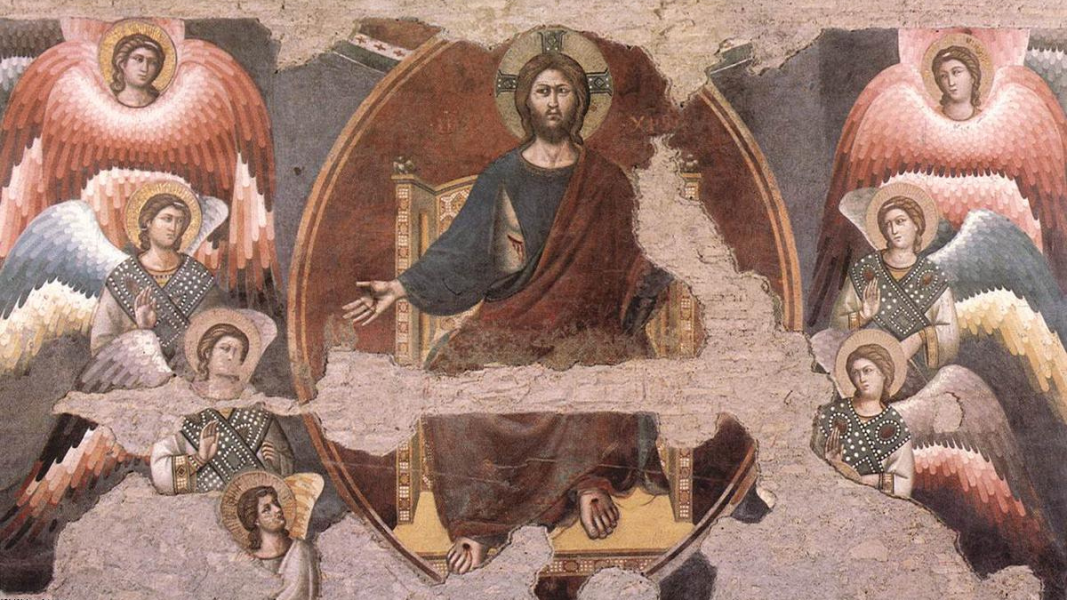
What Gaudí thought is told by the temple itself in its information booklets. The façade of the Glory will present the history of humanity “from Adam and Eve to the Last Judgment.” On the outer columns of the narthex will go the seven capital sins. Purgatory will be “right under heaven.” Hell, Gaudí placed it at a level lower than the temple, next to Mallorca Street. And at the top of the portico, Jesus Christ at the Last Judgment, whom the booklet’s caption bluntly calls “Christ the Judge.” The text summarizes it this way: if the Nativity façade tells of Jesus’ coming into the world and the Passion façade his final days, “the Glory façade could only be centered on his glory.”
The cardinal called it “a concept of a time.” The Catechism does not speak of eras: “The Church’s teaching affirms the existence of hell and its eternity.” The Creed does not either: Christ “will come in glory to judge the living and the dead.” Credit must be given to Omella that he denied nothing. In the same reply he spoke of a work “theologically well represented” and of artists who succeed in representing “heaven, purgatory and hell”; half an hour later, in Spanish, he recalled that Gaudí wanted it to be seen from the outside “what heaven is like, what hell is like, what purgatory is like,” and added: “well, it is not easy.” A benign reading is therefore possible: that he was speaking about how to tell it today and why the Board is in no hurry. But the adjective was his: the concept of a time was “both theological and civil.” If what has become obsolete is theology, it is not clear what will have to be represented theologically well.
It is not the first time this week. On Sunday, the solemnity of Christ the King, a commentator on the same station went so far as to say that “God is not a judge.” And the clearest voice on Tuesday about the judgment was not the archbishop’s. At ten-thirty, the host of the magazine announced that the Tuesday biblical contributor, Oriol Jara, intended to speak “about heaven and hell,” and added: “Will we speak? I don’t know.” Jara preached Christ as the only one who saves and quoted Saint John: “whoever does not believe in him has already been condemned.” Heaven was spoken of. Hell was not.
The station had its own correspondent in the room. On Monday it had promised to ask the two “questions that challenge us.” She introduced herself as a journalist “from Catalunya Cristiana and Ràdio Estel” and asked Vilà how his first hours in what will be his home were going, “also on a personal level.” Vilà spoke of meetings and how hard it had been to keep the secret of the appointment. The question about Sunday’s vote was asked by El Debate, and Vilà referred to the note from the Episcopal Conference. No one asked about the radio.
In the last question in Catalan, TV3 wanted to know whether Omella was satisfied with his legacy. “The legacy, whoever has the capacity to judge, let him do so,” he replied, and recounted that every night, at Compline, he asks the Lord for forgiveness: “I entrust it into the hands of God and history will judge.” At 12:57, the studio closed the connection with a tribute to the cardinal, “a decisive man” who “has moved” the archdiocese, and signed off: “We’re going to Montserrat.” What sounded next was the PSC spot: “Let’s vote with strength against the right and the far right.” It was the second of the four socialist spots on Tuesday. Since last Wednesday there have been at least twenty-one. From no other party have we heard any.
Omella stated that the Construction Board will be chaired by the new archbishop, so Vilà will also have to chair the decision on how the judgment is sculpted. He will also chair the radio foundation. On the façade plan, above is Christ the Judge. On the radio, after the cardinal, the PSC was heard.
“Ràdio Estel, the archbishop’s radio” is a daily section of InfoVaticana. We listen attentively to the radio of the Archbishop of Barcelona and tell you what we find: advertising, guests, language, what is said and what is kept silent. Ràdio Estel belongs to the Fundació Missatge Humà i Cristià, linked to the Archdiocese of Barcelona and presided over by its archbishop.
The Archbishop of Barcelona is responsible for what is heard on it.
Read also
- The archbishop’s radio, twelve minutes after the Christ the King Mass: “Let’s vote with strength against the right”
- The new Archbishop of Barcelona anticipates how he will govern: “Each one is responsible for the task he assumes”
- The radio that Vilà inherits: “Vote PSC,” talk show against PP and Vox and not a word about abortion