


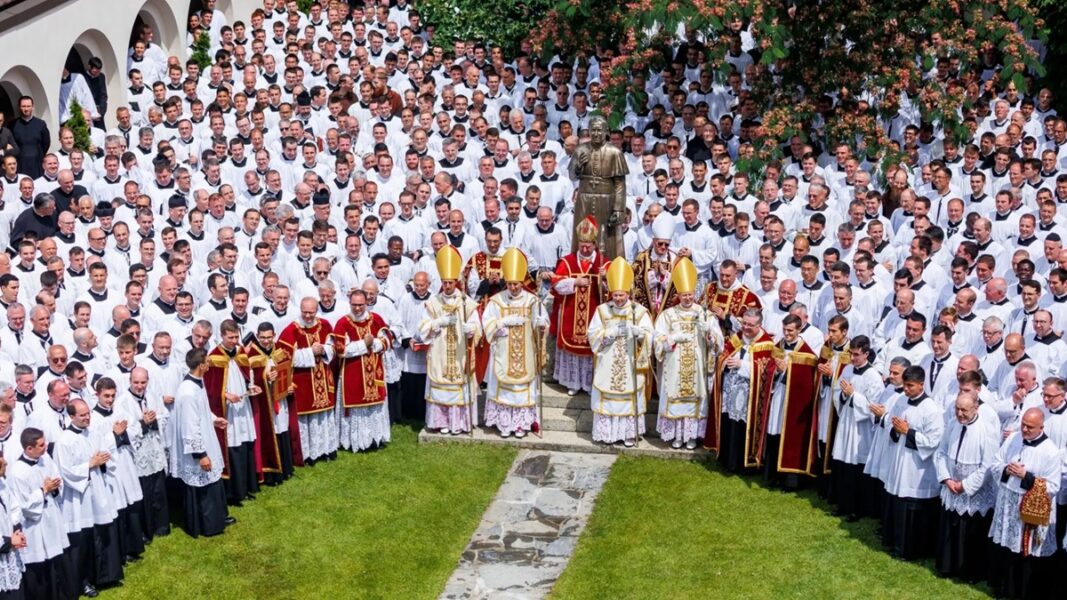
The Priestly Fraternity of Saint Pius X has released its annual statistics, with data closed as of November 1, 2026. The balance was published by FSSPX Actualidad on November 25. According to this count, the work founded by Archbishop Marcel Lefebvre in 1970 has 1,539 members: 6 bishops, 740 priests, 284 seminarians, 152 brothers, 89 oblates, and 268 sisters, including professed, novices, and postulants. The average age is 44 years, and the members come from 58 nationalities.
This is the first count since the episcopal consecrations celebrated in Écône on July 1. The following day, Cardinal Víctor Manuel Fernández, prefect of the Dicastery for the Doctrine of the Faith, signed a decree of excommunication latae sententiae against the consecrating and consecrated bishops.
Growth in almost all branches
Compared with the 2025 figures, the balance is positive. A year ago the Fraternity had 1,482 members, 733 priests, 264 seminarians, 145 brothers, 88 oblates, and 250 sisters. In twelve months it has gained 57 members. The most striking figure is that of the seminarians, which rises from 264 to 284. Priests increase by only seven, from 733 to 740. The report does not explain this balance: it does not say how many have been ordained, how many have died, or how many have left.
The women’s branch grows from 250 to 268 members. The Congregation of the Sisters of the Fraternity, founded by Archbishop Lefebvre with the help of his sister, Mother Marie-Gabriel, now has 227 professed and 41 novices and postulants. The religious sisters depend on their own Mother General, but work in close union with the Fraternity. The brothers rise from 145 to 152 and the oblates from 88 to 89.
The profile of the members is also changing. Nationalities increase from 50 to 58. The average age drops from 47 to 44. The Fraternity also records 105 deceased members since its foundation, compared with 99 last year.
Six bishops, without jurisdiction
On July 1, Bishop de Galarreta, assisted by Bishop Fellay, conferred episcopal consecration on Bishop Pascal Schreiber, Bishop Michael Goldade, Bishop Michel Poinsinet de Sivry, and Bishop Marc Hanappier. Schreiber was rector of the Sacred Heart Seminary in Zaitzkofen. Goldade directed the St. Thomas Aquinas Seminary in Dillwyn (United States). Poinsinet de Sivry was superior of the Benelux District, and Hanappier taught in Dillwyn.
The report repeats the Fraternity’s position since 1988. Its bishops limit themselves to conferring Holy Orders and Confirmation, and “neither receive nor claim any episcopal jurisdiction” over priests or faithful. Rome, however, sees the consecrations as a schismatic act. The Dicastery’s Explanatory Note states that the sacred ministers of the FSSPX “are in schism and must therefore be considered schismatics.” The Fraternity rejects this qualification and maintains that the consecrations cannot be considered a schismatic act.
More Mass centers and associated communities
Territorial expansion is the indicator that rises the most. The Fraternity serves 871 of its own Mass locations, compared with 798 last year. Those of associated communities rise from 79 to 121. The FSSPX is present in 82 countries, five more than in 2025, and is organized into 18 districts and autonomous houses. It maintains its five international seminaries, where formation lasts six years.
Its own houses rise from 184 to 196. Those of associated communities jump from 19 to 51, an increase the document does not explain. The Fraternity’s schools remain at 94, while those of associated communities rise from 46 to 50. According to the text, priests live in priories, ideally of at least three, and from there attend to nearby chapels.
The Fraternity itself closes the report with its reading of the data: it states that it continues to grow “despite contradictions and difficulties.” The statistics do not include any estimate of the number of faithful who attend its chapels.