


By Stephen P. White
NOTE: Today is Black Friday, which has nothing of Good Friday or anything recognizably Christian about it. But you can make it so by spreading a little Christmas cheer: with your support for The Catholic Thing. – Robert Royal
We live in an apocalyptic age. Even now one can almost hear the deep groaning of the foundations of our modern Babel, creaking under the impossible weight of man’s pride. Our “wise men” predict either boundless prosperity or total destruction as they compete to build the very machines they tell us to fear and which, they hope, will give them wealth and power beyond all comprehension. That seems like a bad deal for most of us.
Meanwhile, we have just celebrated the most Christian of our secular holidays, a day set aside for gratitude for gifts received and commemorated, as far as possible, in the company of family and friends. Thanksgiving has become, if only by its proximity on the calendar, the gateway to the “holiday season,” which is another way of saying “Advent begins on Sunday.”
Today –Black Friday– is perhaps the least Christian of our secular holidays. It seems we have lost the sense of irony and self-criticism that the name once carried when it was first given, decades ago. If anyone doubts that Black Friday is a holiday, I suggest they pay closer attention. The natural consumption of the Thanksgiving table, even taken to excess, is nothing compared to the binge that follows on this great feast day of consumerism.
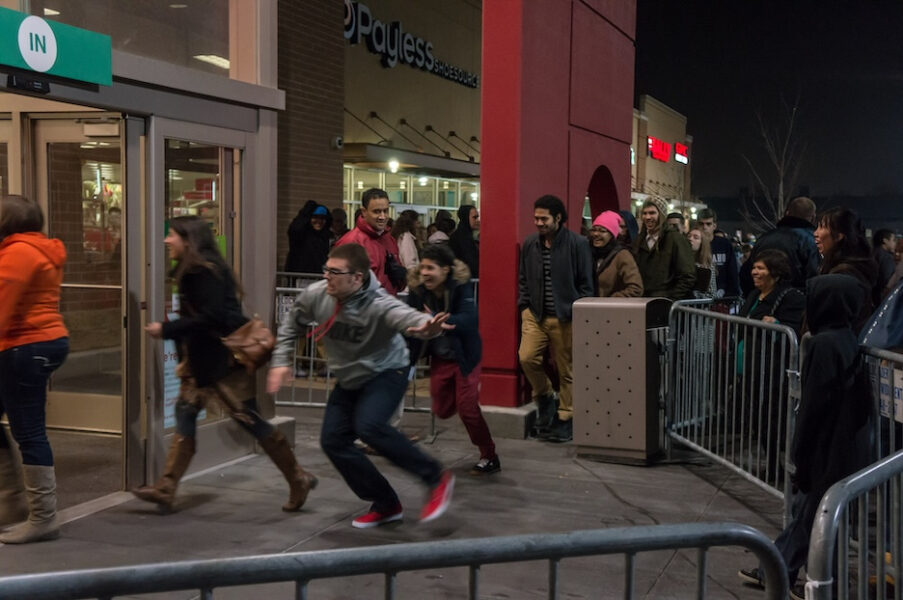
Still, very good deals are to be had. And thanks to some of those same precocious geniuses who are about to bring us the AI apocalypse, I can do my Christmas shopping from the comfort and safety of my living room. There was a time, not so long ago, when shopping on Black Friday involved a slight risk of being trampled by a human stampede in some suburban mall. Now I don’t even have to get off the couch. The truth is, Christmas shopping has to be done one way or another, and if there is any virtue in paying more for the same gifts later, I’m not sure what it is.
Speaking of virtue, since antiquity it has been understood that virtue has the quality of a mean, that is, of a moral quality that suffers from neither excess nor defect. (Thus, courage lies between recklessness and cowardice, both of which are vices.)
But there was another element in the definition of virtue, less remembered today: that virtue is a habit in accordance with nature. I suppose one could be “moderately unnatural,” but moderation does not turn the unnatural into virtue.
Human art has made consumption less constrained by nature than before. The ancient distinction between economy and chrematistics –the unnatural accumulation of wealth for its own sake– which formed the classical basis for warnings (and something more than warnings) against usury, seems hopelessly outdated today.
Or perhaps it seems outdated when we check the balance of our 401k retirement fund, and somewhat less outdated when we are paying the credit card bills for all those Christmas purchases.
For a younger generation, burdened with student loans and priced out of the housing market by older generations who treated housing primarily as an investment good, the economy of recent decades seems less a miracle of human ingenuity than an intergenerational Ponzi scheme carried out on a global scale.
Whether one sees a kernel of truth in those complaints or is scandalized by the ingratitude of a younger generation’s flirtation with socialism is, in a way, irrelevant: the ancient distinction between the management of household goods (economy) and unnatural accumulation (chrematistics) could well prove politically and socially explosive in the years to come.
Or perhaps those sparks of discord will be extinguished, drowned in a flood of abundance unleashed by an AI revolution in which tens of trillions of dollars have already been invested. I find that unlikely. After all, there is a reason we cannot simply have good things (see Genesis 3).
Still, the material abundance we enjoy today, however insatiable we remain, would have been almost unimaginable just a few generations ago. And yet, here we are. It seems far more likely to me that AI will make us all richer than that it will make us even a little happier.
Pope Benedict XVI once wrote about “economic forms based on solidarity, which find their natural sphere in civil society,” and which do more than create wealth: they also “build society.”
I confess I do not know exactly what that would look like, but I sense that it resembles more the economic activity of an ordinary household (in which producing, sharing, buying, saving, and borrowing are meant to serve the persons of that household) than some optimized, maximized, and hyper-efficient algorithm of accumulation.
There is nothing wrong with maximizing the return on an investment; it is simply that the return is measured very differently when one invests in real people rather than in money itself. The psalmist knew well what he was writing:
The idols of the nations are silver and gold,the work of human hands.They have mouths but do not speak;they have eyes but do not see;they have ears but do not hear,nor is there any breath in their mouths.Those who make them become like them,as do all who trust in them.
Whatever the future holds for us, we will still need Thanksgiving. (We could probably do without Black Friday, but something tells me we won’t.) If love covers a multitude of sins, gratitude immunizes us against many others. Gratitude draws us out of ourselves and, in doing so, helps us not to “become like them,” like the idols we ourselves create, whether of silver, gold, or silicon.
Yes, we live in an apocalyptic age: the age of Revelation. That too is a reason for gratitude rather than fear. And, as Advent approaches, it is a reason for hope. “Come, Lord Jesus! The grace of the Lord Jesus be with all.”
About the author
Stephen P. White is executive director of the Saint John Paul II National Shrine and a fellow in Catholic Studies at the Ethics and Public Policy Center.