


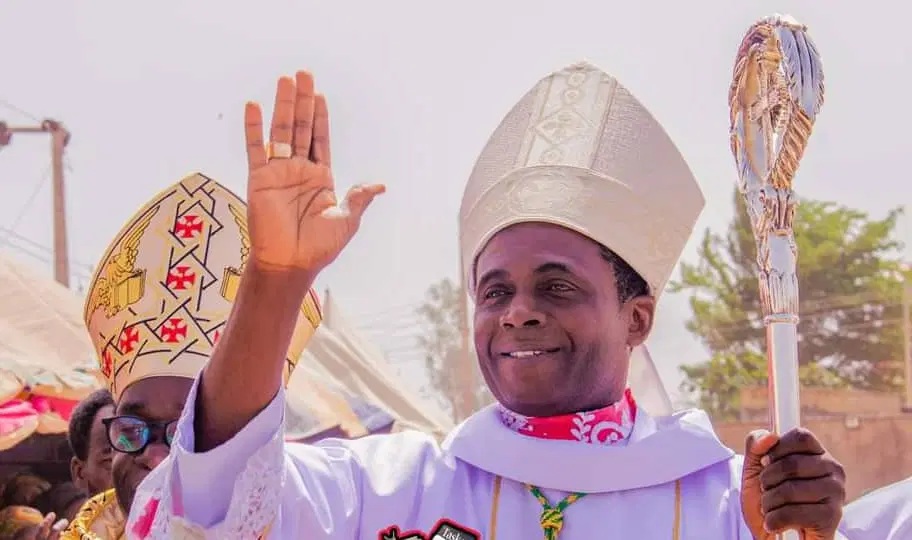
Bishop Gerald Mamman Musa of Katsina has described in an interview with the U.S. Catholic outlet The Pillar the difficulties facing the small Catholic community in Nigeria’s far north. According to the prelate, legal restrictions are compounded by a widespread sense of fear that shapes Christians’ daily lives and discourages conversions.
“Many Muslim leaders have stated clearly that, if they became governors, they would not be willing to work with Christians,” the bishop said.
Musa recalled an episode from when he served as a bishop’s secretary. The diocese wanted to buy land from a Muslim owner to build a church for the area’s growing Catholic population. The owner was ready to sell, but changed his mind once he learned the land’s intended use: he refused to sell it “for all the money in the world” and explained that his neighbors would never forgive him.
No law officially prohibits building churches in the region, nor is there a statute that punishes conversion. Yet, the bishop noted, “most people who wish to convert are afraid of the consequences,” which range from losing their inheritance to suffering physical attacks.
A Hausa bishop in a Muslim-majority land
The Diocese of Katsina was erected in October 2023 by Pope Francis, carved out of the Diocese of Sokoto and made a suffragan of the Archdiocese of Kaduna. Musa is its first bishop. The Pillar presents him as the first Hausa bishop in the Church’s history. The Hausa, one of northern Nigeria’s major ethnic groups, are overwhelmingly Muslim, and their language is the most widely spoken in the region.
The bishop’s father converted to Catholicism at age twelve and raised his eight children in the faith, while the rest of the family remained Muslim. His middle name, Mamman—a Hausa adaptation of Mohammad—was given to him by a Muslim aunt. According to the prelate, most of the diocese’s roughly 20,000 Catholics are also Hausa and represent less than 1 % of the territory’s population.
Katsina is one of the twelve northern states that adopted sharia in 2000. “Sharia makes others feel like second-class citizens in the same state, and that is how Christians feel,” Musa observed. “When it is said that sharia must be imposed by force and that democracy and the Constitution are worthless, it is Christians who will suffer.”
The bishop views the introduction of Islamic law as largely a populist measure by local governments, whose promises to end corruption and nepotism went unfulfilled because “the politicians who introduced it are not willing to submit to the law.” Along the same lines, he criticized the closure of all schools during Ramadan, ordered last year by several northern states, including Katsina. He pointed out that these are among the country’s most educationally backward states, while the children of certain governors study outside the state or even abroad. “So who benefits from all this?” he asked.
Violence with multiple causes
Nigeria has endured more than a decade of violent attacks against Christians in some regions. Musa stresses that the violence is complex. Religion is a factor, but so are long-standing conflicts between herders and farmers, worsened by easy access to automatic weapons. “Poverty, historical grievances, and politics all play a role,” he summarized.
Much of the conflict is concentrated in the country’s central belt, where predominantly Muslim Fulani herders encroach on land farmed mostly by Christians. The bishop explains that religious persecution is cited because the victims are overwhelmingly Christian and the attackers shout “Allahu Akbar.” He notes, however, that tensions have also risen in the north between Fulani and Hausa, who are Muslim but traditionally farmers. Musa rejects demonizing an entire ethnic group, though he is concerned about the radicalization of the Fulani: “There are signs of radicalization, often traceable to politicians, backed by clerics and then by other leaders. There are clear indications that religious factors are at play in some of these conflicts.”
Trump’s bombings and the elections
In October 2025, President Donald Trump again designated Nigeria a “country of particular concern” for religious freedom. Weeks later he threatened to enter the country firing indiscriminately if the Nigerian government did not stop attacks on Christians. On Christmas Day, Washington announced airstrikes in the northwest, which the U.S. government said targeted Islamic State jihadist camps.
Almost a year later, the bishop sees no change. “People hoped the bombing would alter the attitude of extremist Muslims, but nothing has changed,” he said. “The area where the bomb fell is not even where we have conflicts between Muslims and Christians.”
Security appears to have improved. According to The Pillar’s data, five kidnappings or murders of Catholic clergy and religious have been recorded so far in 2026, compared with the dozens typical in other years. Musa urges caution and attributes the improvement to the proximity of presidential elections scheduled for January 16, 2027. “Last week, several priests in my diocese narrowly escaped kidnapping. The situation may look better, but when elections approach there is a lot of window-dressing, and then everything returns to square one.”
What worries him most is the deterioration of coexistence. “What we have seen in recent years, especially in neighboring states, is segregation,” he warned. Christians and Muslims who once lived together now live apart. For the bishop, the state has a decisive role to play: “Instead of saying that one group or religion has its own law and others another, we need a law inspired by people’s everyday lives and by our cultural, religious, and human values. We have not explored that path.”