


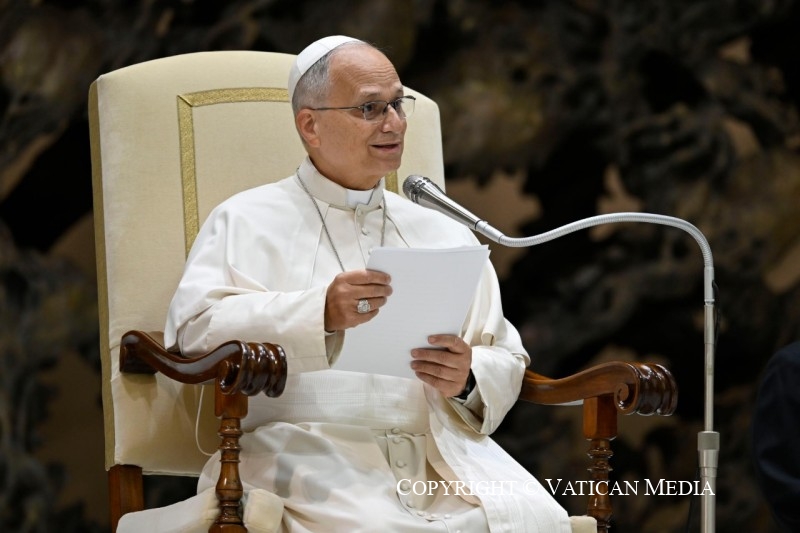
Pope Leo XIV received this Thursday, November 26, in the Synod Hall the participants in the joint Assembly of the Union of Superiors General (USG) and the International Union of Superiors General (UISG), more than 250 leaders of orders and congregations, and asked them to be “artisans of an unarmed and disarming peace.” The Pope did not read a prepared speech, but responded to six questions asked in four languages, according to the text of the dialogue published by the Holy See. The assembly, whose theme is “Walking together toward an unarmed and disarming peace,” is being held from November 25 to 27 in Sacrofano, near Rome.
Peace begins with the “yes” of each religious
To the first question, on how to be artisans of peace, the Pope replied that peace is Christ’s peace and that the religious begins “the peaceful revolution of the Gospel” above all with his or her “yes.” Later, speaking about division in the world and in communities, he noted that what divides, “today as yesterday,” is greed, “the desire to have for oneself and to make oneself by oneself.” In response, he proposed that living the evangelical counsels of chastity, poverty, and obedience, and doing so in common, is to be “a mirror in the world of God’s light.”
Authority: to serve with charity and prefer to be loved rather than feared
Asked how to overcome divisions within congregations, Pope Leo XIV referred to Saint Augustine and proposed serving with charity, for which he cited the Augustinian Rule, according to which the superior should prefer to be loved rather than feared. He added that whoever exercises authority must act “before God,” that is, from prayer. To another question about what he has learned in the exercise of his ministry, he replied that one must listen a great deal, have much patience, and continually renew faith.
Synodality and artificial intelligence
On synodality, the Pope maintained that community is a gift of God and that consecrated life must be a model of listening, learning “to move from the I to the we, from thinking alone to thinking together.” In the final question, concerning the use of artificial intelligence to promote human dignity and care for creation, he described it as a new instrument that must be guided by human intelligence, “with its conscience and its freedom.” He also recalled that the principal task of consecrated persons is to bear witness to the dignity of the person, and, according to the assembly program, after the audience the Latin Patriarch of Jerusalem, Cardinal Pierbattista Pizzaballa, was scheduled to speak.