


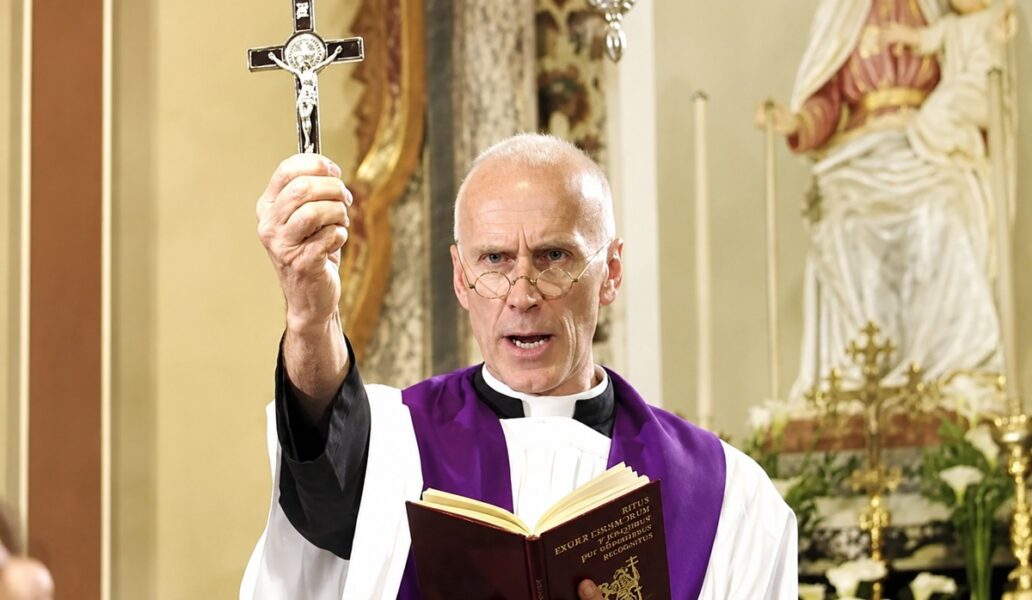
The Italian documentary Libera nos – Il trionfo sul male, directed by Giovanni Ziberna and Valeria Baldan and produced by Sine Sole Cinema, premiered this November in French theaters. It is the latest stop on a journey that began in Italy in 2022 and later passed through Spain, Latin America, and the United States. As Ziberna told La Nuova Bussola Quotidiana, the film reached eighth place in the U.S. independent cinema rankings in 2025.
On the occasion of the French release, the Italian newspaper interviewed Father Francesco Bamonte, who also appears in the documentary. Bamonte is a religious of the Servants of the Immaculate Heart of Mary, an exorcist of the Diocese of Rome, and vice president of the International Association of Exorcists (AIE). Father Gabriele Amorth founded this association in 1994, and the Congregation for the Clergy approved its statutes in 2014. For Bamonte, exorcism does not resemble what horror films portray: it is “a moment of light” in which the power of God is manifested.
A documentary against sensationalism
Ziberna explains the warm reception due to the interest in the topic, although he notes that cinema has almost always portrayed it with caricatures. Bamonte agrees. The AIE decided to sponsor the film “above all because it rejects all sensationalism.” In addition, the film attempts to explain what the Church truly teaches about the devil, his extraordinary action, and the concrete experience of exorcists. In his view, the testimonies in the documentary convey a correct theological vision, which is why he attributes to it a “formative purpose.”
Several exorcists and theologians appear in the film. Don Matteo De Meo, an exorcist and doctor in patristics, maintains that the devil is not a symbol. According to him, the demon gains ground both when his existence is denied and when an unhealthy interest is shown in him. Theologian and demonologist Renzo Lavatori explains the fall of Lucifer and his plan to destroy Christ, which ultimately led to his defeat. He warns that today he directs that same effort against the Church, the body of Christ. The documentary also reviews the norms of the ministry: who receives the mandate and what qualities are required of the exorcist. It also highlights the value of sacramentals (blessed water, salt, and oil), prayer, and sacrifice in keeping the demon at bay.
Formation for priests and a warning against occultism
Asked about the lack of demonology training in seminaries, Bamonte recalls that the AIE has been organizing courses in Italy and other countries for years. They are based on the Guidelines on the Ministry of Exorcism in Light of the Current Ritual. The goal is for priests to learn to discern each case and guide the faithful, because the first people approached by those who believe they are suffering from an extraordinary action of the demon are usually ordinary priests, not exorcists. That is why he considers Libera nos “a valid introduction” to the topic, both for priests and laypeople.
The Roman exorcist emphasizes that the film exposes the dangers of esotericism, occultism, magic, and spiritualism. It does so at a time when the New Age is also advancing among Catholics who consider these practices harmless. Bamonte maintains that their danger is not only spiritual: they also attack the freedom and dignity of the person and create “devastating moral dependencies.” The documentary devotes part of its footage to explaining why horoscopes, reiki, tarot, spiritualism sessions, or consultations with magicians are not harmless practices.
The Virgin, whom the devil fears
A large part of Bamonte’s testimony in the film revolves around the Virgin Mary, to whom he already dedicated the book La Vergine Maria e il diavolo negli esorcismi. He recounts that in some exorcisms the demon shouts at a presence no one can see to leave. When he asked if he was speaking to the Virgin, the demon answered yes. At other times, he relates, the demon complains that there is “too much light.” Bamonte explains that, compelled by God to tell the truth through the authority of the exorcist, the demon admits that this light comes from her. “It is a great comfort to know that the Virgin comes to pray and assists us,” he states.
The exorcists in the documentary explain that the demon, being proud, flees before Mary’s humility. Hence the efficacy they attribute to the Rosary and to the consecration of the person or family to the Virgin. Father Amorth, who died in 2016, also appears in the film with one of his best-known phrases: “The Rosary is stronger than the atomic bomb.” Bamonte also recalls an occasion when, after an exorcism, he prayed the Rosary with his collaborators. Then the demon angrily described the Virgin as a mother who waits for her children until the end and weeps when they do not listen to her.
Ziberna has already announced his next work, which will address the danger of sects and occultism, spiritual healing, and the ordinary struggle against evil.