


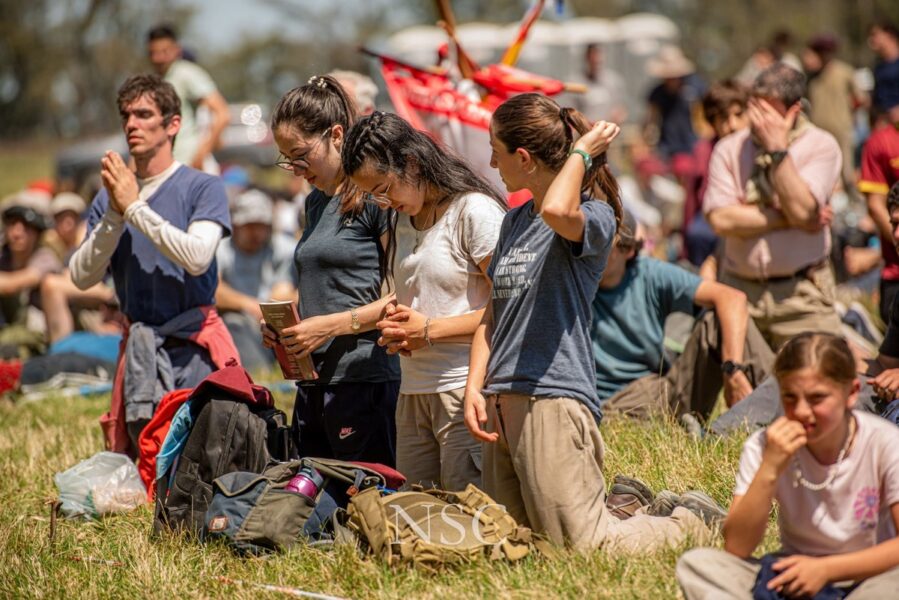
The Sunday magazine of The New York Times has dedicated this November 23 a wide-ranging report to a phenomenon that American clergy have been discussing for some time: young men of Generation Z entering the Catholic Church after discovering the faith online. The piece is written by Canadian journalist Zander Sherman, with photographs by Will Warasila. It gathers the testimony of three converts and begins with a cautious observation: after decades of decline, the retreat of Christianity in the United States appears to have halted.
The data aligns with the latest major study from the Pew Research Center. According to its Religious Landscape Study 2023-2024, the proportion of Christians has remained relatively stable since 2019. Today, 62% of American adults identify as Christian: 40% Protestant, 19% Catholic, and 3% from other denominations. Pew itself warns, however, that young adults remain far less religious than their elders. The Times report also references surveys indicating a rebound in religious practice among Generation Z men, though it acknowledges that the phenomenon is still “poorly quantified.”
Sherman, who spoke with dozens of converts, describes strikingly similar paths among them: debates on YouTube, Reddit forums, discussions on apps, and a religious identity often formed before ever stepping into a church. Many of these young men, the author notes, were dissatisfied with modern life and saw in Catholicism an alternative that offered meaning. This could explain why some seek a more traditional expression of the faith than is common among Catholics.
From Discord to the Traditional Mass in Ottawa
Antonio Spagnuolo, a 20-year-old from Quebec, is the most striking case. His mother was raised Protestant and his father is Muslim. As a child he attended the mosque, but over the years he came to consider himself an atheist. During the pandemic, depressed and shut in front of a screen, he admits he filled the void with video games and pornography. He became interested in Catholicism on Discord servers, chatting with teenagers from around the world who were passionate about history, politics, and religion. With those virtual friends he prayed the rosary every day and learned to pronounce Latin, without his parents knowing.
One Sunday in March 2021, he secretly took a bus to St. Clement parish in Ottawa. There he attended a Mass entirely in Latin, with the priest facing away from the congregation. Although everything felt completely foreign, the experience did not deter him. St. Clement is entrusted to the Priestly Fraternity of St. Peter, celebrates the sacraments according to the 1962 liturgical books, and was the first diocesan parish dedicated exclusively to the Traditional Mass after the liturgical reform following the Second Vatican Council. Spagnuolo converted at 17 and goes to confession every two weeks. He says his family initially reacted with anger, but that he has since contributed to the conversion of his mother and sisters.
Arguments Before Emotions
Hanuman Durina de Hiduegh works in the tech sector in Detroit, is 28 years old, and converted in April 2025. His parents left Catholicism for Hinduism before he was born, though the family still attended Midnight Mass at the home of a great-grandfather who was Catholic. Already married and with a good job, he recounts that he and his wife realized their goals—making money and buying a house—lacked any real foundation. They studied the various Christian denominations online, asked ChatGPT about Calvinist double predestination, and compared the answers with those of authors from centuries past.
He explains that what ultimately convinced them was Catholicism’s insistence that belief alone is not enough: one must strive to love rightly and live according to God’s will. It is a personal formulation, but it echoes the teaching of the Council of Trent. In its decree on justification, Trent rejected the thesis of sola fides and taught that the justification received grows through good works. Durina de Hiduegh estimates that around 30% of his colleagues under 30 are Catholic, and he especially highlights the naturalness with which they speak of their faith today.
Bryan Blowers, 22, studies Architecture at Texas A&M University. On November 21 he received baptism, confirmation, and first communion at the St. Mary’s Catholic Center, at the end of the Order of Christian Initiation of Adults (OCIA, formerly known as RCIA). He was raised in a non-denominational evangelical church, and says his interest was sparked in Florence, standing before churches built by generations who would never see them completed. Then came the podcasts: Pints With Aquinas, Fr. Mike Schmitz, and The Counsel of Trent. He says he deliberately avoided Reddit and less rigorous sources.
A Search for Authority and Stability
Blowers will marry in February; his fiancée also received confirmation and first communion that same day. He says he approached the faith more with reason than with emotion, and that at his parish he was taught that going to Mass is a duty of praise to God, not the pursuit of an emotional experience. What sustains him, he explains, is knowing that the authority is not himself. In his view, his generation seeks stability because the values of secular culture are unpredictable, and he compares faith to the handrail of a staircase.
Durina de Hiduegh points in the same direction when he recalls his great-grandfather, whom he describes as a bearer of a more objective morality, less subject to the fashions of the moment. The report offers no new statistics and does not claim to be a sociological study. Its value lies in the testimonies of young people who come to the Church after reading, discussing, and reasoning—and who, in some cases like Ottawa, find their place in the traditional liturgy.