


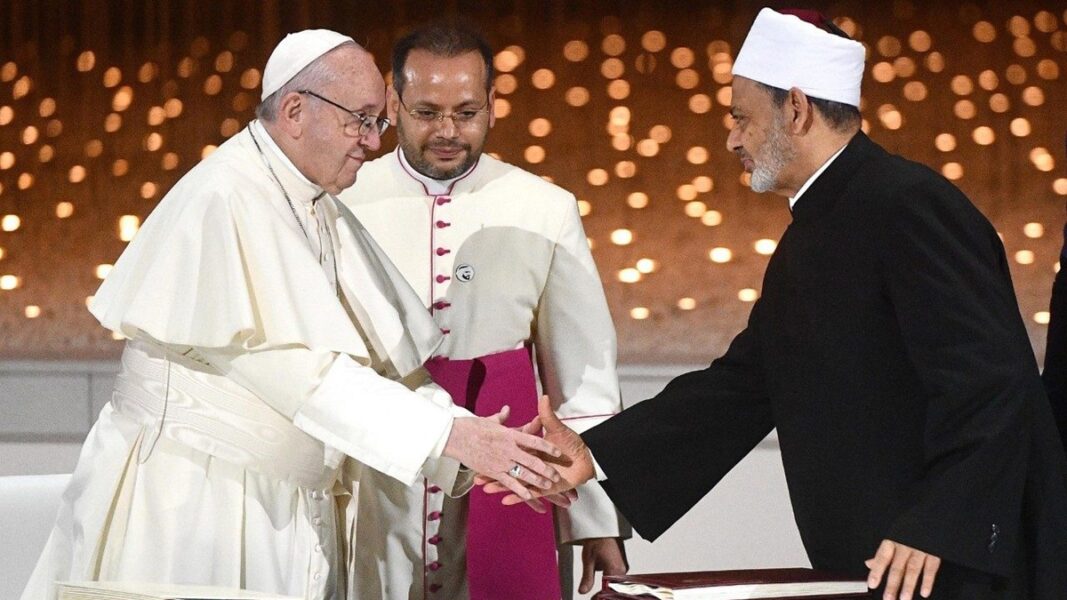
Monsignor Yoannis Lahzi Gaid, an Egyptian Coptic Catholic priest and personal secretary to Pope Francis, has called for reciprocity in religious freedom as a prerequisite for any meaningful dialogue with Islam. He made this statement in an interview with Alessandro Bertoldi published on November 18 in the Italian daily Il Tempo, where he also discussed the reading of the Abu Dhabi Declaration, the Document on Human Fraternity signed in 2019 by Francis and the Grand Imam of Al-Azhar, in whose drafting and promotion he participated. Gaid maintains that the document can serve as a brake on the clash of civilizations, but only if it is read with intellectual honesty and applied practically both in the East and in the West. In this context, he argues that reciprocity in religious freedom, freedom of conscience, and equality before the law must become the criterion by which the commitments made by each party are measured.
A “moral declaration,” not a theological agreement
The former secretary of Francis insists that the Abu Dhabi text is a moral declaration and not a theological agreement, and therefore rejects any interpretation based on syncretism or the assumption that Christians and Muslims share the same beliefs. In his view, recognizing doctrinal divergences—such as those concerning the Trinity, the Incarnation, or even the very notion of fraternity—does not hinder dialogue but rather frees it from misunderstanding. Along these lines, Gaid warns against what he calls the “illusione della trasparenza semantica,” that is, the belief that using the same words implies sharing the same concepts. Without clarity and without reciprocity, he adds, dialogue is reduced to an exercise in diplomatic courtesy, although he considers it indispensable as long as it is grounded in truth.
Freedom of conversion and consistency of interlocutors
According to Gaid, credible Muslim interlocutors are those who demonstrate consistency between what they say in the West and what they convey to their own communities, condemn violence, and demand for Christians living in Muslim-majority countries the same rights they ask for Muslims in Europe, including freedom of conversion. The prelate also referred to political Islam, which some Arab states are combating, something he described as an “encouraging sign,” and advocated for cultural and educational reforms as well as a renewal of religious discourse. Regarding the West, he stated that integration is not automatic, not even among second- and third-generation immigrants, and proposed reconciling hospitality, security, and religious freedom through a firm application of common law, distinguishing criticism of doctrines from discrimination against individuals.
A document that continues to spark debate
The Abu Dhabi Declaration is one of the most controversial texts of Francis’s pontificate, particularly because of the passage that presents the plurality of religions as the fruit of a wise divine will. Gaid’s words, as he now presides over the Foundation for Human Fraternity, provide an interpretation from one of the collaborators who participated in its drafting. InfoVaticana has recently reported how the document continues to appear among the episodes that perplex many Catholics, in the interview with Bishop Athanasius Schneider on the “double attack” against the Church.