


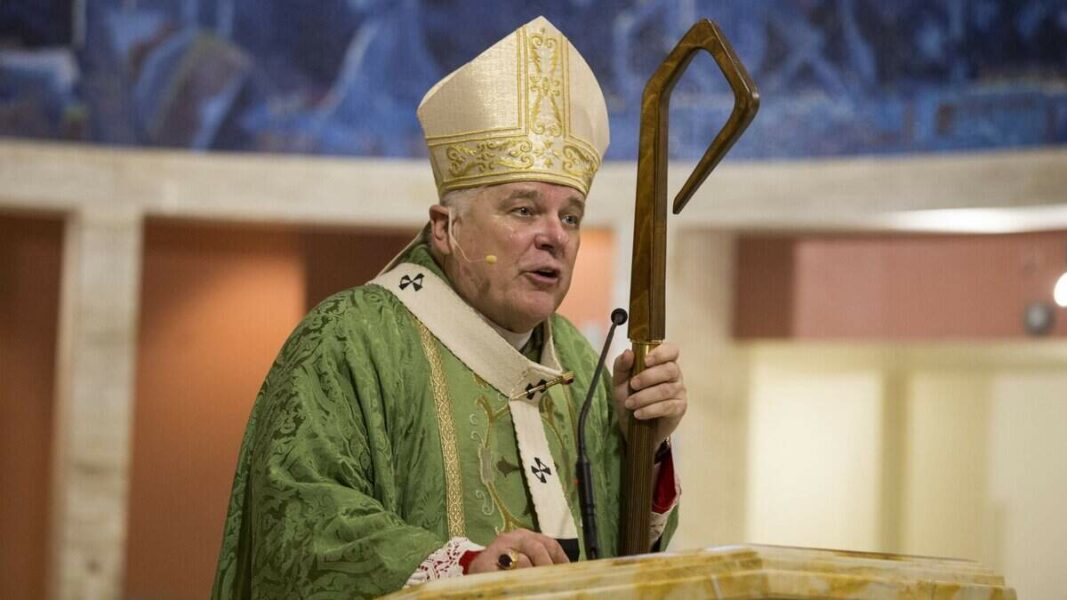
Archbishop of Miami Thomas Wenski used the Q&A portion of the panel “A New Generation of Seekers” to point out an absence he found striking: no one had mentioned secularism. The session took place on the afternoon of November 18 during the fall plenary assembly of the United States Conference of Catholic Bishops (USCCB) in Baltimore.
“Well, throughout this presentation no one has mentioned Charles Taylor or his analysis of secularism, something we’ve been dealing with for a generation or more,” the prelate stated.
Charles Taylor and the “disenchantment” of the West
Wenski drew on the work of the Canadian Catholic philosopher. In A Secular Age (2007), Taylor describes Western modernity as a process of “disenchantment” of the world. If secularism can be read that way, the archbishop argued, what we see today among many young people points in the opposite direction: “What we are seeing, I believe, in these young people is a search for re-enchantment.”
The archbishop offered two very visible liturgical examples. “It can be seen in those who kneel, in those who insist on kneeling to receive Holy Communion. It can be seen in the young people who go to the Latin Mass and insist on attending,” he said. “They are seeking to rediscover the magic, so to speak, the charm that the Catholic Church possesses in such abundance.”
Wenski, 76, has led the Archdiocese of Miami since 2010. He added that he was surprised neither the word “secularism” nor the idea of “re-enchantment” had surfaced as keys to understanding what these young people are seeking.
His remarks touch on two issues that continue to divide the Church in the United States. Since Traditionis custodes (2021), celebration with the 1962 Missal has been heavily restricted, and Leo XIV has authorized it only on a case-by-case basis. In Charlotte, a draft attributed to Bishop Michael Martin was leaked that proposed, among other measures, banning communion received kneeling. On this point, the instruction Redemptionis Sacramentum (2004) is clear: paragraph 91 states that it is not lawful to deny communion to a faithful person solely because they wish to receive it kneeling.
What the survey says
The panel was moderated by Aaron Weldon of the New Wineskins Project. Participants included Brandon Vaidyanathan, professor of Sociology at The Catholic University of America and principal investigator of the study; theologian Angela Franks; and Joshua Abando, a university chaplain who works with Generation Z.
The conversation was based on the 2026 Survey on Beauty and Beliefs, conducted by The Catholic University of America with Gallup. About 5,000 U.S. adults were interviewed, 1,165 of them between the ages of 18 and 29. Sixty-four percent of young Catholics say religion matters more to them than it did five years ago, compared with 41 percent of Catholics over 30. Among young people whose faith has grown, 82 percent attribute an important role to encountering beauty in churches or religious rites.
The study also dismantles a stereotype. Thirty percent of young Catholics describe themselves as “religious but not spiritual,” compared with 12 percent of older Catholics, and only 14 percent consider themselves “spiritual but not religious.”
The speakers nevertheless urged caution against speaking of a religious revival. Weekly Mass attendance among young Catholics hovers around 25 percent, and daily prayer is less frequent than among their elders. The panel also noted that 58 percent of young U.S. Catholics are Hispanic, a group that attends Mass weekly less frequently. The Church, they warned, remains “quite far” from a renaissance.
From tarot to liturgy
Franks invoked Zygmunt Bauman’s concept of “liquid modernity” to explain why the Church attracts people as a stable institution in a society of shifting identities. Abando, drawing on his work with university students, spoke of Generation Z’s desire to find something solid, real, and tangible.
Vaidyanathan was the one who responded directly to Wenski. According to the sociologist, the longing for enchantment has been shifting away from traditional religion toward other practices, such as tarot, which is widespread among millennials. He also acknowledged that the stalling of secularization raises a new question: whether the enchantment once associated with traditional religion can be rediscovered within the Church.