


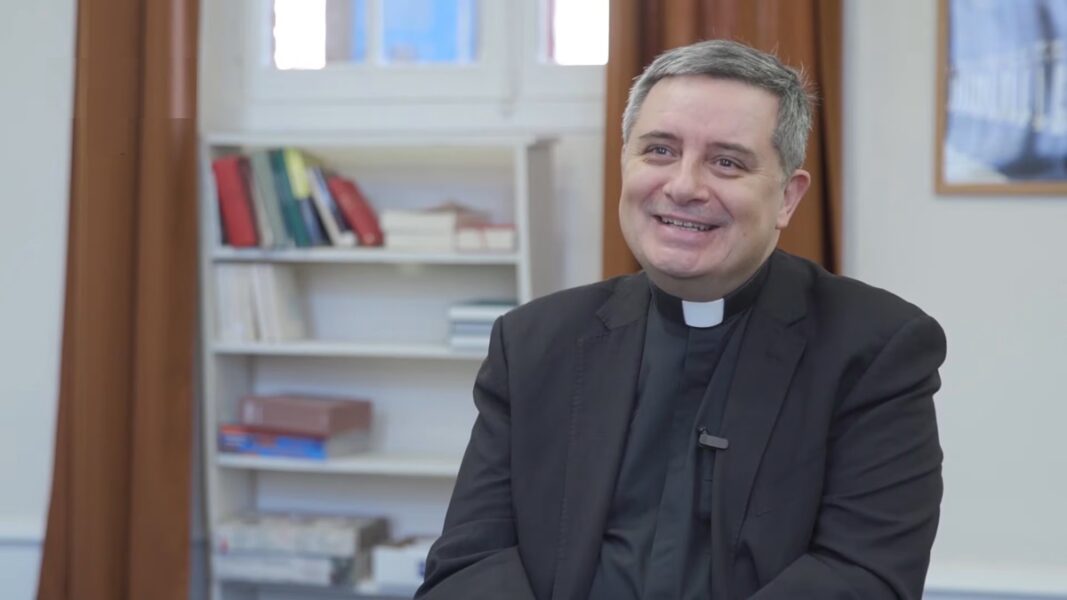
Eight months after the visit of Leo XIV to Monaco, the diocese of the Principality continues to wonder what to do with what it received that day. Its archbishop, Dominique-Marie David, explains it in an interview with Andrea Gagliarducci for ACI Stampa published on November 20. In it, he describes a phenomenon already seen in neighboring France: young people who have been raised without faith and who, as adults, ask to enter the Church.
The Pope was in Monaco on March 28 on a one-day trip, the first by a pontiff to the Principality. He met with Prince Albert II, with the Catholic community in the cathedral and with young people and catechumens in front of the church of Santa Devota, and celebrated Mass at the Louis II stadium.
“What do we do with what we have received?”
For Bishop David, that is the question his diocese is asking today. “Everyone felt touched by this visit, by the words, by the gestures, by the Pope’s attitude and behavior,” he states. According to him, the idea is to revisit the papal speeches with the parishes, the diocesan services and the movements. “We are beginning to imagine a great diocesan assembly, in line with the principles of synodality,” he says.
The archbishop also speaks of creating working groups on evangelization, the Social Doctrine of the Church and the welcome of catechumens. He justifies it this way: “We have many young people who want to enter the Church, and that requires a change of mindset in the parishes so that they can welcome them, accompany them and integrate them.”
From Leo XIV’s first speech, before the nation, the prelate highlights the reference to the parable of the talents, which he believes the Pope treated “in a very clear, but also very delicate and respectful way,” because “it was evident that he knew the situation in Monaco.” He also recalls two expressions the Pontiff addressed to the young people: “laboratory of solidarity” and “window open to hope.”
Neophytes heading to Seoul
The archbishop acknowledges that they are closely following what is happening in France, where the increase in catechumens is not limited to the big cities. In Monaco, he says, the same thing is happening. As an example, he cites the group preparing the diocese’s participation in the World Youth Day in Seoul, scheduled for next year, which is largely made up of young neophytes: “They are the future leaders, and that is why we have immediately put them at the service and on mission.”
Bishop David sees several causes. The first is that it is “a generation that has received nothing in terms of the transmission of the faith and that comes from another generation that has received nothing”: according to him, it was their grandparents who began to drift away. The second is social media, which in this case would have played a “very positive” role, because young people raise their questions there “and sometimes social media gives good answers.” The third is friendship: “All you need for the transmission of the faith is a friend to turn to, who takes you to church and introduces you to a priest and other Christians.”
As a starting point, he points to the Jubilee of Youth 2025, which in his opinion left “a strong impression” and came at a time when it was necessary to renew those responsible for youth ministry. “This movement of young people is providential for us,” he states.
Beyond appearances
Monaco is one of the few European states with Catholicism as the official religion. The archbishop acknowledges this, but warns that Catholic origin and culture are not enough: “The mission remains to present the encounter with Christ.” The fact that people of 140 nationalities live in the Principality is seen by him as a richness, because it helps not to be locked into a faith that is “purely cultural or traditional.”
The main challenge, he concludes, is to transmit the faith without losing sight, as the Pope reminded, of the dignity of the person in a country marked by well-being and wealth. “I am often told that, as bishop of Monaco, I live in a rich, somewhat superficial world. What interests me is what is behind the appearance,” he says. He gives the example of Zacchaeus, whom Jesus knew how to see “behind the reputation.”