


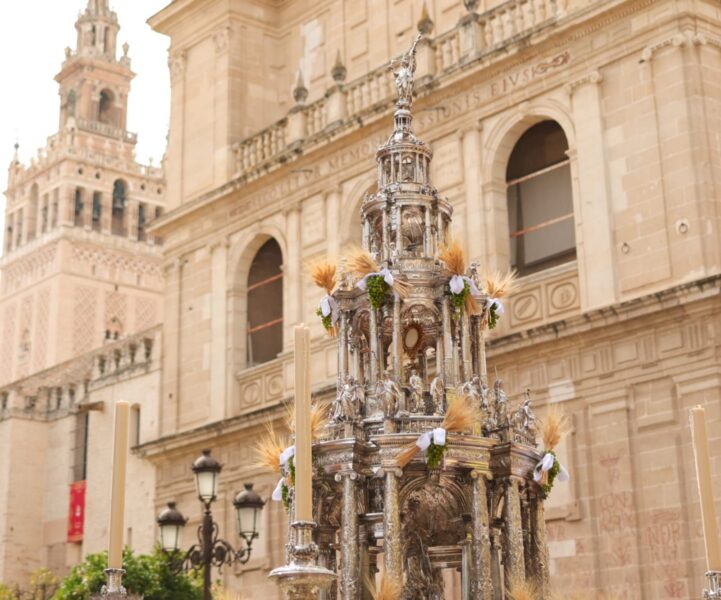
The Cathedral of Seville celebrated this Monday, November 23, the feast of Saint Clement, the 778th anniversary of the entry of Ferdinand III the Saint into the city in 1248, with the traditional procession of the Sword through the naves of the temple. The mayor, José Luis Sanz, carried the Lobera, the king’s sword, on behalf of the Crown, while the youngest councilor of the City Council, Blanca Gastalver, carried the Banner of Saint Ferdinand.
The day began with the opening of the doors of San Miguel and de los Palos at 7:45. At 8:30, the Eucharist was celebrated in the Royal Chapel, presided over by the dean and concelebrated by the royal chaplains, and from that moment the silver urn that holds the incorrupt body of Saint Ferdinand remained open for the veneration of the faithful until 13:30, with access through the door of los Palos.
Choral Office, procession and solemn Eucharist
At 9:30, the office of readings and lauds took place in the choir, after which the procession of the Sword was formed, which toured the naves of the Cathedral with a station in the Royal Chapel. The Cathedral Chapter, the House of Castile and León, the Chapter of Alfonso X the Wise, the Order of Saint Clement and the municipal corporation participated in the procession. A doctoral canon of the Chapter carried the relic of Saint Clement, and the event concluded with the solemn Eucharist at the high altar.
A tradition that dates back to Alfonso X
The commemoration recalls the capitulation of Seville to Ferdinand III on November 23, 1248, the day of Saint Clement. It was Alfonso X who institutionalized it in 1254 through a privilege dated December 30 in Burgos. The silver urn, completed in 1719 and attributed to Juan Laureano de Pina and his collaborators, is opened to the public on four dates a year by provision of a royal decree of 1729, and November 23 is one of them.