


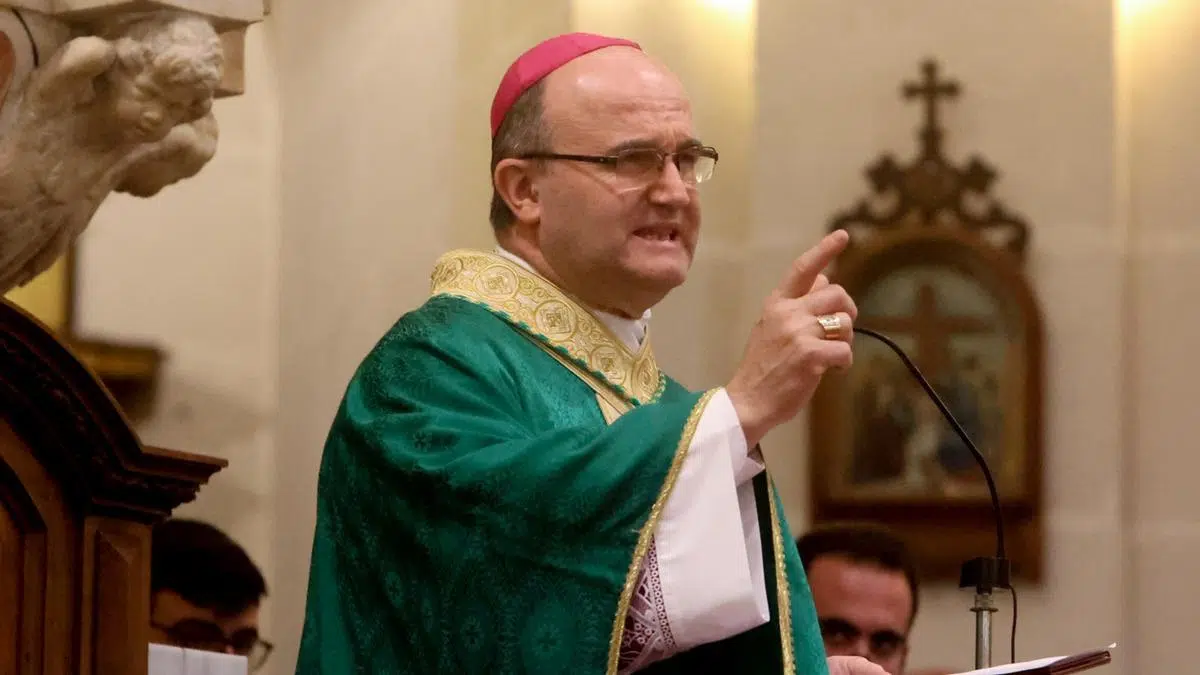
José Ignacio Munilla has excommunicated this media outlet on the radio. There is no decree, no process, no crime, and therefore no excommunication. There is a bishop who this Monday, on Sexto Continente, his Radio María program, referred without naming it to “some media outlet that claims to be Catholic.” He was talking about the piece that InfoVaticana published on November 20, whose argument can be summarized as follows: that his reproach to Trump and Putin for remaining silent before Xi Jinping lacked one addressee, the Holy See, which has maintained since 2018 an agreement with Beijing that no one has been able to read. In response to an objection about a secret text, the bishop of Orihuela-Alicante has replied with a judgment on the faith of the person raising it.
The formula appears four times in the same passage. The outlet “claims to be Catholic,” and he repeats it: “That claims to be Catholic.” Its critics are “people who claim, or who say they are Catholic” and it is “more faithful to Trumpism than to Catholic principles.” And the verdict: “They say they are Catholic, but they are more pro-Trump than Catholic.” To the two charges he adds a third for anyone who does not understand his explanation of Rome’s silence: “One has to be short-sighted.” In the same sentence in which he disputes their name, Munilla places those critics “within the Catholic Church.” Inside, but without the adjective. Regarding Xi Jinping, he maintains in the same program that the Church “has to measure its words.” About this outlet, there was no need to measure them.
Church law is less expeditious. A Catholic is not whoever a bishop considers such on air, but the baptized person united to the Church by the bonds of the profession of faith, the sacraments, and ecclesiastical governance (canons 96 and 205). Excommunication is a censure. It requires a crime, and the Code provides for it in the most serious cases, such as apostasy, heresy, or schism (canon 1364). It cannot be validly imposed without prior warning (canon 1347), nor imposed or declared without a decree or sentence. Asking about a diplomatic agreement does not appear in the catalog. What does appear is the right, “and sometimes even the duty,” of the faithful to express their opinion to their pastors on matters affecting the good of the Church and to make it known to others, while safeguarding the integrity of the faith and reverence toward their pastors (canon 212). The piece to which Munilla responds said that his question was a good one and that he was right to point out the silence of Trump and Putin.
In this story there have been real excommunications, and they did not fall on journalists. In July 2011, the Holy See declared that Huang Bingzhang, ordained bishop of Shantou without a pontifical mandate, had incurred the penalties of the then canon 1382, now 1387: excommunication latae sententiae reserved to the Apostolic See. On September 22, 2018, the same day the agreement was signed, Francis readmitted him to full communion along with six other bishops ordained without a mandate. To give him the see, according to AsiaNews, a Vatican delegation asked the bishop recognized by Rome who occupied it, Pedro Zhuang Jianjian, 88 years old, to step down. Huang, now vice president of the Patriotic Association, was last Wednesday in Xiamen among the bishops who accompanied the ordination of the twentieth prelate to emerge from the agreement. To the one who received consecration without a mandate from the Pope, Rome restored communion on the day of the signing. To the one who asks what was signed, a Spanish bishop disputes his claim to the name Catholic.
Munilla has said nothing about any of this. In his response there is not a word about the secrecy of the text or about the bishops who emerge from it. He has preferred the short path: when the question is uncomfortable, the one asking is examined. The method has a drawback. Even if those who run this outlet were everything the bishop says—Trumpists, short-sighted, and Catholic only in name—the agreement would still not be published, Huang would still be in Shantou, and minors would still be unable to enter Chinese churches. Munilla himself admitted in the same program that the agreement “has turned out badly” and that Beijing has committed “very serious betrayals.” To know what was betrayed, one must read what was signed. The question remains where it was, and it can be asked of Rome whether one is Catholic, Trumpist, or short-sighted. To answer it, only the text is needed.
Read also
- “Not a word”: Munilla reproaches Trump and Putin for their silence before Xi and remains silent about Rome’s pact with Beijing
- Rome presents the new bishop of Xiamen, a leader of the Chinese Patriotic Association, as a parish priest
- China bans minors from entering churches: posters, cameras, and detained catechists