


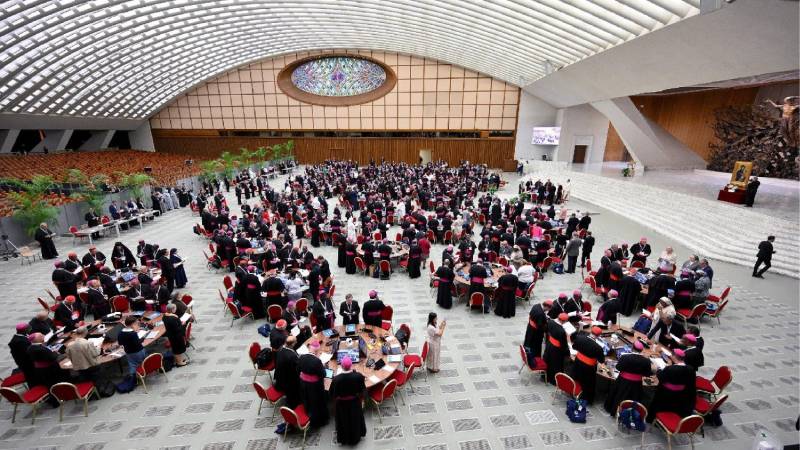
American theologian Larry Chapp published an extensive analysis on November 13 in Catholic World Report addressing a question the synodal process has not resolved: what exactly does a “listening Church” mean. With this formula, the promoters of synodality summarize the shift from a Church that teaches “from the top down” to one attentive to the “lived experience” of the faithful. The author’s conclusion is severe. The expression lacks defined contours, and that vagueness, he argues, is not innocent.
A listening without contours
Chapp begins with a fact: under Pope Leo XIV, synodality remains a central project, yet the Pontiff has still not clarified the direction he intends to give it. In that margin of ambiguity, ambiguities flourish. According to the columnist, when defenders of the “new synodal Church” are asked to explain what listening entails and what the previous Church failed to hear, their answers avoid any definition.
What does appear frequently, he notes, is the linkage between “listening,” “accompaniment,” and “complex circumstances,” along with the rejection of uniform pastoral responses. Chapp recalls that classical moral theology never ignored circumstances. Together with the moral object and intention, they form one of the three criteria by which any act is judged, and confessors have applied them for centuries with pastoral mercy. Portraying past pastors as a group of pharisaical and insensitive clerics is, in his view, a calumny against the past.
The old moral debate under a new name
The core of the critique is historical. Chapp links the rhetoric of listening to proportionalism, the current associated with Bernard Häring, Charles Curran, and Richard McCormick. This school made the morality of acts depend on circumstances and their foreseeable consequences, and it provided cover for dissent against Humanae Vitae. It was precisely that denial of intrinsically evil acts that led John Paul II to publish Veritatis Splendor in 1993. The author notes that Francis once presented Häring as a model for moral theology, though he admits this does not amount to an explicit endorsement of proportionalism.
The columnist also examines the method. It is impossible to listen to 1.4 billion Catholics, so listening ends up being selective and lacking transparency. Chapp asks who chose the witnesses invited to share their experiences and by what criteria. According to his article, barely 1% of Catholics participated in the consultations prior to the Synod on Synodality, and yet those contributions were presented as the action of the Holy Spirit through the People of God. “This is a farce. And it clearly smells of manipulation,” he writes.
Chapp adds that this listening does not treat everyone equally. The pain of those living LGBT experiences is attended to, but not that of the faithful who ask for a dignified liturgy or who love the traditional Mass. He also warns of a deeper risk: elevating conscience to an almost oracular voice placed above doctrine. Traditional morality has always considered it capable of being deformed, even with sincerity.
A word that is not in Scripture
The lack of definition that Chapp denounces also has a terminological dimension. The Second Vatican Council spoke of episcopal collegiality, but did not use the word “synodality.” Its use became widespread during the pontificate of Francis. In Spain, the Toledo priest Gabriel Calvo Zarraute has repeatedly insisted that the term does not appear anywhere in Sacred Scripture. In an interview he even referred to the “ideological farce of synodality.” His argument was that, while “walking together” was being preached, decisions were concentrated more than ever in the person of the Pope.
Chapp concludes that opaque and selective listening is not listening at all. In his judgment, the synodal project will fail to the extent that it does not confront the deep existential crisis the Church is experiencing today. The warning comes at a time when Leo XIV has still not clarified what place synodality will occupy in his pontificate.