


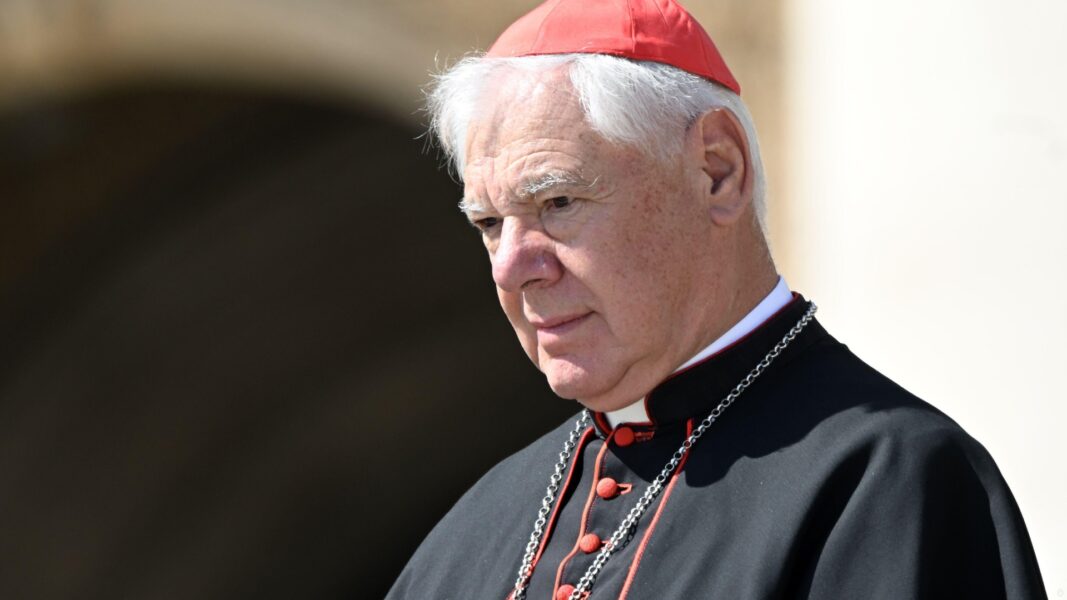
Cardinal Gerhard Ludwig Müller has once again thoroughly questioned the theological foundations of the synodal process. In a speech at the Catholic University of Lublin (Poland), reported by the Catholic Herald, the German prelate warned that the Church risks abandoning its mission when it resorts to consultative processes to decide matters that belong to the magisterium.
His criticisms were directed at both the German Synodal Way and the Synod on Synodality convened by Francis for the universal Church. Both processes, which have lasted several years, have frequently invoked the “Spirit” and included laypeople and clergy as participants in the consultations. They have also led to controversial proposals, such as the ordination of women, the admission of married clergy, or a less hierarchical Church with a more democratic style.
“The mystery of the Church of Christ cannot be understood solely in terms of sociological, political, and psychological categories, nor can it be confused with an earthly charitable organization or any NGO,” the cardinal stated.
Against a “misinterpretation” of synodality
Müller recalled that when the Second Vatican Council spoke of the “Synod gathered in the Holy Spirit,” it did so to proclaim the Gospel to all peoples and to enlighten them with the light of Christ, which shines in the visible and sacramental face of the Church. That is why, he explained, the Holy Spirit cannot be set against Christ, the Head of the Church, or against the visible, apostolic, and sacramental Church in the name of an invisible Church, “as Martin Luther did in his time and as Protestant sects do today.”
The prefect emeritus stated that within the Catholic tradition today there circulates a misinterpretation of synodality: under the pretext of “reform,” direct inspirations of the Holy Spirit are invoked “to undermine the hierarchical and sacramental structure of the Church.”
The cardinal did not reject consultative bodies as such. He warned, however, that when they are convened, their deliberations cannot be legitimized by appealing to the direct action of the Holy Spirit. Nor can they be presented as binding and irreversible reforms or as a development of doctrine when they openly contradict Sacred Scripture, apostolic Tradition, and dogmatically defined teaching.
The final document and papal primacy
The harshest part of the speech referred to what he called a “latent danger” in recent Roman synods, in which, according to him, the magisterium of the bishops “was reduced to a mere expression of opinion in a consultative process with selected laypeople.”
The reference points to the final document of the Synod on Synodality, which the mixed assembly of bishops, clergy, and laity voted on and approved in October 2024. Francis decided not to publish a post-synodal exhortation. In his accompanying note, he stated that the text “participates in the ordinary Magisterium of the Successor of Peter” and asked that it be received as such, describing it as a way of exercising the authentic teaching of the Bishop of Rome with “novel characteristics.”
Müller sees a serious risk in this approach. In his view, “an extension of papal primacy into the realm of heresy” occurs when the Pope’s ratification is presented as an inspiration of the Holy Spirit. This happens, he specified, when the Pontiff seeks to declare with his primatial authority that the texts of a body that is not part of the Church’s constitution belong to the ordinary magisterium.
The cardinal did not develop this point further or directly accuse Francis of heresy. He preferred to describe what he considers the true task of the magisterium, which is the constant proclamation of doctrine based on Scripture and apostolic Tradition. “The revealed doctrine of the faith remains the criterion by which the doctrinal development of the Church is measured,” he emphasized.
A mission “abandoned from within”
The speech also included a severe diagnosis of the state of the Church. Müller lamented that many of the faithful lack the intellectual and spiritual strength necessary to bear witness to humanity’s dependence on God, the Incarnation, and the sacramental presence of Christ in the Church. He also criticized ecclesial documents and programs that seek to bring the Church closer to people “but deliberately avoid mentioning the name of God and his saving work.”
For the cardinal, the decline in clergy and seminarians is a symptom of that distancing. “It is an unmistakable sign that the Church’s mission has been abandoned from within when its infrastructure is allowed to deteriorate, churches are torn down, monasteries and seminaries are closed,” he stated. On the same list he included the abandonment of schools, hospitals, and faculties of theology, and a catechesis turned into entertainment. He described it as “sad and heartbreaking” that priests and religious lead a secular, middle-class life, and concluded: “Those who abandon their identity cannot aspire to remain relevant.”
Müller rejected the idea that the Church should focus primarily on climate change, migration policy, or the power of the laity. He also denied that evangelization can bear fruit if the commandments or the indissolubility of marriage are relativized, if its nature as an exclusive union between a man and a woman open to children is diluted, or if exceptions to priestly celibacy are expanded.
In response, he called on Catholics for a faith that does not fear society and is even willing to face martyrdom. “What matters is that Jesus Christ, the Son of God, assumed our humanity even to death on the cross,” he concluded.