


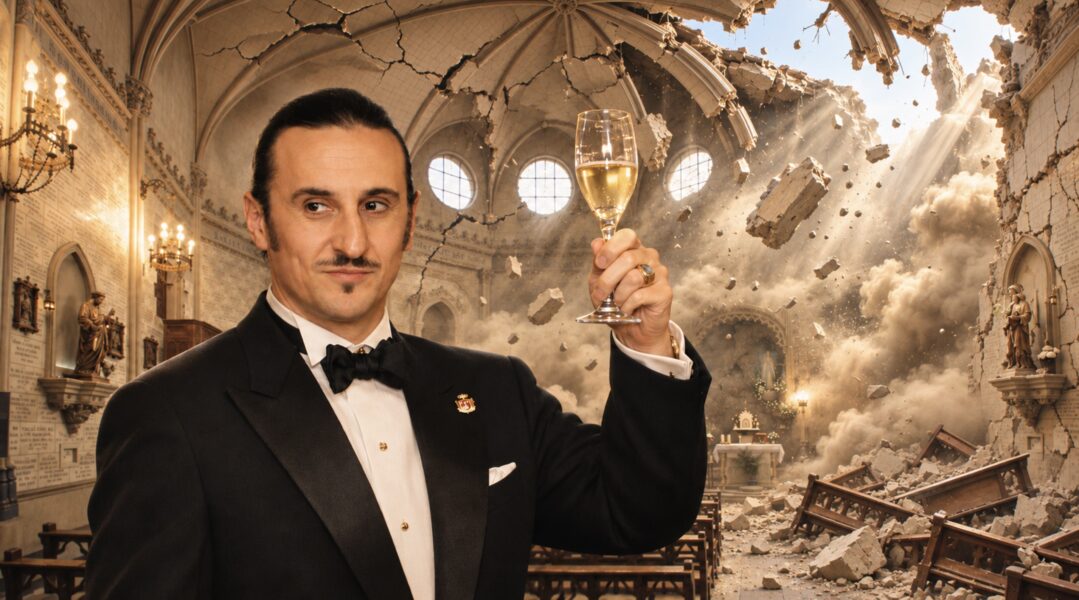
At number 21 Fortuny Street, in Madrid’s Almagro district, the marble speaks. Hundreds of small, humble, tightly packed plaques have repeated the same word since 1922: thanks. Thanks for an unexpected cure, for a son who came home, for an operation that succeeded against the doctors’ prognosis. They are the ex-votos of the Oratory of Our Lady of Lourdes, an affectionate replica of the grotto of Massabielle. Even a stone brought from the Pyrenean shrine is kept there, kissed for generations by Madrileños whose faith has nothing to do with the price per square meter in Chamberí.
All that grateful marble now stands in the way of a marquis. Luis Felipe Fernández-Salvador y Campodónico is an Ecuadorian businessman, VI Marquis of Lises and president of something called The Embassy of Nature; he already controls 81 % of the building. According to OKDIARIO has revealed, his project requires removing the tabernacle, dismantling the altar, taking away the images of the Virgin and the saints, ripping out the marble plaques and exhuming the remains of the founders. Where Mass is celebrated daily he intends to establish the Madrid headquarters of his embassy of nature. With unmatched audacity, he already lists Fortuny 21 as his Madrid address. The tabernacle is still inside and the marquis has already hung the sign.
Portrait of a marquis with his own jungle
The man deserves a careful description, because it explains the outrage. Born in Guayaquil in 1982, he presents himself as an explorer, filmmaker and Italo-Ecuadorian investor. He directed a film about the curse of Atahualpa’s treasure. In 2024 he obtained the Royal Letter of Succession to a marquisate granted by Philip V in 1745, and since then he has paraded the title across carpets around the world with almost childlike enthusiasm. At every event he recalls that he is the great-great-grandson of the president of the assembly that founded the Republic of Ecuador. Genealogy, like marble, is also on display.
His crowning achievement is an unbroken succession of stage sets. During the Paris Olympic Games he covered an eighteenth-century mansion in the Marais—once the residence of a servant of the Sun King—with Amazonian vegetation and christened it Casa Ecuador. In March 2025 he repeated the performance in a neo-Gothic palace on Serrano Street, its façade draped in red roses and golden banana plants, and hosted six gala dinners for the most varied segments of Madrid society. Then came Miami, Abu Dhabi, the Formula 1 circuit and the promise of New York and Venice. Wherever there is a box, a portable jungle appears and a marquis at the center of the photograph.
Distinctions fall like leaves in the Amazonian autumn. He received an award for Hispanic excellence in global impact at Mar-a-Lago. The City of Miami Beach proclaimed May 2 as Luis Felipe Fernández-Salvador Day, the National Assembly of Ecuador bestowed a decoration on him, and at Harvard he presented a “universal declaration” on governance inspired by nature. His embassy defines itself as a supranational institution of functional governance, aspires to have ecosystems recognized as subjects of law, and preaches a “nature intelligence” superior to the artificial kind. He also boasts of having no chief executive officer, although the EFE agency presents his partner Daniel del Valle precisely in that role.
A velvet-green lodge
Embassies without a state, proclamations without a people, universal declarations nobody asked for, solemn titles, dinners for the initiated and a vocabulary of grand ecological orient. The entire apparatus of Fernández-Salvador exudes the unmistakable aroma of a drawing-room lodge, that godless religiosity that replaces the altar with the rostrum and the creed with the press release. The temple was missing, and he has already found one consecrated, with its grotto, its stone from Lourdes and its dead buried beneath.
Saint Paul described it twenty centuries ago in the Letter to the Romans: those who exchanged the glory of the incorruptible God for images ended up worshipping the creature instead of the Creator (Rom 1:23-25). The temptation returns now in linen suits, imported roses and invented diplomatic credentials. The Mother of God is expelled to enthrone a catalogue Pachamama, and the ex-votos of the healed sick would remain, at best, as folklore for the guests’ afternoon tea.
The grandson who will not sell
Against this machinery of tinsel stands a single heir. The grandson of the Countess of Sierrabella retains 19 % of the building and refuses to sell, because his grandmother, María Trinidad de Santiago-Concha y Tineo, built that oratory for worship and left it so written. Three of the four heirs gave in. He resists. The marquis’s response has been to go to court to force the auction of the property and wrest by judicial means what he could not buy with money. The will of a Catholic founder is thus treated as a procedural obstacle by someone who presumes to lecture the world on the rights of rivers.
The commission agents of the eight-pointed cross
The scandal has a seamy underside as well. InfoVaticana has been able to confirm that in the purchase of the heirs’ shares, intermediaries linked to the Order of Malta have been involved. These people have collected commissions for facilitating the sale of a Marian shrine to someone who intends to desecrate it. People who wear on their lapel the cross of an order born to serve sick pilgrims have cashed in on the house of Our Lady of Lourdes, the seat of those who accompany those same sick people to the shrine. They have handed it over to a collector of titles with his own vegetal religion. Thirty pieces of silver bearing a noble coat of arms are still thirty pieces of silver.
The archdiocese has the last word
The marquis can buy walls, but not the cult. Canon 1224 of the Code of Canon Law prohibits dedicating an oratory to profane uses without the authorization of the Ordinary. In the 1990s the archdiocese already had to remind the owners that pastoral care and the rector depend on ecclesiastical authority. According to ACI Prensa, the diocese considered buying the building and declined because of the cost of the works. Meanwhile, the chaplain of the Hospitality comforted himself by recalling that there are other places in Madrid to pray to Our Lady of Lourdes. With that resigned logic, half the churches in the capital could end up converted into exhibition halls.
Fortuny is home to the Lourdes Hospitality of Madrid, which since 1958 has accompanied the sick and people with disabilities to the French shrine. Mass is celebrated there every day, the Blessed Sacrament is adored on the 11th of each month, and neighbors, volunteers and the sick come to pray. No deed authorizes extinguishing the sanctuary lamp. That signature can only be placed by the Archbishop of Madrid, and the faithful deserve to know soon whether he intends to defend the oratory or sign its death certificate.
What an ex-voto is worth
An ex-voto has no market price. It is the signature of someone who asked with tears and returned with gratitude, and every plaque at Fortuny is a notarial act of mercy. The Marquis of Lises wants rights for the jungle. Let him begin by respecting the rights of the dead who rest beneath that floor, of the founder who consecrated it, and of the living who continue to enter to pray. The Virgin has been on Fortuny Street for more than a hundred years and no one has heard her ask to be moved.